

Six months is the honest lifespan of most cordless lamps bought for a dining room from a domestic range. They arrive looking sharp, and by the second season the batteries hold roughly half the runtime they started with, a couple have been knocked off a table by a passing tray, and the powder-coated bases have gone chalky from nightly wipe-downs with a sanitiser that was never meant to touch them. Choosing the rechargeable table lamps restaurant floors actually demand is a durability decision dressed up as a decorative one. The rechargeable table lamps restaurant operators still like in year three are the ones bought for the service rather than for the photograph.

Key Takeaways
Specify battery runtime against your longest service, then add a margin. A lamp that lasts exactly one shift will not last one shift after a year of charge cycles.
Finish durability matters more than the spec sheet suggests. Sealed stone, glass and solid brass tolerate daily cleaning far better than thin painted coatings.
Aim for warm colour temperature in the region of 2200K to 2700K and high colour rendering so food, wine and skin tones read properly in a dimmed room.
Weight is a feature. A lamp with a stone or dense metal base stays put when a table gets crowded.
Ask about spare batteries, replacement parts and charging bases before you commit to volume. The rechargeable table lamps restaurant teams cannot service themselves are consumables, whatever the invoice calls them.

Why Domestic Rechargeable Lamps Fail in a Cover-Heavy Venue
A lamp on a side table at home is switched on for three hours, four nights a week, and dusted occasionally. The same lamp in a restaurant doing 90 covers might be lifted, wiped, knocked, carried to a terrace, charged, and switched on again inside 24 hours. That is a different machine entirely, and the failure points show up in a predictable order.
First the battery. Lithium cells degrade with cycles, and a domestic lamp is often specified with just enough capacity to look good in a product listing. Then the switch or touch dimmer, which gets used dozens of times a day rather than dozens of times a month. Then the finish, because the cleaning routine in hospitality is not gentle; a matt paint that survives a home shelf will scuff at the base rim where staff grip it. Last, the charging setup, which is where most venues quietly lose money. If each lamp needs its own cable and no one owns the process, you end up with a drawer of tangled leads and a floor manager rationing working lamps between tables.
The rechargeable table lamps restaurant floors chew through fastest are almost always the ones with sealed cells and thin coatings. By contrast, restaurant rechargeable table lamps that survive share a pattern: replaceable batteries or serviceable modules, a base heavy enough to resist a nudge, a surface that shrugs off cleaning products, and a charging system that a busy team can actually keep up with.
Battery Endurance Matched to a Real Service Rhythm
Do the arithmetic before you fall for a shape. Specify the rechargeable table lamps restaurant services actually run, not the ones a showroom demonstrates for ten minutes. Work out your longest continuous run of lit hours, not your average. A venue open from midday until late may need a lamp lit for eight or nine hours on a winter Saturday, and if the terrace opens early in summer, longer.
Now discount the headline figure. Manufacturers usually quote runtime at the lowest dimmed setting, and battery capacity falls as cycles accumulate. Treat the quoted number as a best case and plan for meaningfully less once the lamps have a year of nightly charging behind them. If you need nine hours of usable light at your working brightness, buy a lamp quoting somewhere well north of twelve.
Charging logistics matter just as much. Ask whether the range offers a multi-lamp charging tray or magnetic dock, because the rechargeable table lamps restaurant staff have to plug in one by one at 1am are the ones that never all make it back to the floor charged. Some venues run two sets and rotate: one on the floor, one on charge. That doubles the outlay but halves the operational stress, and it is the approach we see most often in hotel dining rooms that also dress a bar and a terrace from the same stock.
Charge them somewhere ventilated and supervised, not crammed into a cupboard behind dry goods. UK fire services publish clear guidance on safe charging and storage of lithium-ion batteries, and a designated charging station with a hard surface is worth building into the back-of-house layout from day one. Any fixed charging point should be installed by a qualified electrician.
Wipe-Clean Surfaces, IP Ratings and Finish Durability
Finish is where the cleaning routine does its damage. Every lamp on a restaurant table will be cleaned with something. Usually a spray, sometimes a cloth soaked in whatever is nearest. The finish has to take that nightly, plus the occasional splash of red wine, olive oil or candle wax.
Sealed natural stone and alabaster do well here, provided the sealant is specified for the setting and refreshed periodically. Solid brass ages gracefully and can be relacquered or allowed to patinate deliberately. Glass is the easiest surface of all to clean, though it shows fingerprints under low light. The materials that struggle are thin painted metals, soft-touch rubberised coatings (which go tacky), and untreated timber. Where a painted finish is unavoidable, a cast body carries it far better than pressed sheet, which is why something like the Nomad Matt White Cast Aluminium Rechargeable LED Table Lamp holds up at the base rim where staff grip and wipe it night after night.
On ingress protection: an IP54 rating means the lamp is protected against dust ingress and against water splashed from any direction, which is the sensible baseline for anything going outside or near a terrace. Indoor-only lamps do not need it, but the rechargeable table lamps restaurant terraces borrow on a warm evening are usually the same ones that were specified for indoor use only, and it is cheaper to specify IP54 across the board than to buy twice. Check whether the charging port is sealed or covered, since that is the usual weak point. A lamp designed for that migration, such as the Solitus Rechargeable LED Outdoor Table Lamp in black, treats the charge contact as an outdoor detail rather than an afterthought, which is the distinction worth checking on any shortlist.
One hard-won lesson from the studio: ask the supplier which cleaning products are approved. We had a bistro group clean sealed marble bases with a citrus degreaser for a month before anyone noticed the surface had gone dull. Alcohol-based sanitiser on a soft cloth, wrung out, then a dry buff. That is the routine. Nothing acidic near stone.
Lumen Output and Colour Temperature That Flatter Food and Faces
Cordless lamps are not there to illuminate the table. They are there to give each setting a small warm centre so the room reads as a series of intimate pools rather than one flat wash. Output in the region of 30 to 120 lumens at full brightness is usually plenty; anything much brighter and the lamp starts to compete with your pendants and flatten the mood. On a tight two-top, where the lamp shares space with glassware and a bread plate, a low-wattage fitting like the Veloxis Outdoor Rechargeable LED Table Lamp in matt black sits at the quiet end of that range rather than dominating the setting.
Colour temperature is where specifications for rechargeable table lamps restaurant designers sign off most often go wrong. Aim for 2200K to 2700K. Above 3000K, food starts to look clinical and skin tones turn grey, which is precisely the opposite of what a restaurant is paying for. Look for high colour rendering as well, ideally CRI 90 or better, so that a rare steak, a saffron risotto and a glass of Barolo all read as the colours the chef intended.
Dimming behaviour deserves a test before you buy. Good rechargeable restaurant table lamps dim smoothly and, better still, warm slightly as they dim, mimicking candlelight. Cheap ones step in visible jumps or flicker at the bottom of the range. Order samples and run them at 20 per cent brightness for an hour before you sign off.
Where Alabaster and Natural Stone Change the Result
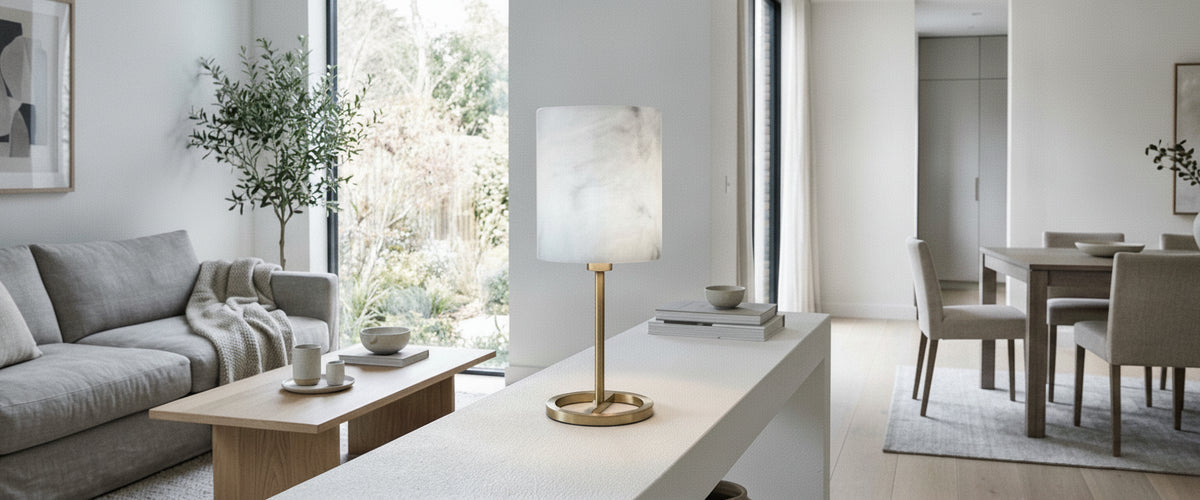
This is the part cordless lighting often misses. A plastic diffuser gives even light and no character. Alabaster gives light a depth you cannot fake, because the stone is genuinely translucent and its veining scatters the beam in a slightly different way on every single piece. Sit an alabaster shade on a dressed table at 2400K and it glows from within rather than shining outward. Faces soften. Glassware picks up warmth. These are the rechargeable table lamps restaurant guests actually comment on.
Weight is the practical bonus. Stone bases sit low and heavy, so the lamp stops travelling across the table every time someone reaches for the bread. At Niori we work almost exclusively in alabaster, marble, onyx, natural stone, glass and brass, and the same qualities that make these materials work for a dining room pendant carry down to table scale. If you are building a scheme where the cordless lamps need to speak the same language as the ceiling fixtures, browsing the alabaster lighting range alongside your table lamp shortlist is the fastest way to see whether the stone tones agree.
Onyx deserves a caution. It is beautiful and dramatic, with stronger banding and a warmer transmission, but it is softer and more porous than marble, so it wants a gentler cleaning regime. For high-turnover venues, a fine white alabaster or a tighter-grained marble is usually the more sensible working choice, with onyx saved for the bar or the private dining room.
What to Ask a Supplier Before Ordering Rechargeable Table Lamps Restaurant Teams Use Nightly
A serious supplier will answer all of these without hesitating. Hesitation is your answer.
Is the battery user-replaceable, and can we buy spares? If not, the lamp has a fixed lifespan and you should budget accordingly.
What is the stated runtime, and at what brightness setting? Ask for the figure at full output, not at minimum.
How many charge cycles before capacity drops meaningfully? A straight answer here separates real manufacturers from rebadgers.
What charging options exist for volume? Docks, trays, USB-C, magnetic contacts.
What is the IP rating, and is the charging port sealed?
Which cleaning products are approved for this finish? Get it in writing.
Can we order a sample first? One lamp, tested through a full service, tells you more than any spec sheet.
Are replacement shades available? Stone shades chip. It happens. You want a route to replace one without replacing the lamp.
What is the electrical certification for the UK market? Confirm the charger and lamp carry appropriate marking and testing.
Lead Times, Minimum Quantities and Reading a Quote Properly
Natural stone is quarried, cut and finished by hand, so lead times on rechargeable table lamps restaurant projects with stone shades run longer than on injection-moulded pieces, and they vary with the block available at the time of order. Ask for an honest window rather than an optimistic one, and build in slack if the lamps are tied to an opening date. If you are fitting out for a spring opening, start the conversation in autumn.
Minimum order quantities depend on whether you are buying from stock or commissioning something specific to the venue. Bespoke shade profiles, a house brass finish, or a stone selected to match your bar top will carry a minimum. Standard pieces usually will not. Ask both questions separately, because the answers differ.
On budget, resist the urge to compare on unit price alone. Making your restaurant table lamps rechargeable rather than wired frees the layout, but it moves cost into the battery, the dimming module and the aftercare behind them, alongside material, scale and finishing quality. A lamp with replaceable cells and available spare shades costs more up front and less over three years. Ask for a tailored quote that spells out unit cost, spares pricing, charging accessories, packing and delivery, and any lead-time assumptions. A good quote reads like a plan; a vague one reads like a risk.
Also ask what happens when one lamp fails in month seven. Who ships the part, how fast, and at whose cost. Venues that skip this question end up with a shelf of dead lamps nobody has time to chase.
The Short Version
Specify runtime with headroom. Choose finishes that take a nightly wipe. Keep the light warm and the output modest. Weight the base. Confirm you can buy spares before you buy the lamps. The rechargeable table lamps restaurant floors keep working through year three earn their cost because they were chosen as equipment with a decorative job, rather than as decoration you hope will survive.
If you are coordinating cordless lamps with pendants, wall lights and larger fixtures across a dining room, terrace and private room, it helps to see the whole material palette in one place; the full niori lighting collection is a reasonable starting point for that conversation, and our team is happy to talk through samples and volume before anything is committed.