
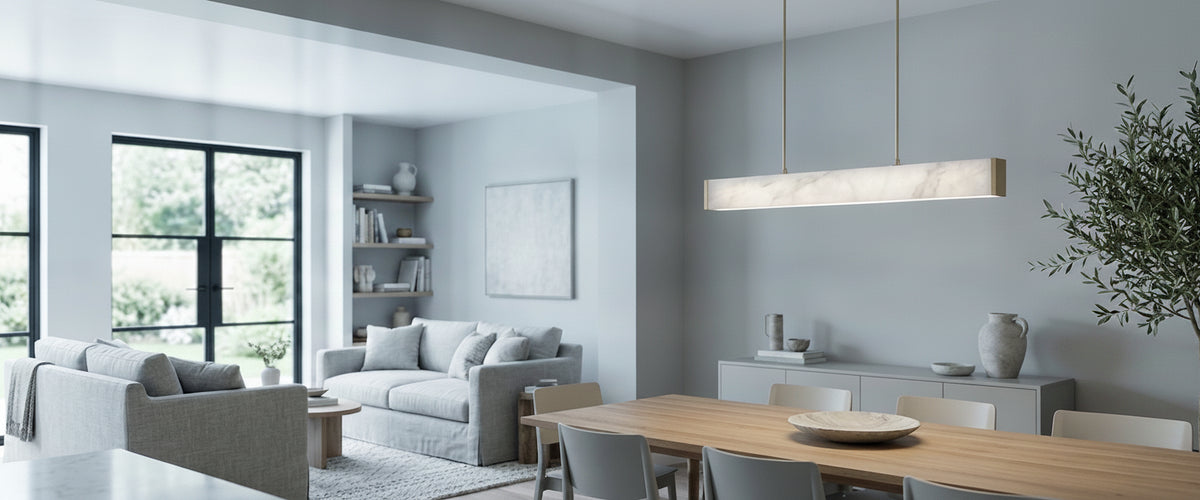

A linen pendant lights is the fastest way to make a hard room feel kinder. Fabric takes the edge off the beam, softens shadows, and throws a light most people describe as flattering before they can explain why. It is also the shade material that ages fastest, cleans worst, and behaves least predictably once you string several of them in a row over a five-metre island. Before you commit, it helps to know precisely what the fabric is doing to the light, and what a denser material like alabaster does instead.

Key Takeaways
- A linen pendant light scatters rather than transmits. Light leaves a woven shade already broken up, which is why it reads soft but rarely reads luminous.
- The liner decides the mood. A white liner keeps output high and neutral; a gold or champagne liner warms the downlight noticeably and cuts a little of it.
- Weave density controls glow versus glare. Loose weaves halo prettily and reveal the lamp; tight weaves control the source but flatten the shade.
- A linear pendant light fixture is a different design problem to a single pendant, because the eye reads consistency along the run rather than one focal object.
- Hanging height: roughly 70 to 90 cm (28 to 35 in) from the underside of the shade to the tabletop or worktop, adjusted for ceiling height and sightlines.
- Alabaster wins where you need brightness, cleanability and a stable finish; fabric wins where you want softness and texture in a low-traffic room.

What a Linen Pendant Light Does to Light That Glass and Metal Cannot
Fabric is a scattering medium. Light hits the woven fibres, bounces around inside the weave, and exits in every direction at once. That is why a linen pendant light produces almost no crisp shadows and why faces look better under it than under a bare glass globe. The colour shifts slightly too. Natural linen has a warm, faintly greenish-grey cast that nudges output towards straw; bleached cloth stays closer to neutral.
What woven fabric cannot do is glow with any depth. Look at a lit fabric shade from across the room and you see an evenly bright surface. Look at lit alabaster and you see through into the stone: veining, cloud, mineral density, the slow gradient where a thicker section holds the light back. That interior structure is why alabaster has been carved into lamps and window panels for centuries, a material history the Victoria and Albert Museum traces through its European sculpture and architectural collections. Fabric diffuses. Stone glows. They are not interchangeable, and briefs that treat them as one category tend to disappoint at the switch-on.
Metal shades sit at the other extreme, throwing a controlled cone with a hard edge. Blown glass sits somewhere between fabric and stone, depending on opacity. If you want a quick sense of how a translucent stone shade reads against fabric, the pieces in our alabaster lighting collection show how much visual weight a stone shade carries even before it is switched on.
Weave Density and Liner Choice: The Two Decisions That Set the Mood
Two specifications matter far more when you are choosing a linen pendant light than the fabric colour printed on a swatch card.
Weave density. An open, slubby weave lets the filament show through as a soft bright core. It looks handsome in a bedroom or a snug and is genuinely uncomfortable over a dining table at eye level, because the source is visible from a seated position. A tight, high-thread-count cloth hides the lamp but sacrifices the textural pleasure most people bought fabric for in the first place.
Liner. An unlined shade glows all the way round and spills light onto the ceiling. A white-lined shade pushes more light down and keeps the colour honest. A gold or bronze liner warms everything below it, which flatters timber and brass and does unkind things to cool grey stone worktops. Champagne-lined fabric over honed grey quartzite is a combination that comes up often, and it rarely survives switch-on: the worktop reads muddy beige instead of cool and mineral. Two alabaster pendants in the same position let the stone read as intended.
Why a Linen Shade Reads Differently Across a Linear Run
A single pendant is an object. Three or five pendants in a row become a rhythm, and rhythm exposes inconsistency. Linen is a natural fibre with genuine batch variation; two shades cut from different bolts can differ in cast enough to notice when they hang a metre apart at eye level. Ordering fabric shades together as one set, rather than replacing a single shade later, is the only real defence.
There is a second issue. A row of linen pendant lights reads as busy, because each shade has its own visible silhouette, its own halo, its own dust line. A continuous linear pendant light fixture with one long diffuser reads as a single architectural gesture. Where the run needs to read as one line rather than three separate objects, a single-body fixture such as the Step White LED Linear Pendant Light 118.5cm is closer to the right design language, and one continuous 3000K source holds its colour along the whole length in a way a set of fabric shades cannot promise. Over a long island or a ten-seat table, that calm is often worth more than the texture you give up. Alabaster suits the same job: a slab-form linear pendant lit from within looks like a lit horizon rather than a string of lampshades.
If you do want fabric in a run, keep the shade shapes simple and the drop rods identical, and resist mixing woven shades with a second material along the same axis. Mixed materials on one line almost always look like a compromise reached halfway through the project.
Hanging Height and Spacing Logic
Over a Kitchen Island
Aim for 75 to 90 cm (30 to 35 in) between the underside of the shade and the worktop. Fabric shades sit at the taller end of that range because a wide drum blocks more sightline than a slim stone cylinder. Space multiple pendants 75 to 90 cm apart centre to centre, and keep the outermost pendants at least 30 cm (12 in) in from each end of the island so the composition looks deliberate.
Over a Dining Table
Drop to around 70 to 80 cm (28 to 32 in) above the tabletop. Seated eye level is lower than standing eye level, so the shade can come down further and should, since a low pendant is what makes a dining table feel enclosed. For a linear fixture, size the body to roughly half to two-thirds of the table length and centre it on the table rather than the room. In practice that means a 118.5 cm body, the length of the Step Gold LED Linear Pendant Light 118.5cm, lands correctly over a table of about 1.8 to 2.4 m, and anything shorter starts to look stranded above a six-seater.
Open-Plan Zones
In open-plan spaces the pendant is doing zoning work as much as lighting work. Keep drops consistent in height across the same visual plane, or stagger them decisively so it reads as a choice. Half-hearted variation looks like an installation error. Browse the wider lighting range if you are trying to match a pendant drop to wall lights and table lamps in the same sightline; consistency of material does more for an open-plan room than consistency of shape.
How Linen Ages, and What That Means in a Kitchen
Linen is hygroscopic and slightly absorbent, which is what makes it pleasant to wear and awkward to hang over a hob. Airborne cooking grease settles on the weave and binds dust into it, and once that combination has worked into the fibre it cannot be brushed out. A linen pendant light in a kitchen tends to develop a faint grey-yellow halo on the upper edge within a couple of years. Sunlight compounds it: the Canadian Conservation Institute publishes clear guidance on how light exposure and particulate soiling degrade textile fibres over time, and a shade hanging in a south-facing kitchen is getting a low-grade version of exactly that exposure.
Routine care for fabric is dry only. Vacuum through a piece of muslin at low suction, brush with a soft goat-hair brush, and never wet the cloth or the internal frame. Alabaster is easier day to day but has its own rule: dust dry with a soft cloth and skip anything acidic or ammonia-based, because gypsum alabaster is soft (around 2 on the Mohs scale) and dulls if it is scrubbed or wetted repeatedly. Marble and onyx are harder and more forgiving, though the same no-vinegar rule applies.
When a Harder Shade Gives You More Control
There are rooms where a linen pendant light is simply the wrong tool.
- Working kitchens. Grease, steam and frequent cleaning favour stone or glass.
- Bathrooms and utility rooms. Humidity and fabric do not mix, and zone regulations narrow your options anyway.
- Hospitality and commercial settings. A restaurant or hotel needs shades that survive years of cleaning schedules and still look identical to each other.
- Rooms that need real output. Fabric absorbs a meaningful share of the lumens. Where you need brightness without glare, alabaster transmits more while still hiding the source.
- Very tall ceilings. At 4 m and above, a woven shade dissolves into a pale blur. Stone holds its presence.
Glass occupies the useful middle ground. If you want to keep the visible rhythm of separate shades but need a surface that wipes clean, something like the Manta 5 Light Linear Glass Pendant Light gives you five distinct points of light on one frame, with none of the grease absorption that makes fabric a liability above a hob.
Buyer's Checklist Before You Order
- Measure ceiling height and confirm the available drop, including rod or cable options.
- Check the shade diameter against your worktop or table width; a shade should never overhang the surface edge.
- Decide liner colour against your actual worktop or table sample, under the bulb temperature you plan to use.
- Confirm dimming: choose a leading-edge or trailing-edge dimmer matched to the driver, and test it before final sign-off.
- Pick a warm colour temperature. 2700K suits dining and living spaces; 3000K holds up better over stone worktops and in task areas.
- Look for CRI 90 or above so food, timber and stone veining read correctly.
- For a linear fixture, ask about the mounting plate, ceiling reinforcement and cable spacing for level hanging.
- Use a qualified electrician for installation and, in older properties, ask them to confirm the ceiling can carry the load of a stone fixture.
- Request a tailored quote rather than assuming a figure. Cost tracks material, scale, engineering, finishing and installation complexity, and stone pieces vary widely.
- Order sets together so material and finish match across a run.
A linen pendant light has real charm and a real place, mostly in bedrooms, snugs and dining rooms where the light needs to be gentle and the shade will not be fighting steam or sunlight. Where the room asks the fixture to work harder, translucent stone gives you the softness without the maintenance penalty. That is the choice Niori was built around, and the reason our pendants, chandeliers, wall lights and lamps stay with alabaster, marble, onyx and brass. Start from the Niori collections if you want to see how the same stone reads at pendant scale, on a wall, and beside a chair.