
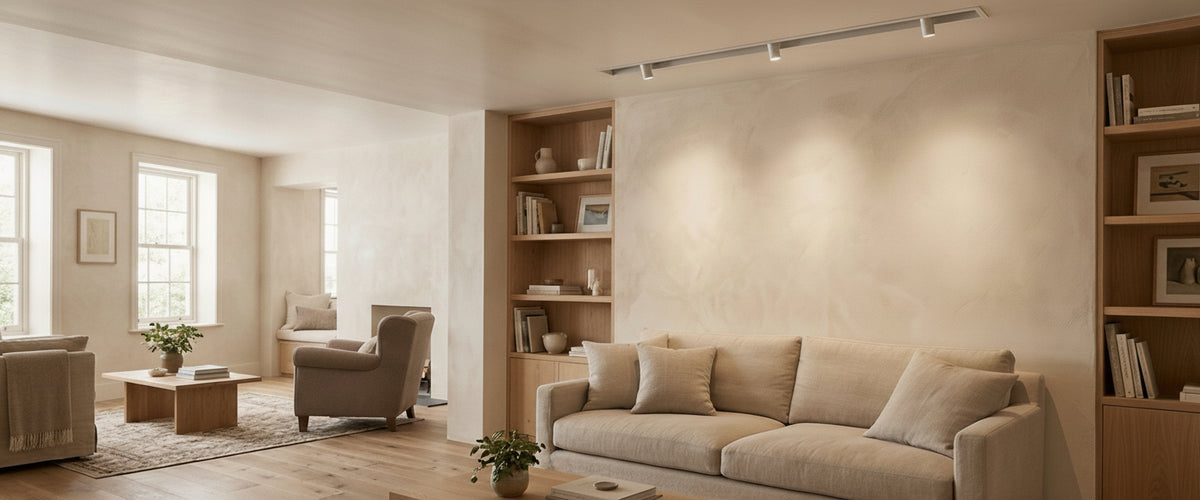

Most track lighting fails for one reason: it gets bought as hardware and installed as hardware, never designed as light. Linear track lights make up the most adaptable ceiling system available to a home or a hospitality space, because every head can be moved, aimed, swapped or added to years after the plasterer has gone home. That same flexibility is why linear track lighting so often ends up looking like a shop fit that wandered into a living room. Get the circuit plan, the beam angles and the color temperature right and a linear track lighting run becomes almost invisible, doing the quiet work of lighting walls, worktops and artwork while the alabaster pendants and wall lights carry the mood.

Key Takeaways
Linear track lighting is a continuous powered rail that accepts movable heads, letting you re-aim and re-space light as a room changes.
Mains voltage (what North American listings call line voltage track lighting) runs at 230V in the UK and needs no remote transformer; low-voltage systems run at 12V or 24V and are usually slimmer.
Single-circuit track switches everything together. Multi-circuit track lets you split accent, task and wall-wash onto separate dimmed groups.
Spacing and aim matter more than fitting count. Evenly spaced heads at a consistent aiming angle stop track reading as a fluorescent strip.
Near alabaster, marble, oak or lime plaster, warm white at 2700K to 3000K almost always beats 4000K.
Track is a supporting layer. The decorative pieces, pendants, chandeliers and sconces, should still lead the scheme.

What Linear Track Lighting Actually Is
A linear track lights is a rail carrying live conductors along its length, mounted to the ceiling surface, recessed into a plaster slot, or suspended on wires. Heads clip in anywhere along the run and rotate on two axes. A linear track light fixture can be a compact spot, a wider flood, a low-glare cylinder rated for controlled UGR, or a slim bar-type luminaire that sits within the rail profile. You will also see the phrase lite line track lights used loosely in listings for the slimmest low-profile systems, the kind that read as a pencil line rather than a channel.
The voltage question comes first with any linear track lighting system. Mains-voltage rails carry full 230V along their length, so the driver sits inside each head and there is no bulky transformer to hide. Low-voltage systems step power down at the supply end and allow a very fine rail, which suits joinery reveals and thin plasterboard bulkheads. Both are safe when installed properly, and both are jobs for a qualified electrician; the rail is a live busbar, not a curtain pole.
The Ceiling Geometries That Reward Linear Track Lighting, and the Ones That Punish It
Track earns its keep where a ceiling is long, awkward, or structurally uncooperative. Loft conversions with sloping soffits. Barn conversions with exposed purlins where downlights would mean butchering timber. Victorian terraces where the joists run the wrong way and every recessed fitting becomes a negotiation. Long galleried hallways. Open-plan kitchen and dining rooms in a rear extension, where the same run needs to serve a worktop at one end and a table at the other.
Track punishes you in low, flat, small rooms. Under about 2.3 metres (7 ft 6 in) a surface rail with proud heads sits in your eyeline and the room feels lower than it is. It also struggles on heavily ornamented ceilings; a track run across a Victorian rose and cornice looks like an argument. In those rooms, wall lights and table lamps do the job better, and a single alabaster pendant hung centrally will give softer, more flattering light than any number of aimed spots.
One more geometry to respect: the wall you actually want to light. Track works best when it runs parallel to a wall at a set offset, not down the dead centre of the ceiling. Centre-line track lights the floor. Offset track lights the room.
Single-Circuit vs Multi-Circuit: The Decision That Reshapes the Plan
Single-circuit linear track lighting carries one live conductor. Every head on the run switches and dims together. It is simple, cheaper to install, and perfectly good for a single job, say washing a run of bookshelves or lighting three pictures in a hallway.
Multi-circuit track carries several independently switched conductors in the same rail. You choose which circuit each head taps into as you clip it in. That means one run above a kitchen island can hold worktop task light on circuit one, art accents on circuit two, and a gentle wall-wash on circuit three, each on its own dimmer. When a client tells us the kitchen feels like a car park at dinner, nine times out of ten it is a single-circuit run with everything wired together and the only choice being on or off.
A multi-circuit run puts worktop task light, art accents and wall-wash on separate dimmers.
Multi-circuit costs more per metre and demands a proper control plan before first fix. It is also the difference between a room that has one setting and a room that has four. If the space does more than one job at more than one time of day, specify multi-circuit.
Beam Angles, Head Rotation and Where Pools of Light Go Wrong
Beam angle is where most linear track lighting schemes come apart. A narrow 10 to 15 degree beam is a scalpel: sculpture, a single painting, a stone bowl on a console. A 24 to 36 degree beam is the general workhorse for worktops and joinery. Anything past 60 degrees behaves as a flood and starts to spill onto ceilings and faces.
Two common failures. The first is the leopard-print ceiling, where every head has a different beam and every pool of light is a different diameter, so the eye reads mess instead of rhythm. Keep beam angles consistent within a run unless you have a deliberate reason to vary them. The second is aiming straight down onto a vertical surface, which produces a hot scallop at the top and darkness at the bottom. For wall-washing, aim at roughly 30 degrees off vertical and set the track offset from the wall at about a third of the ceiling height. For accenting a framed piece, the same 30 degree rule keeps the beam off the glass and out of the viewer's eyes.
Glare is the silent problem. Deep-baffled or low-UGR heads cost more and are worth it in any room where people sit and look up, which is every kitchen-diner ever built. Over a long island or a dining run where sightlines cross the ceiling, a shielded fitting such as the Display UGR Black Linear Track Light, 106.5cm keeps the source out of view while still putting usable light on the worktop.
Mounting Height and Head Spacing That Stop Track Reading as a Strip
Rhythm is what separates designed linear track lighting from retail track. A few working rules we use when planning runs:
Space heads at roughly 0.8 to 1.2 metres (about 2 ft 8 in to 4 ft) apart for general coverage. Tighter than 0.6 metres and the run starts to read as a continuous strip.
Set the first and last head in from the ends of the rail, not flush with the caps. Symmetry at the ends reads as intent.
Offset the run from the wall by around one third of the floor-to-ceiling height for even wall-washing.
On a suspended run over an island, keep the rail 750 to 900 mm (roughly 30 to 36 in) above the worktop so heads clear sightlines across the room.
Do not mix head bodies of different diameters on one run. Same family, same finish, different optics if needed.
Scale is part of the same calculation. A hallway wall of framed pieces or a short stretch of shelving rarely needs a metre-plus run; a half-length fitting like the Display White Accent Linear Track Light, 53.5cm sits more comfortably in a narrow ceiling plane than a full-length rail that overshoots the wall it is meant to serve.
Finish matters too. Black heads recede on dark or timber ceilings and read as strong graphic marks on white plaster. White heads disappear into white ceilings almost entirely, which is usually the goal in a period room.
Why Warm White Near Stone Always Outperforms Cool White
Alabaster is a fine-grained gypsum, prized for centuries because light passes through it rather than bouncing off it. The British Geological Survey catalogues gypsum among the softer sedimentary minerals, and that softness is exactly why alabaster carries such delicate translucency and honeyed veining. Push 4000K light at it and the warm mineral tones flatten to grey. The veining that should look like weather in the stone starts to look like a scratch.
We shipped a pair of alabaster pendants to a converted mill flat in Salford where the owner had already installed 4000K linear track lighting across the whole ceiling. The pendants looked cold and slightly dirty until the heads above them were swapped to 2700K, at which point the same stone read as cream and amber. Nothing about the pendants changed. Everything about the light did.
The same holds for marble, onyx, oiled oak and lime plaster. Specify 2700K for living and dining spaces, 3000K where a kitchen needs a touch more crispness, and reserve 4000K for utility rooms, garages and retail display, where a cooler fitting such as the Display UGR White Linear Track Light 4000K, 106.5cm earns its place for clarity rather than atmosphere. Check the CRI as well; above 90 keeps skin tones and stone veining honest. If you are pairing track with dimmable decorative pieces, confirm driver and dimmer compatibility before you buy, since mismatched control gear is the most common cause of flicker and poor low-end dimming. The Lighting Industry Association publishes guidance worth reading on control compatibility.
Layering Track With Alabaster Pendants and Wall Lights
Linear track lighting should never be the star. Its job is to put light where furniture, art and stone need it, then get out of the way. In practice that means the decorative layer sets the character while the track fills the gaps.
Track washes the art wall at 2700K while the alabaster pendant carries the character of the room.
Over a dining table, hang an alabaster pendant or a stone chandelier at the centre and let track behind it wash the wall of artwork, so the table glows and the room has depth. In a hallway, run track down one side to accent framed pieces and put a pair of alabaster wall lights at eye level to soften the corridor effect. In a living room, keep track for the bookcase and the fireplace wall, and rely on alabaster table and floor lamps for the sitting height. The pieces in the alabaster lighting collection are designed to be looked at directly, which is precisely what a spot never is.
A useful test: turn the track off. If the room still feels finished, the layering is right. If it collapses into darkness, you have asked track to do a decorative job it was never built for.
How to Buy Linear Track Lighting: A Checklist
Map the targets first. List every surface you want lit, art, worktop, shelving, stone wall, then place the rail to serve them.
Choose the voltage. Mains-voltage rail for simplicity and long runs; low voltage for the slimmest profiles and joinery details.
Decide single or multi-circuit before first fix, because retrofitting a second circuit means opening the ceiling.
Match beam angles to targets and keep them consistent along a run.
Lock colour temperature and CRI. 2700K to 3000K, CRI 90 plus, anywhere near stone or timber.
Specify low-glare heads in any seated or open-plan space.
Confirm dimming across every fitting on the circuit, including the decorative pieces.
Book a qualified electrician for supply, connectors, feeds and testing.
Budget honestly. Cost of linear track lighting depends on rail length, circuit count, head optics, control gear and installation complexity, so ask for a tailored quote rather than working from a headline figure.
Care is refreshingly simple. Wipe rails and heads with a dry microfibre cloth a couple of times a year, since dust on a lens dims output faster than most people expect, and never clean a live rail. Alabaster and marble pieces on the same scheme want gentler treatment: soft dry dusting only, no household sprays, no vinegar, no alcohol. Gypsum is porous and reacts badly to acid.
Where Linear Track Lighting Fits in a Considered Scheme
Well-planned linear track lighting fixtures give a room something no fixed downlight arrangement can: the freedom to change your mind. Rehang the art, move the table, extend the kitchen, and the light follows. Pair that adaptability with the warm, diffused glow of stone shades and you get a scheme that works at 8am and at 10pm. Browse the wider lighting range when you are ready to set the decorative layer, then plan the track around it rather than the other way round.