
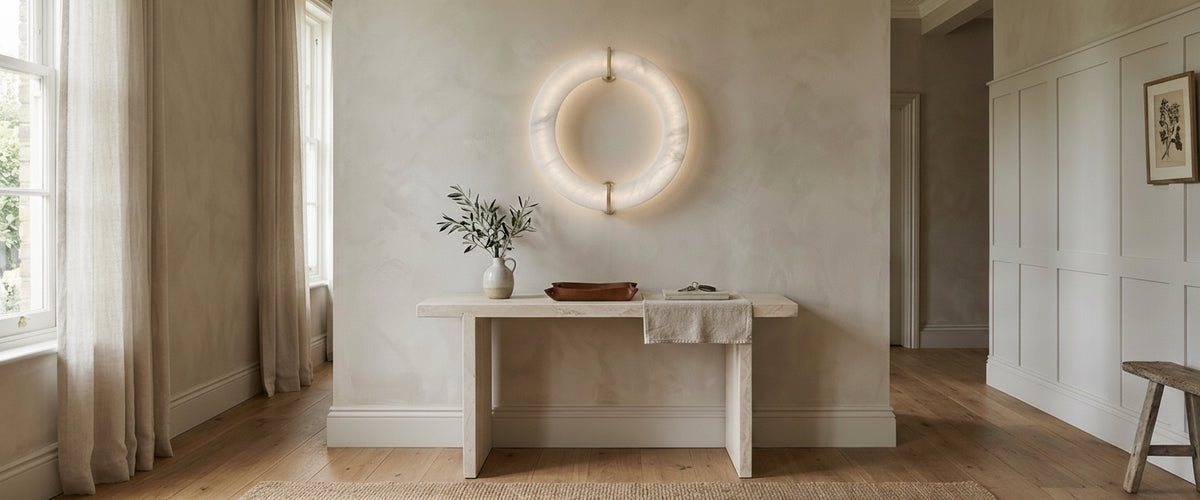

Two clients order the same light grey alabaster wall light. One installs it above a pale limestone hallway console and it reads like backlit silk, cool and quiet and worth every penny. The other mounts it on a warm taupe wall with a 2200K filament bulb behind it, and the stone turns the color of wet concrete. Same fixture. Same quarry. Completely different result. Grey stone is less forgiving than warm white alabaster, and most of the disappointment gets baked in at the specification stage, long before anyone reaches the installation.

Key Takeaways
Light grey alabaster gets its tone from mineral impurities in the gypsum, which also drives how densely it is veined.
Bulb colour temperature is the single biggest variable. Very warm sources push grey stone toward brown; neutral-warm sources keep it silvery.
Light grey alabaster performs best against cool or crisp backgrounds and struggles against yellow-based wall colours.
Thin translucent cuts glow; thicker cuts stop glowing and start sculpting, catching light on the surface instead.
Always ask to see the actual stone sample lit from behind, not photographed flat under studio lights.

What Separates Light Grey Alabaster from Warm White
All alabaster, light grey alabaster included, is a fine-grained gypsum stone, soft enough to carve with hand tools and translucent enough that light passes through the crystal structure rather than bouncing off it. That translucency is why it has been used for lamps, window panels, and funerary carving for thousands of years; the Metropolitan Museum of Art holds Egyptian and Mesopotamian alabaster vessels that still glow when lit from within.
Colour comes from what else was in the seam. Warm white alabaster tends to carry iron oxides and organic traces that give it honey and cream undertones. Light grey alabaster (sometimes listed as light gray alabaster in US catalogues) usually carries clay minerals or fine carbon inclusions instead, which pull the base tone toward a cool, ashy neutral. Those same inclusions travel through the block in bands, so grey stone is often more heavily veined than its warm white cousin, with darker charcoal or graphite lines running against a pale field.
Backlit at 3000K, the banding reads as shadow inside the glow rather than a flat printed pattern.
Veining density matters more than most buyers expect. A lightly veined light grey alabaster slab lights evenly and behaves like a soft neutral. A densely veined one becomes a graphic object the moment power is applied, with the dark bands reading almost black against the illuminated field. Neither is wrong. But a busy piece needs a calm setting, and a calm piece needs something else in the room to carry the interest.
How Bulb Colour Temperature Changes Light Grey Alabaster
Here is the trap. Warm white alabaster is flattered by very warm light because the stone and the bulb are pulling in the same direction. Light grey alabaster is not. Drop a 2200K bulb behind cool grey stone and the amber output mixes with the ashy pigment to produce something closer to mushroom, or worse, a flat greenish tan. The silver quality that made the material attractive in the sample tray disappears.
In practice, 2700K is the safe floor for light grey alabaster and 3000K often suits it better, particularly in bathrooms, kitchens, and stairwells where the surrounding surfaces are cool. Colour temperature is standardised by the International Commission on Illumination, and the numbers on the box are reliable enough to specify from, provided you buy quality lamps. Also check the colour rendering index. A CRI of 90 or above keeps the grey looking like stone rather than plastic; below 80, the veining flattens out and loses its depth.
A note on dimming. Most LED sources shift warmer as they dim, which is lovely behind honey-toned stone and less lovely behind grey. If you want a light grey alabaster pendant to stay silvery at 20 percent output, ask for a driver and lamp combination that holds its colour temperature rather than a warm-dim product. Have a qualified electrician confirm the dimmer is matched to the driver, since mismatched leading-edge dimmers are the usual cause of flicker and buzz in stone fixtures with integrated LEDs.
Rooms Where Light Grey Alabaster Earns Its Place
Cool-toned stone wants cool-toned company. It looks superb in a marble-heavy bathroom, in a kitchen with pale quartzite counters, and along a corridor finished in chalky white or soft greige plaster. Put a pair of light grey alabaster wall lights either side of blackened steel doors in a white plaster hallway and the stone reads as a deliberate mid-tone between the plaster and the dark metal, so the whole wall holds together.
It struggles in rooms built on warmth. A snug with oak panelling, terracotta tile, or a deep red rug will fight the stone rather than support it. The grey stops reading as a considered neutral and starts looking like the light bulb has failed. Dining rooms lit almost entirely by candlelight are similarly risky; the flame is far warmer than any bulb you would specify, and it will drag the stone brown.
North-facing rooms deserve a mention. Daylight from the north is already cool and slightly blue, so a light grey alabaster table lamp sitting unlit in that light can look grim by day even if it is beautiful at night. If the fixture will be seen switched off for most of daylight hours, a warmer stone is often the more livable choice. Browse the full range of tones side by side in our alabaster lighting collection before committing to a cool grey for a room that lives in daylight.
Metal Finishes and Wall Colours That Sharpen the Grey
Light grey alabaster and brushed brass is the pairing most people reach for, and it can work beautifully, but it needs the brass to be pale and brushed rather than deep and lacquered. A fixture in the register of the Aurelian LED Alabaster Wall Light in Brushed Brass, where the metal is a quiet frame rather than a gleam, is the version of that pairing that holds up next to cool stone. A heavily antiqued brass alongside cool grey reads as an accident rather than a decision. Satin nickel and polished chrome are the more reliable partners; both push the stone toward silver and reinforce the mineral quality. Blackened bronze and gunmetal work too, giving you a tonal step-down that makes the lit stone appear brighter by contrast.
On walls, aim for backgrounds with a cool or neutral base. Chalk whites, pale blue-greys, greige with a grey rather than yellow underpin, and plaster finishes all let light grey alabaster hold its own. Avoid magnolia, buttermilk, and warm beige. If the wall is already warm and cannot change, consider mounting the fixture on a darker feature panel or a stone-clad section so the grey has something to contrast against instead of blending into a yellow field.
One more thing about brass. If a project mixes brass hardware elsewhere but you want light grey alabaster lighting, use satin nickel or polished nickel on the fixtures and let the brass live on the joinery and taps. Mixed metals are fine. Mixed metals arguing with a cool stone in the same sightline is not.
Stone Thickness: Thin Cuts Glow, Thick Cuts Sculpt
Thickness is a design decision, not just a structural one. Cut thin, light grey alabaster becomes genuinely translucent, and the veining shows as shadow within the glow. This is what you want in pendants, chandelier plates, and shade elements where the light source sits behind the material.
A thicker column section stops transmitting and starts sculpting, so the glow collects at the edges instead of across the face.
Cut thicker, the stone stops transmitting much light and starts behaving like a solid. You get surface luminance at the edges, a soft rim of brightness, and a much heavier physical presence. Thicker sections suit lamp bases, column wall lights where the stone is a body rather than a diffuser, and floor lamps where the stone needs to carry weight and read as mass. A column format such as the Aurelian LED Alabaster Column Wall Light in Satin Nickel is the clearest example of stone used as a body, with light escaping at the edges rather than through the face. Where you want the opposite effect, a domed shade like the Morfia Mushroom Alabaster Table Lamp keeps the material thin enough across the curve to glow evenly, which is the harder thing to achieve in a grey stone.
Light grey alabaster is more sensitive to this than warm white. Because the pigment absorbs more light, a grey piece cut to the same thickness as a warm white one will look dimmer and denser. If you want real glow, expect the stone to be cut finer, which means it needs careful handling in transit and installation. Ask how the fixture is packed and whether the stone element is fitted on site or arrives assembled.
What to Check in the Stone Sample Before You Order
Photographs lie about stone. Studio lighting flattens veining and neutralises undertone, so a light grey alabaster sample that looks silver online can arrive reading olive or lilac. Work through this list before signing off a specification:
See it backlit. Hold the sample against a lamp, not a window. Transmitted light is the only honest test for a fixture.
Test it at your chosen colour temperature. Bring the actual bulb you plan to use, or ask for the sample to be lit at 2700K and 3000K so you can compare.
Look for the undertone. Set the sample next to a piece of white paper. You will immediately see whether the grey leans blue, green, or brown.
Check veining direction. Ask how the stone will be oriented in the finished piece. Vertical banding on a column light reads very differently to horizontal.
Take it to the room. Hold the sample against the actual wall colour, worktop, and metalwork at the times of day the space is used.
Ask about variation. Natural stone is not a repeatable product. If you are ordering several matching fixtures, confirm whether they will be cut from the same block.
Confirm the finish. Honed, polished, and lightly textured surfaces scatter light differently and change how light grey alabaster reads.
Buying and Living with Light Grey Alabaster
Budget for stone lighting depends on the block, the scale of the piece, how much of the stone is carved rather than sawn, the metalwork, the driver engineering, and the installation. A small wall light and a multi-plate chandelier are not comparable projects, so ask for a tailored quote against your actual specification rather than working from a general figure.
Care is straightforward if you respect the material. Light grey alabaster is gypsum, soft and reactive to acid, so no vinegar, no citrus cleaners, no bathroom spray. Dry dusting with a soft cloth handles almost everything; for marks, a barely damp cloth and an immediate dry-off is the limit. Keep it away from direct water contact, which means specifying carefully in bathrooms and confirming the fitting's rating for the zone. Our wider lighting collection covers marble and onyx alternatives if a wetter location rules alabaster out.
Specify light grey alabaster deliberately and it gives you something warm white cannot: a cool, mineral, faintly architectural light that sits comfortably alongside steel, nickel, and pale stone. Specify it casually and it will look like a light that needs a new bulb. The stone rewards the extra half hour spent with a sample in the room.