
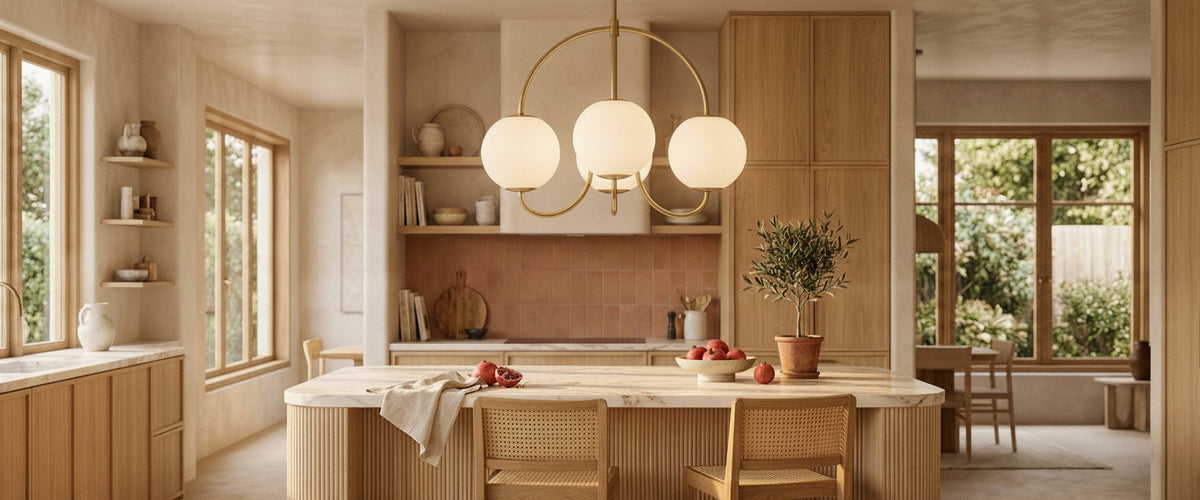

Three pendants bunched into the middle of a ten-foot island, hung so low that anyone over six feet has to duck, is the single most common lighting error we see in kitchen photographs. The fixtures are usually fine. The arithmetic is not. glass pendant bar lighting live or die on two numbers most people decide last: how far apart the drops sit, and how high above the surface they stop. Get those right and even a modest run of glass looks deliberate. Get them wrong and no amount of hand-blown detail will save the room. So before you shortlist glass pendant bar lights, work out the geometry of the surface underneath them.

Key Takeaways
- Configuration follows the counter shape. Long, narrow surfaces want a linear array of glass pendant bar lights; square or compact islands usually want a single statement drop or a tight cluster.
- Glass finish controls the light. Clear glass throws a hard, sparkling pool; opal and ribbed glass spread it; smoked glass dims everything and needs more lumens behind it.
- Mounting height: roughly 30 to 36 inches (76 to 91 cm) from the countertop to the bottom of the shade, less over a dining table, adjusted upward in tall rooms.
- Spacing: think in terms of the gap at each end of the run, not just the gap between fixtures.
- Backdrop changes everything. Clear glass disappears against white tile and reads as sculpture against dark plaster or brick.

Linear Array, Cluster, or Single Drop: Which Configuration Suits Which Counter
Start with the surface, not the fixture. Glass pendant bar lights only look effortless when the run is sized to the counter beneath it. A galley island of seven feet or more, or a run of bar seating, is asking for a linear array: two, three, or occasionally five separate drops on a straight axis, or one integrated bar fitting with multiple shades on a shared canopy. The shared-canopy version is the practical choice when you only have one ceiling outlet and rewiring the joists is not on the table; a three-shade fitting on a single bar, such as the Vesper 3 Light Bar Pendant in White, keeps the rhythm of a row without asking for three separate feeds. Individual glass pendant bar lights give you more freedom to fine-tune spacing on site, which matters more than most buyers expect.
Compact islands, roughly four to five feet long, are usually spoiled by three small pendants. One larger drop, centered, does more work and leaves the counter visually clear. A cluster, where several globes hang at staggered heights from one plate, suits a square island or a breakfast nook where you want mass rather than rhythm, a multi-globe fitting like the Havlen 7 Light Pendant with Swirled Glass Globes works on that logic, gathering the light into one mass instead of spacing it out. Clusters are also the safer bet under a sloped or vaulted ceiling, where a strict linear array can look like it is sliding downhill. If you are weighing configurations against a specific room, it helps to browse a full lighting range by fixture type first and shortlist by form, then narrow by finish.
One caution on peninsulas and pass-throughs: a run of glass bar pendant lights over a peninsula must clear sightlines from the adjoining seating area. We have had clients in open-plan Texas builds hang a beautiful three-light run only to find it cuts the view from the sofa straight through to the yard. Sit down in the main seating position and check the eye line before you commit to a height.
Seeded, Smoked, Ribbed, and Clear: How Each Glass Shapes the Pool of Light
Glass is not one material with one behavior, and the finish you choose decides what glass pendant bar lights actually do to the counter below. Clear glass is essentially a window; the bulb is the light source and the shade is jewelry around it. You get sparkle, high contrast, and a tight pool on the counter, plus glare if you choose the wrong lamp. Seeded glass, with its trapped air bubbles, scatters a little of that output and softens the edges of the pool. The technique has a long history in hand-blown production, and museum glass collections show how deliberately bubbles and inclusions have been used as decorative effects rather than defects (The Met's glass collection is a good place to see how far back that goes).
Ribbed and fluted glass refracts light sideways along the flutes, which puts a decorative pattern on the ceiling and walls as well as on the counter. It is the most forgiving option if you like clear glass but hate glare. Opal glass hides the lamp entirely and behaves closest to alabaster: even, low-contrast, no visible filament. Where a run over bar seating needs a soft diffused glow rather than a hard sparkle at eye level, an opal shade such as the Volanne Glass Pendant Light in Opal White is closer to the right design language than clear glass with an exposed filament. Smoked and bronze-tinted glass looks superb switched off and swallows output when switched on, so plan for higher-lumen lamps or a supporting layer of downlights.
This is where alabaster earns its place in the conversation. Glass either transmits light or blocks it; stone glows. Alabaster is mineral-thin enough that light travels a short distance inside the material before it leaves, which is why a lit alabaster shade reads warm and dimensional rather than simply bright. Across the alabaster lighting range you can see the same effect at different scales: each block has its own veining, so no two shades diffuse identically. Over a bar or island where people sit facing the fixture at eye level, that low-glare quality is worth serious consideration against clear glass pendant bar lights.
Mounting Height by Surface: The Numbers That Actually Work
Height is where glass pendant bar lights are most often mis-specified. Measure from the finished surface to the lowest point of the shade, not to the canopy or the ceiling.
- Kitchen island, standard 36-inch counter: 30 to 36 inches (76 to 91 cm) of clearance. Go toward 30 if the pendants are small and you want a defined pool; go toward 36 if the shades are wide or the household is tall.
- Raised bar counter, around 42 inches: tighten to roughly 28 to 32 inches (71 to 81 cm), since the surface is already higher and the room needs the visual space above.
- Dining table: 30 to 34 inches (76 to 86 cm). People are seated, sightlines are lower, and you can afford to bring the light down closer to the table.
- Ceilings above 8 feet: add about 3 inches of drop for every additional foot of ceiling height, then check it on site. Tall rooms swallow small fixtures.
Order adjustable rods or extra cable where the option exists, and always dry-hang before final fixing. A pendant that looks correct on a plan drawing frequently reads two inches too high once the counter stone is in and the stools are under it.
Why the Gap Between Pendants Is the Decision Most Buyers Get Wrong
Buyers tend to fix on the distance between fixtures and forget the end gaps, and it is the quietest failure mode in a row of glass pendant bar lights. The result is a row that floats in the middle of the island with dead counter at either end. The cleaner approach: divide the island length by the number of pendants, then center each fixture within its own share of that length. For three pendants on a nine-foot island, that puts them on three-foot sections, centered at 18 inches, 54 inches, and 90 inches from one end. The end gaps end up half the size of the gaps between fixtures, and the run sits properly inside the counter rather than crowding into it.
As a working range, 24 to 30 inches (61 to 76 cm) center-to-center suits medium shades of 8 to 12 inches diameter. Bigger shades need bigger gaps, and the visual gap between shade edges matters more than the gap between centers. If two shades come within a few inches of touching, the eye reads them as one clumsy mass. Keep at least 6 inches of clear air between shade edges, ideally more.
A related trap: an even number of glass pendant bar lights over a surface with a strong central feature, such as a faucet or a cooktop, leaves a gap exactly where you need light. Odd numbers usually solve it. We advised a Napa client last year to drop from four pendants to three on a long island for exactly this reason, and the improvement was mostly about what disappeared from the middle of the run.
Dark Walls, White Tiles, and Bare Brick: How Backdrop Changes What Glass Reads As
The same fixture is a different object in a different room, and clear glass pendant bar lights that read as sculpture in a showroom can vanish at home. Against a white subway-tile backsplash under bright daylight, clear glass all but disappears; you see hardware, cable, and bulb, which is fine if the metalwork is the point and disappointing if it is not. Against dark plaster, inky cabinetry, or a deep gray-green wall, clear and smoked glass gain outline and read as sculptural. Bare brick and rough stone are busy backdrops, and fine ribbed detail tends to get lost against them, so simple globe forms and solid shades usually hold their own better.
Reflective surroundings matter too. A mirrored splashback or a run of polished stone doubles every filament you hang, which is why opal, alabaster, or heavily seeded glass tends to sit more calmly in those rooms. Brass detailing warms up cool marble; nickel or chrome sharpens up warm oak and travertine.
Bulbs, Dimming, and Wiring
Specification is the last place glass pendant bar lights tend to go wrong, and the cheapest place to get it right.
- Color temperature: 2700K for kitchens and bars. 3000K only if the room leans cool and modern. Anything above that turns warm stone and brass clinical.
- Color rendering: CRI 90 or above. Food, wood, and natural stone all look flat under poor rendering.
- Lamp choice by glass: clear glass needs a decorative filament or a low-glare frosted lamp; opal and alabaster can take a standard LED because the source is hidden.
- Dimming: specify dimmable lamps and a compatible dimmer, usually trailing-edge for LED loads. Mismatched drivers and dimmers cause flicker and buzz; the Energy Saving Trust has plain guidance on LED performance worth reading before you specify.
- Installation: ceiling boxes, joist positions, and load ratings are a job for a qualified electrician, particularly for multi-drop bar fittings on a single canopy.
A Short Buying Checklist
Work through this before you order glass pendant bar lights for any surface.
- Measure the counter length and the ceiling height before shortlisting anything.
- Decide configuration from the surface shape: linear for long runs, single drop for compact, cluster for square or sloped ceilings.
- Choose glass finish based on glare tolerance and backdrop, not photographs alone.
- Check the shade diameter against your planned spacing so shades never crowd.
- Confirm whether the fixture takes rod, chain, or cable suspension and how far it adjusts.
- Check sightlines from adjoining seating in open-plan rooms.
- Confirm dimmer and lamp compatibility with your electrician.
- For scale, engineering, or custom finishes, ask for a tailored quote; budget depends on material, size, complexity, and installation rather than any fixed band.
Care Over the Long Run
Glass pendant bar lights hung near a hob or cooktop collect an oily film that dulls output within months; warm water, mild detergent, and a lint-free cloth handle it, and it needs doing more often than most people plan for. Alabaster and marble behave differently. They are porous and should never meet vinegar, citrus, or ammonia cleaners; a dry microfiber cloth and, occasionally, a barely damp one is all a stone shade wants. Switch off and let a fixture cool fully before touching it, and support the shade rather than the cable while you work. Small habits, but the difference between a fixture that looks right in year eight and one that quietly fades. If you want to see how the finishes compare in person before deciding, the Niori range covers alabaster, natural stone, glass, and brass across pendants, chandeliers, wall lights, and lamps.