
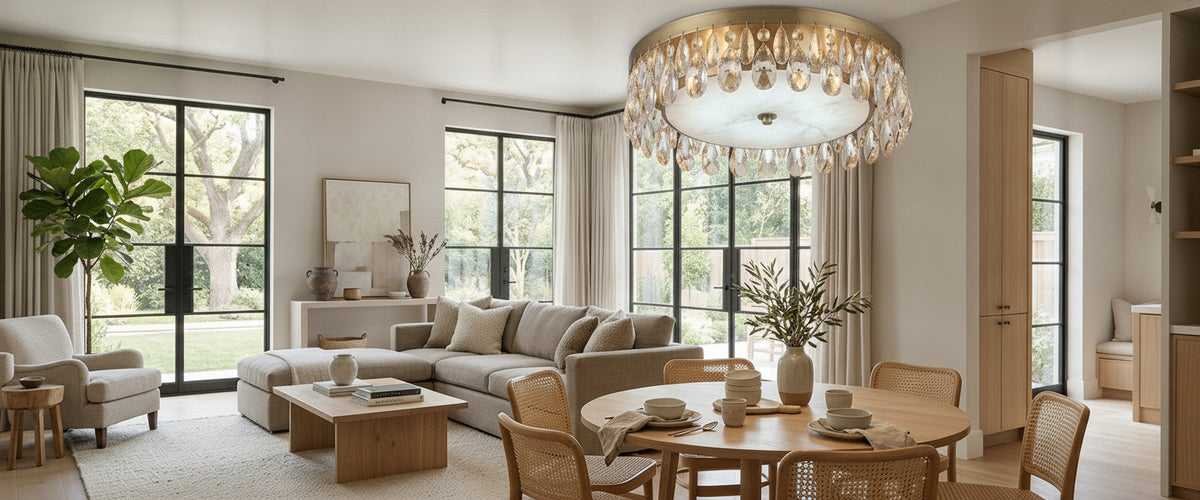

Most crystal flush mounts fail for the same reason: someone bought sparkle by the yard and ignored the ceiling it had to sit against. Choose well and a crystal flush mount does something very few fittings manage, delivering real light and real refraction into a room with no headroom to spare. Choose badly and it reads like an afterthought screwed into a hallway ceiling. The difference is rarely the crystal alone. It is diameter, frame finish, bulb color and the ceiling cavity you never checked before ordering.

At a Glance
Flush is not semi-flush. A true crystal flush mount sits tight to the plaster with no visible stem, which changes how light spreads and how much sparkle you actually see.
Diameter carries the room. Undersized crystal on a wide ceiling looks accidental; err generous rather than timid.
Frame finish dates faster than crystal. Antique brass, brushed nickel and matt black age very differently against warm and cool schemes.
Warm dimmable light keeps refraction flattering. Around 2700K, high color rendering, on a compatible dimmer.
Check the cavity before you buy. Joist positions, plasterboard depth and driver housing decide whether the fitting sits properly.
Crystal sparkles, alabaster glows. Many projects want both, in different rooms.

Why a Crystal Flush Mount Is a Different Proposition to a Semi-Flush or Pendant
A pendant hangs in free air, so light escapes in every direction and the fitting is read as an object first. A semi-flush drops 4 to 8 inches (100mm to 200mm) on a short stem, which keeps a little air beneath it and lets light wash upward onto the ceiling. A crystal flush mount removes that gap entirely. The body presses against the plaster, the light throws downward and sideways, and the ceiling stays comparatively dark.
That has consequences. Without an uplight component, a room lit only by flush fittings can feel slightly heavy at the top, which is why they work best as part of a layered scheme rather than the sole source. It also means the crystal is doing its refraction close to the surface, so the facets read as a broad shimmer rather than as individual falling drops. If you want long teardrops catching light in mid-air, you want a chandelier and the height to hang it. If you have 7.5 to 8 feet (2.3m to 2.5m) of ceiling and a door that swings, a crystal flush mount is the honest answer.
The Rooms Where a Crystal Flush Mount Reads Refined
Entrance halls are the strongest case. A hallway is a transition space with heavy traffic and usually the lowest ceiling in a period conversion, and a wide crystal flush mount gives the first-impression moment that a downlight grid never will. Landings and stairwell heads follow closely, particularly where a fitting sits directly over a stair and cannot be allowed to drop.
Dressing rooms and principal bedrooms suit them too, because crystal at close range rewards a slow look. In bathrooms, check the IP rating and zone requirements carefully before committing; plenty of decorative fittings are simply not rated for the space above a bath. Hospitality clients tend to use a crystal flush mount in corridors, lift lobbies and cloakrooms, where a hanging fitting would be knocked or would fight with signage. If you are pulling together a scheme across several rooms, it helps to browse the full lighting range in one sitting so the flush fittings, wall lights and table lamps share a family of finishes rather than arriving as separate decisions.
Where crystal struggles: open-plan kitchens with a lot of stainless steel, and any room with strong cool daylight and gray-toned joinery. Faceted glass under cool light can turn slightly clinical. That is the moment to consider alabaster instead.
Diameter, Frame Finish and Crystal Grade
Three specification decisions separate a fitting that looks commissioned from one that looks catalogued.
Diameter
The old designer rule still holds up: add the room's length and width in feet, and the resulting number in inches gives a reasonable fixture diameter. A 12ft by 14ft room lands around 26 inches (roughly 65cm). That puts a crystal flush mount on the scale of the Astro 3 Light Crystal Ceiling Light, 60cm in the right range for an average sitting room, while a small disc such as the Astro Crystal Ceiling Light, 20cm belongs over a cloakroom, a wardrobe run or a tight landing rather than floating in the middle of open floor. For a hallway, work instead from the width of the space and keep the fitting comfortably clear of the walls on both sides. Over a dining table, the fitting should read narrower than the table, never wider. The single most common mistake we see is a 30cm fitting floating in the middle of a generous ceiling, which makes the whole room look smaller.
Frame Finish
The metalwork behind the crystal is what dates a fitting. Polished chrome swings in and out of fashion quickly and can look hard against warm timber. Antique or aged brass sits well with warm whites, oak and stone, and it forgives fingerprints. Brushed nickel is the neutral option in cooler, grayer schemes. Matt black frames read graphic and contemporary but can look heavy in a small hallway, because the frame becomes the dominant shape once the light is off. Always look at the fitting unlit as well as lit; a crystal flush mount spends most of its life switched off in daylight.
Crystal Grade
Not all faceted glass behaves the same. Precisely cut crystal with high optical clarity, whether leaded or a good lead-free equivalent, throws defined, colored refraction. Cheaper pressed glass has softer edges, visible mould seams and a slightly gray cast that kills the effect. The Corning Museum of Glass has useful background on how lead content and cutting affect the way glass bends light, which explains why two fittings of identical shape can look so different in the same room. Ask about facet count, cut method and whether the drops are individually strung or molded in panels.
Ceiling Height and Footprint: The Numbers That Govern the Result
Below about 8 feet (2.4m), a crystal flush mount is usually the only sensible choice over circulation routes and beds. Between 2.4m and 2.7m you have the option of a semi-flush, and the extra breathing room often flatters crystal because a sliver of light escapes upward. Above 2.7m a flush fitting starts to look shy unless the diameter grows to compensate. Where a wide stair opening or a generous entrance hall needs the fitting to hold the ceiling on its own, something on the scale of the Astro 18 Light Crystal Ceiling Light, 115cm reads in proportion where a standard 60cm disc would simply disappear.
Footprint matters more than people expect. A wide, shallow crystal flush mount casts a broad pool of light and covers a large area of ceiling, so it needs to be centered on something meaningful: the room, the stair opening, the rug, the bed. Centre it on the light point the electrician happened to leave and you will notice the misalignment every day. Moving a ceiling rose during a refurbishment is far cheaper than living with the compromise.
Bulb Choice and Dimming: Keeping the Refraction Warm
A crystal flush mount amplifies whatever color temperature you feed it. At 4000K the sparkle goes blue-white and slightly surgical. At 2700K it turns golden and the facets pick up warmth from the room. For most homes, choose 2700K LED lamps with a color rendering index of 90 or above, and check whether the fitting takes E14 candle lamps, G9 capsules or an integrated LED module.
Clear-glass candle or capsule lamps produce sharper, more defined refraction than frosted ones, because the filament acts as a point source. The trade-off is glare when you look up at the fitting from a stair or a bed. In bedrooms, frosted lamps and a lower output usually win. Dimming is close to essential: a crystal flush mount at full output reads bright and busy, while the same fitting at 30 percent reads like jewellery. Confirm that the driver or lamp is dimmable and that your dimmer module is compatible with low-wattage LED loads, because mismatched pairings cause flicker and buzzing that no amount of good crystal can rescue.
What a Tight Ceiling Cavity Demands Before You Order
This is the step that catches out even experienced buyers. A crystal flush mount needs a mounting plate that spans to a joist or a suitable fixing, and heavier crystal designs need proper structural support rather than plasterboard fixings alone. Ask three things before ordering: the weight of the fitting, the depth of the canopy, and whether any driver sits inside the canopy or needs to be recessed above the ceiling line.
Period properties complicate this further. In a Georgian flat with original lath and plaster and a decorative cornice, the electrician will often need to add a timber noggin between joists before the plate can be fixed safely, which can add a day to the schedule. Worth knowing before the fitting arrives. Any hard-wired ceiling fitting should be installed by a qualified electrician working to current wiring regulations, and Electrical Safety First publishes clear guidance on when notifiable work applies. If you are retrofitting into an existing rose, check that the backing box is deep enough to accommodate the connections without forcing the canopy to sit proud.
Crystal or Alabaster? Choosing the Right Material for the Room
Crystal reflects. Alabaster transmits. That single difference decides most projects. Faceted crystal breaks light into points, so a crystal flush mount needs a bit of contrast and darkness around it to perform. Alabaster is translucent stone, so light passes through the material itself and comes out warm, soft and diffused, with the mineral veining visible in the glow. In a bedroom, a study or a snug where you want calm rather than glitter, alabaster is the better instinct, and the flush and semi-flush options in the alabaster lighting collection give the same low-profile solution without the sparkle.
Plenty of schemes use both. A crystal flush mount in the entrance hall for the arrival moment, alabaster wall lights up the stair, an alabaster table lamp in the bedroom. Onyx sits between the two, with stronger banding and more color, and it suits rooms with darker joinery. Designers on hospitality projects mirror this logic: crystal in public circulation, stone in the guest rooms.
Buyer's Checklist Before You Order
Measure ceiling height at the exact fixing point, not the middle of the room.
Calculate diameter from room dimensions, then check clearance to walls, doors and cabinetry.
Confirm whether you are buying a genuine crystal flush mount or a semi-flush; the product photography is not always clear.
Ask for the fitting weight and required fixing method before booking the electrician.
Check the lamp base type, maximum wattage and whether the fitting is dimmable.
Specify 2700K, CRI 90-plus lamps and a compatible LED dimmer module.
For bathrooms, confirm the IP rating suits the zone.
View the frame finish against your actual joinery and metalwork samples, not on screen.
Ask about spare crystal drops and replacement parts availability for the long term.
Living With It: Care That Keeps the Sparkle
A crystal flush mount collects dust faster than most decorative fittings because the facets are effectively hundreds of small ledges. Switch off, let the lamps cool, and dust with a dry microfiber cloth or a soft brush every couple of months. For a deeper clean, a lightly dampened cloth with distilled water works; avoid ammonia-based sprays, which attack plated and lacquered frames. Never spray liquid directly at the fitting, because moisture tracking into a lamp holder is a genuine hazard.
Natural stone asks for the opposite approach. Alabaster is a soft, porous gypsum stone that should never be soaked or cleaned with household chemicals; dry dusting is the whole routine, with any sealed surface treated only as the maker advises. Decorative lighting is a long-term purchase, and materials behave very differently over a decade of use.
Getting Advice on Scale and Specification
Cost for a crystal flush mount varies with diameter, crystal grade, frame finish, lamp count and any bespoke sizing or engineering work, so a considered quotation is more useful than a headline figure. Send through your ceiling height, room dimensions, existing metalwork finishes and a photograph of the ceiling, and we can advise on whether a crystal flush mount, a semi-flush or a low-drop chandelier suits the space. If you are specifying across a whole house or a hospitality project, start at the Niori homepage to see how the alabaster, stone and crystal ranges sit together before you commit to a single fitting.