
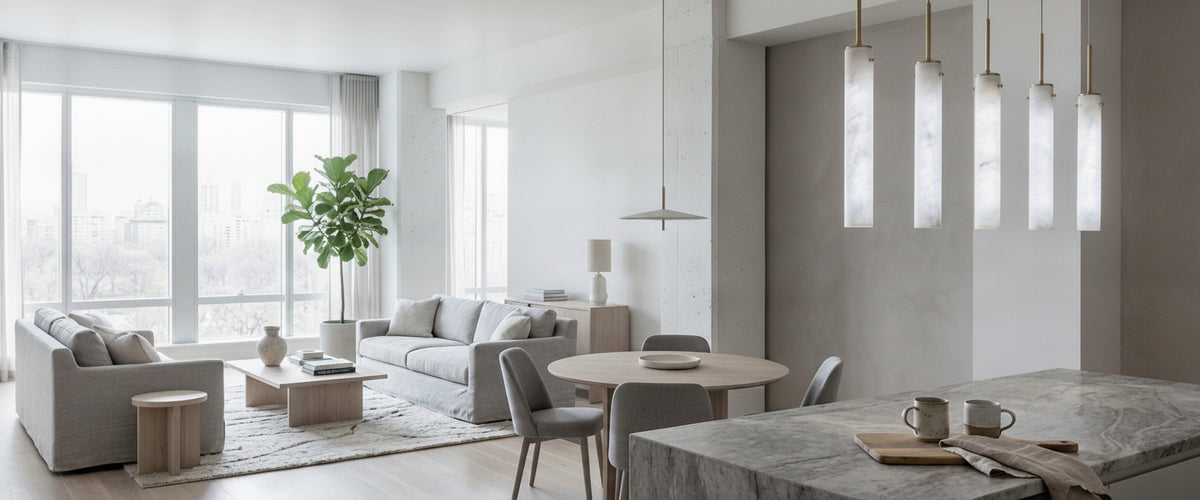

A restaurant opens with a run of beautiful pendants over the bar. Eighteen months later, half of them flicker on the dimmer, two have been swapped for a slightly different finish after a delivery accident, and the cleaning team has scoured the shades into a dull patchwork. None of that is an aesthetic failure. commercial pendant lights fail for procedural reasons, and almost all of those reasons are settled before anyone places an order.

Key Takeaways
- Commercial pendant lighting has to answer to switching zones, cleaning regimes, maintenance access and re-order continuity, none of which matter much at home.
- Fix your dimming protocol (mains, 0-10V, DALI) before you approve a single fixture, not after.
- Mounting height is a safety and sightline decision first, a styling decision second.
- Alabaster and natural stone age well commercially because the surface has depth; a scratch reads as texture rather than damage, unlike painted metal.
- Brief the supplier on the whole project at once, even if you install in phases, so batch and finish stay consistent.

Where Commercial Pendant Specs Diverge from Domestic Ones
Domestic buyers choose a pendant, hang it, and live with it. A commercial specification carries a second layer of obligations: emergency lighting coordination, a switching schedule that lets staff run half a room at low level during setup, a cleaning protocol that will not destroy the finish, and a spares strategy for when a fixture is damaged during a deep clean. Commercial pendant lights also get handled far more. Bar staff knock them. Contractors move ladders past them. Function teams drape them for events, which nobody warned you about at design stage.
The cost of ignoring that gap is rarely one big invoice. It arrives as attrition: a replacement here, a re-lamp there, a mismatched batch that forces an entire run to be swapped so the room reads evenly again. Phased projects are the usual culprit. Scope a hotel floor by floor rather than building-wide and every reorder brings a fresh negotiation over veining and translucency, even when nothing has actually failed. Avoidable, and expensive in time.
One more divergence worth naming: light levels. A domestic pendant can be decorative and nothing else. In hospitality and retail, the pendant is usually doing task work as well as atmosphere, so its output and diffusion have to be checked against the rest of the scheme rather than admired in isolation.
Pendant Families That Hold Character Across Restaurant, Hotel and Retail
Three broad families cover most commercial pendant lights, and they behave very differently under real use.
Diffused Stone Discs and Domes
Alabaster discs and shallow domes give a wide, soft wash with no visible source. That matters over dining tables and reception desks, where a glary point source ruins the mood and makes faces look harsh. The stone itself does the diffusion work; light passes through the crystalline structure and comes out warm and slightly uneven, which is exactly what makes it look expensive. These sit comfortably in modern commercial pendant lights schemes because the form is quiet and the material carries the interest.
Linear Bars and Runs
Commercial linear pendant lighting suits long tables, communal benches, bar tops and retail counters. A single linear fixture reads cleaner than five separate pendants fighting for alignment, and it is far easier to keep level over a 3 m (10 ft) counter. Linear alabaster bars or stone-and-brass runs work well where you need continuous illumination without a stripe of visible LED.
Clusters and Large Statement Pieces
Large commercial pendant lighting earns its keep in double-height spaces: atria, stairwells, lobbies with a mezzanine. The mistake is scaling to the floor plan rather than the volume. In a 6 m (20 ft) void, a pendant sized for a domestic hallway simply disappears. Cluster arrangements of stone globes or circular suspended rings hold the vertical space better and give the eye something to follow on the way up. Browse the wider lighting range to see how disc, linear and cluster forms differ once you compare them side by side.
Mounting Heights for High-Traffic Zones
Drop heights for commercial pendant lights are a safety question before they are a styling one. Get it wrong and you will be dealing with head strikes, blocked sightlines, or a bar team that cannot see the till. Typical working ranges to test against your own drawings:
- Over dining tables: roughly 750 to 900 mm (30 to 35 in) from tabletop to the base of the shade. Lower if the pendant is fully opaque on top and you want intimacy; higher if guests sit face to face across a narrow top.
- Over bar counters: similar range, but check the eye line of a standing server first. If a pendant blocks the view from the pass to the bar, the kitchen will complain within a week.
- Circulation routes and walkways: keep at least 2.1 m (7 ft) of clear headroom under the fixture, and more where trolleys, luggage or event staging move through.
- Reception and retail counters: hang high enough that the fixture does not sit between staff and customer at eye level. Diffused stone helps here because the face of the shade never becomes a glare source.
- Double-height voids: position the lowest element so it is visible from both floors and never within reach of a mezzanine rail.
Confirm final drops with your lighting designer against ceiling build-ups, sprinkler positions and any structural steel. Suspension is adjustable on most pendant lighting; commercial ceilings are not.
Dimming Protocol, Driver Spec and Group Switching
This is where most commercial LED pendant lights come unstuck. A fixture that dims smoothly on a domestic trailing-edge dimmer may buzz, flicker or drop out at the bottom of the curve when it is wired into a building control system. Decide the protocol before you approve anything.
- Mains dimming (trailing edge): simplest, fine for small sites with a handful of circuits. Check minimum load and confirm the driver is listed as compatible.
- 0-10V: reliable, widely used, good for straightforward zone control in retail and casual dining.
- DALI: the sensible default for hotels and multi-zone venues where scenes change through the day and you want addressable control and fault reporting.
Also fix your colour temperature and consistency tolerance in writing. For hospitality, 2700K is the usual warm setting; 3000K reads slightly crisper and suits retail displays. Ask for a binning tolerance so a run of twelve pendants does not include one that skews green. Group switching deserves the same rigour: staff need a low-level setting for cleaning and setup, a service level, and a late-evening level. Three scenes, decided at design stage, will save you an ugly retrofit later.
All fixed wiring and control installation must go to a qualified electrician working to the current UK wiring regulations. The IET's electrical guidance is the reference point your contractor will already be working from, and it is worth checking that your control strategy has been reviewed alongside the fixture schedule rather than after it.
How Stone and Metal Finishes Perform Over Years, Not Months
The finishes on commercial pendant lights have to survive a housekeeping trolley, not just a photoshoot. Alabaster is a gypsum stone, which means it is softer than marble and genuinely dislikes standing water and acidic cleaners. In a commercial setting that translates into one rule: dry dust only, and no proprietary sprays. Stone Federation Great Britain publishes sensible guidance on natural stone care that a facilities team can work from. Put the cleaning instruction in the O&M manual and, if you can, laminate a card for the trolley itself. The damage we see is almost never from age; it is from someone reaching for a general-purpose cleaner.
The upside is significant. Stone weathers gracefully. A light surface mark on alabaster reads as part of the material's character, whereas the same mark on a powder-coated shade reads as a defect that needs replacing. Marble and onyx are harder and cope better in high-contact zones such as bar undersides and stair landings. Brass detailing is the other variable: unlacquered brass will patina unevenly where hands touch it, which is lovely in a whisky bar and wrong in a clinical retail interior. Specify brushed or lacquered brass if you need the finish to stay put. The alabaster lighting collection is a useful place to compare how different stone thicknesses and metal pairings read once lit.
Briefing a Supplier for a Multi-Zone Project
Phased installs are where finish drift creeps in. Natural stone varies by block, and brass finishes shift slightly between production runs. Schedule the commercial pendant lights for the whole building in a single brief and you sidestep most of it.
Supplier Briefing Checklist
- Total quantity across all zones, including a spares allowance for damage and future maintenance.
- Dimming protocol and driver type, stated explicitly, plus who is supplying the drivers.
- Colour temperature, output and consistency tolerance.
- Suspension lengths per zone, with ceiling type and fixing constraints noted.
- Required certifications and documentation for building sign-off.
- Finish reference: agree a sample for stone translucency and metal tone, and ask for it to be held.
- Delivery sequencing by zone, with storage responsibility agreed in advance.
- Cleaning and maintenance instructions supplied in writing for the facilities team.
On budget, resist the urge to price by fixture count alone. Cost on a commercial pendant lighting package tracks material, scale, engineering, control integration, installation and finishing, and a linear run in stone is a different proposition from a small single pendant. Ask for a tailored quote against the full schedule rather than a per-unit figure, and make sure it separates fixture, driver and any bespoke suspension work.
Commercial pendant lights reward front-loaded thinking. Decide the control strategy, agree the finish reference, size to the volume, and write down the cleaning rules. Do those four things and the pendants will still look right on the day the lease renews. If you are scoping a project across several zones, start from the full Niori range and work backwards to the schedule rather than choosing fixtures room by room.