
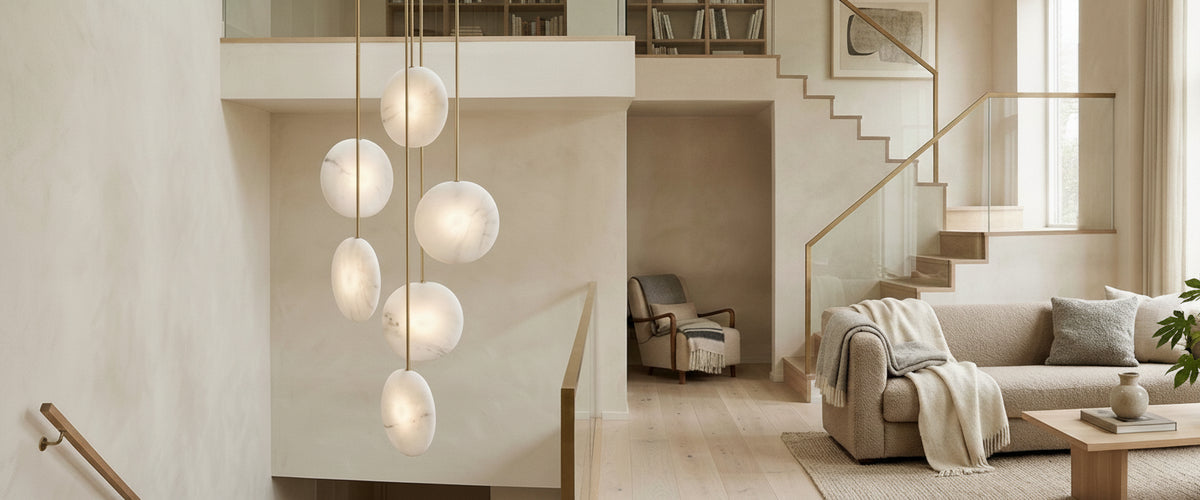

Hang three pendants in a straight line over a table and you have a row. Hang seven at staggered drops in a stairwell void and you have a sculptural object with real presence, or a tangle of cables, depending on decisions made weeks before the electrician turns up. Cluster pendant lighting is the least forgiving format we deal with at Niori, because every misjudgment in scale, drop and canopy width gets multiplied by the number of shades hanging from it.
Done properly, a cluster behaves like one fixture. Your eye reads the group, not the parts. Done carelessly, it reads as several lamps that happened to arrive at the same address.

Key Takeaways Before You Specify
Settle scale first. Ceiling height and room volume dictate shade count and spread before you look at a single finish.
Material decides the light. Alabaster and onyx glow and spread; opaque metal concentrates downward; clear glass sparkles but reveals every bulb.
The canopy is the anchor. One wide canopy holds a group together. Several small ones scatter it.
Dimming is not optional. Five to nine bulbs at full output in a domestic room is uncomfortable.
Weight and access come first. Stone shades need a fixing survey and a plan for how anyone reaches them again.

What Cluster Pendant Lighting Actually Is, and Why Scale Comes First
A cluster pendant is a group of individual shades suspended from a shared canopy or ceiling plate, usually at staggered heights, wired and switched as one fixture. That makes it distinct from a linear row of separate pendants, each with its own canopy and circuit run. The distinction matters practically: a cluster arrives as one piece of engineering, and it needs one structural fixing point capable of taking the full load.
Scale is the first conversation, and it should happen before anyone opens a finishes board. Five small shades under a 2.4 m (8 ft) ceiling read as clutter. The same five in a double-height hall at 5.5 m (18 ft) disappear. The useful mental test is to picture the group as a solid object, a rough sphere or column of air that the shades occupy, and ask whether that object suits the room. If the imaginary volume looks timid, add shades or widen the spread. If it crowds the space, reduce the count and increase the size of each shade instead.
It helps to hold a physical reference in mind. A shade on the scale of the Impossible Oval Pendant Light, 105cm is already room-defining on its own, so two or three of them group only in a genuinely tall void; the 65cm version of the same form sits at three or five without the ceiling feeling occupied. Trios look best when they are genuinely irregular in height, with a clear tallest and shortest, because even staggering reads as indecision. At seven shades or more, cluster pendant lighting can carry a more rhythmic arrangement, since the eye stops counting.
Staggered drops give a stair-void group depth from the hall, the half-landing and the floor above.
Stone, Glass and Metal Shades: How Material Changes the Spread of Light
Material is the single biggest variable in how cluster pendant lighting behaves once the power is on, and it is why we push clients towards natural stone more often than not.
Alabaster. Translucent, veined, lit from within. Each shade becomes a soft source in its own right, so the group throws warm ambient light in every direction rather than hard pools on the floor. Veining shifts from shade to shade, giving variation you cannot fake with a uniform finish. Browse our alabaster lighting collection to see how the stone reads when it is backlit rather than surface-lit.
Onyx and marble. Onyx is more dramatic, with stronger banding and a warmer amber cast. Marble is denser and reads as a solid form with a glowing edge. Both suit a group that wants weight and presence rather than a diffuse cloud of light.
Opaque glass and ceramic. Even, predictable, less characterful. Useful when the form itself is the statement and you do not want veining competing with it.
Clear or ribbed glass. Sparkle and reflection, but every filament shows. In a group of eight, that is eight glare sources at eye level in a stairwell. Specify low-output decorative lamps if you go this route.
Metal shades. Directional: light goes down and nowhere else. Over a dining table that discipline can be exactly what you want, and a flat disc such as the Slim Black Round LED Pendant Light 50W 4000K, 46cm shows how tightly the throw is contained, but the ceiling above will go dark.
For large voids, consider mixing: stone shades on the longer drops that people see close up from a landing, plainer shades higher in the group. It keeps the material budget sensible without weakening the piece.
Canopy Width, Drop Length and the Measurements That Hold It Together
Coherence is mostly arithmetic. A few working rules from projects we have shipped:
Spread against the surface below. Over a dining table, keep the overall footprint to roughly half to two thirds of the table width, centred on the table rather than the room. Rooms are rarely as symmetrical as plans suggest.
Hang height over a table. The lowest shade should sit around 75 to 90 cm (30 to 35 in) above the tabletop. Higher and the light stops being intimate; lower and people bang their heads standing up.
Head clearance in circulation space. In a hallway or over a stair, nothing should come below about 2.1 m (7 ft) from any walking surface, checked against the stair pitch rather than the landing.
Canopy diameter. A wide single canopy reads as intent. If it is narrower than roughly a third of the spread, the cables splay and the group looks like it is falling apart. Ask whether the canopy can be sized to the installation.
Drop variation. In a double-height space, 60 cm (24 in) or more between the shortest and longest drop gives real depth. Anything tighter looks like a mistake.
One thing catches people out: cluster pendant lighting is usually viewed from more than one level. A stairwell group is seen from below, from the half-landing and from the upper floor. Sketch all three sightlines, because an arrangement that looks balanced from the hall floor can look lopsided from the landing above.
Where Cluster Pendant Lighting Genuinely Earns Its Ceiling
Double-Height Halls and Stair Voids
This is the strongest case. Tall voids swallow single fixtures, and cluster pendant lighting fills vertical space in a way one pendant cannot without becoming enormous. Alabaster performs particularly well here, staying luminous from below and from the side, so the piece looks intentional from every landing. We supplied a group for a converted chapel in Somerset where the client had already tried one large pendant; it looked like a full stop in the middle of a very long sentence. Nine staggered stone shades solved it in an afternoon of adjustment.
Over a round table, keep the spread to half or two thirds of the table width.
Dining Tables
Round and square tables suit grouped pendants better than long refectory tables, where a linear run usually serves better. The group gives the room a centre of gravity. Keep output modest and warm, and let table lamps or wall lights carry the perimeter.
Kitchen Islands, Bedrooms and Landings
Over an island, a group works when the island is a social object rather than a prep surface; if you are chopping under it, add dedicated task light. In bedrooms, a small asymmetric arrangement on one side of the bed can replace a bedside lamp entirely and free the table; a shade the size of the Sphere Small LED Pendant Light Chrome 4.8W 3000K, 12cm is closer to the right proportion there. Landings often need nothing more than a compact three-shade group to resolve an awkward junction.
Bulb Count, Wattage and Why Dimming Is Non-Negotiable
Bulb count is where cluster pendant lighting quietly becomes a comfort problem. Seven shades at 6 W each is not the same experience as one 42 W source; it is seven separate points of brightness in the visual field. Total lumens matter less than how many places your eye has to adjust to.
For stone shades, warm colour temperature does the heavy lifting. Around 2700 K flatters alabaster veining and keeps the amber tones in onyx honest; push to 4000 K and the stone looks grey. Choose lamps with a high colour rendering index, ideally CRI 90 or above, or the mineral colour will read as muddy. Guidance on light levels and control for domestic and hospitality spaces is published by the Chartered Institution of Building Services Engineers.
Dimming should be designed in, not retrofitted. Confirm the driver is dimmable, that the dimmer module suits the specific LED lamps, and that every shade runs on one channel so they brighten and fade together. Mismatched dimming produces flicker in one or two shades, which is more distracting than no dimming at all.
The Details Buyers Overlook Until the Electrician Arrives
These are the questions we ask before cluster pendant lighting leaves the studio, in the order they cause problems.
Weight and fixing. Stone is heavy. Plasterboard with no noggin above it will not hold a multi-shade fixture. Survey the fixing point and, in older properties, expect to add timber support between joists.
Ceiling void depth. Drivers and connection blocks need somewhere to live. If the void is shallow, say so before ordering.
Who adjusts the drops. Cable lengths are set on site. Book the electrician long enough to hang the piece, stand back, and change their mind twice.
Access for cleaning. Shades at 5 m (16 ft) need a tower or a pole. Decide now, not in three years.
Certification. Any new or altered circuit should be completed by a qualified electrician registered with a competent person scheme, with a certificate issued on completion.
Delivery and unpacking. Stone shades travel individually. Allow space to lay them out and check veining, because you may want to reorder them within the group.
Living With Stone Overhead
Alabaster is a gypsum stone, soft at roughly 2 on the Mohs scale, and sensitive to moisture. Dust with a dry, soft brush or clean microfibre cloth, and keep water, glass cleaner and household sprays away entirely, since damp dulls the surface and leaves marks that do not lift. Conservation guidance from bodies such as the Smithsonian's Museum Conservation Institute makes the same point about aqueous cleaning on gypsum-based materials. Marble and onyx are harder but still porous, and both prefer dry cleaning.
Positioned away from steam and handled sensibly, a stone group will outlast several redecorations, which is part of the argument for buying well the first time. Budget depends on shade material, count, spread, canopy engineering and installation work, so the sensible route is a tailored quote against your actual ceiling. If you are still weighing formats, compare grouped pendants against a single large fixture or a wall-light scheme across the full lighting range before committing.
Get the scale right and cluster pendant lighting will do more for a difficult space than any other fixture type. Get it wrong and no amount of beautiful stone will rescue it. Measure twice, sketch the sightlines, and specify the dimming on day one.