
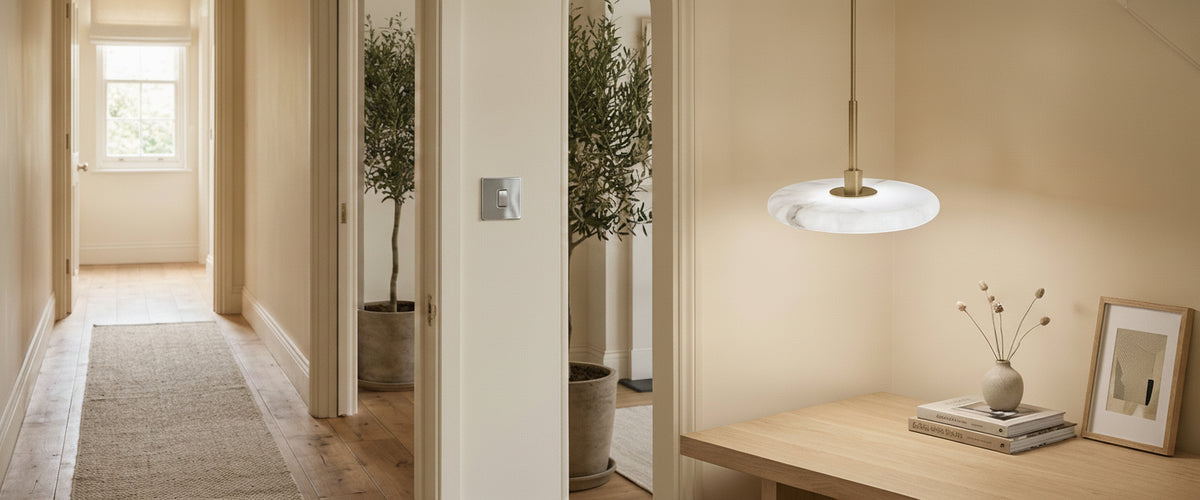

The pendants are hung, the paint has cured, the stone has been sealed, and then a builder screws a thin white plate to the wall directly beneath a hand-carved alabaster wall light. That one detail can undo months of careful work. chrome screwless light switches sit in the same category as door ironmongery and skirting profiles: nobody praises them when they are right, and everybody notices them when they are wrong. They are also, mercifully, one of the cheapest corrections available before handover.
Niori sells alabaster and natural-stone lighting, so we spend our days looking at how surfaces reflect light. Switch plates enter that conversation more often than people expect, because they are the metal your hand touches every day and the metal that sits closest to eye level.
![13A 2G DP Switched Socket with Dual USB-C [65W DUAL FASTCHARGE] - Brushed Chrome](https://cdn.shopify.com/s/files/1/0729/8993/3835/files/1982870_2d869fa1-d1c2-44cc-acb4-2c21ce616536.jpg?v=1747074745&width=800&height=800&crop=center&format=jpg)
At a Glance
- Screwless means a two-part plate: a mounting frame fixes to the back box and a fascia clips over it, hiding every fixing. Listings often shuffle the words to “chrome light switch screwless”; the construction is the same either way.
- Polished chrome is cool and mirror-bright. Brushed chrome (often sold as satin) is softer and far kinder to fingerprints.
- Chrome reads blue-ish next to warm 2700K light. Alabaster and honey-toned stone can look slightly yellow beside it, which is either a deliberate contrast or an accident.
- Plate thickness and edge machining separate good plates from cheap pressings. Ask about material gauge and how the fascia clips.
- Confirm gang count, two-way switching, dimmer type and back-box depth before ordering. A 25mm box rarely takes a dimmer module.
- Always use a qualified electrician. Electrical work in the home falls under Part P of the Building Regulations in England and Wales, and some of it is notifiable.
![13A 2G DP Switched Socket with Dual USB-C [65W DUAL FASTCHARGE] - Brushed Chrome](https://cdn.shopify.com/s/files/1/0729/8993/3835/files/1982874_a745291a-616e-4945-94f3-e1074af37271.jpg?v=1747074742&width=800&height=800&crop=center&format=jpg)
Why the Switch Plate Is the Detail Most Schemes Get Wrong at the Very End
Switch plates are ordered late because they feel like a commodity. By the time someone remembers them, the budget is tight, the electrician wants them on site tomorrow, and a generic box of white moulded plates arrives. Six months later the client is standing in a beautifully lit hallway wondering why it still looks like a rental.
Screwless plates fix a specific visual problem. Two exposed screw heads create a small horizontal line that your eye reads as machinery. Remove them and the plate becomes a clean rectangle of metal, far easier to sit next to refined joinery or a stone-shaded wall light. Chrome screwless light switches take that a step further by adding reflectivity, so the plate picks up the colour of the room rather than sitting on it as a flat white blank.
There is a practical gain too. A clipped fascia lifts off for decorating without disturbing the mounting frame, which matters in managed apartments and hotel rooms where walls are repainted on a cycle.
Polished or Brushed: How the Same Finish Reads Under Warm and Cool Light
Chrome is an electroplated finish rather than a solid metal, and the plating decides how chrome screwless light switches behave optically. Polished chrome is close to a mirror. Under a cool downlight it looks crisp and slightly clinical. Under a 2700K bulb behind alabaster it does something more interesting: it borrows the warmth of the light and softens considerably, while still throwing a bright specular highlight along its edge.
Brushed chrome scatters that highlight across fine directional grain. It reads greyer, quieter and more architectural, and it is the sensible choice anywhere hands land constantly, since fingerprints disappear into the grain instead of sitting on the surface like a signature.
One studio observation worth passing on: when we photograph alabaster pendants, a polished chrome surface anywhere in frame is usually the second brightest thing in the shot after the fixture itself. That is fine in a bathroom or dressing room. In a low-lit dining room it pulls attention off the ceiling piece you spent months choosing, so brushed chrome usually wins where the room is dim by design.
The Rooms Where Chrome Screwless Light Switches Sharpen the Finish
Chrome earns its place where the palette already contains cool tones or reflective surfaces.
Bathrooms and Shower Rooms
Chrome tapware is still the default in British bathrooms, and matching the switch or pull-cord plate to the brassware is the easiest coordination win available. Marble and honed limestone sit comfortably alongside it, and beside an alabaster wall light polished chrome plates pick up the same glow without competing. Where the mirror wall wants a fitting in the same metal rather than a contrast, a pair of wall lights such as the Mona 2 Light Wall Light in polished chrome keeps tapware, plate and fixture within a single finish family, which is far easier to hold together than three near-matches.
Kitchens with Stainless Steel or Grey Stone
Next to stainless appliances, quartz worktops or a grey marble splashback, chrome disappears into the scheme in the best way. Brushed chrome is the safer specification here, because kitchen walls take more contact than any other room in the house.
Hallways, Stairwells and Utility Spaces
Circulation spaces benefit from a plate that catches a little light, especially where wall lights are spaced along a run. If you are pairing switches with a run of stone wall lights, browse the alabaster lighting collection first and let the plate finish follow; the fixture is the bigger commitment.
Where Chrome Fights the Palette
Cool chrome struggles against deep oak panelling, terracotta, unlacquered brass and warm cream plaster. In a sitting room built around walnut, aged brass and a honey-veined alabaster chandelier, a polished plate reads as a cold interruption. A client in an Edinburgh townhouse ordered chrome throughout for consistency, then swapped every plate in the drawing room for a warmer finish within a fortnight. The hallway chrome stayed. Consistency across a whole house matters less than consistency within a sightline.
Plate Depth, Construction and Fascia Fit
Budget chrome screwless light switches expose themselves here. A cheap plate is thin steel with plating run over an unfinished edge; run a fingertip along it and you feel the sharpness. A good plate has machined edges, an even radius, and plating that wraps the corners without pooling.
- Material gauge: heavier plates sit flatter against uneven plaster and resist flexing when you press the rocker.
- Fascia clip mechanism: ask whether the fascia clips with sprung tabs or lugs, and whether it comes off without marking. A plate that needs levering with a blade will get scarred.
- Rocker and module alignment: on multi-gang plates, misaligned rockers are the giveaway. Look at photographs of a four-gang unit rather than a one-gang.
- Total build depth: the mounting frame sits behind the fascia, so the assembly needs more room than a flat single plate.
- Standards compliance: household switches sold in the UK are made to British and European standards such as the BS EN 60669 series. If a supplier cannot tell you which standard a product meets, that is your answer.
Anti-microbial fascias are worth knowing about for clinics, treatment rooms and hospitality back-of-house, though they are more commonly offered in white than in metal. The 10AX 1 Gang 2-Way Wide Rocker Anti-Microbial Switch in white screwless is the usual form it takes: the same two-part construction and wide rocker action, carried on a wipeable non-metal fascia.
Pairing Chrome Switches with Nickel and Brass Without the Scheme Turning Clinical
Mixed metals work when there is a hierarchy. Choose a dominant metal for the fixtures, a secondary metal for ironmongery, and let the switch plate follow one of them rather than introducing a third.
Chrome and polished nickel are close cousins, and that is exactly the problem. Nickel is warmer and slightly softer in tone; side by side on the same wall, the pairing looks like a mistake rather than a decision. Keep them in different rooms, or commit to one.
Chrome and brass can work beautifully, but only with distance and intent. A brass-collared alabaster pendant over a dining table and chrome plates by the door is fine, because they never share a sightline. Brass wall lights with chrome plates directly beneath them is not. Where chrome dominates, the plate decision becomes straightforward: a bright polished ceiling piece such as the Noviel Sputnik Pendant 12 Light in chrome sets the tone and the plate simply follows it. If you are still choosing fittings, view the metal options across the wider lighting range before you lock the switch finish.
Alabaster is the useful mediator. Its light output is warm and diffuse enough to soften cool metals in the same space, which is why chrome screwless light switches can hold up in rooms that would otherwise reject them outright.
Gang Count, Dimmer Compatibility and Back-Box Depth: Your Pre-Order Checklist
Before ordering chrome screwless light switches, walk the plan with the drawings in front of you and work through the following.
- Count gangs per position, not per room. Mark every switch drop with how many circuits it controls.
- Confirm one-way or two-way. Any light controlled from two doorways needs two-way switching at both ends. Stairs and long hallways almost always do.
- Measure back-box depth. UK metal boxes commonly come in 25mm (1 in) and 35mm (1.4 in). Dimmer modules and screwless mounting frames usually want the deeper box.
- Match the dimmer to the load. Most LED drivers, including those in stone pendants and wall lights, want trailing-edge dimming. Check minimum and maximum load in watts; two small LED fittings can fall below a dimmer's minimum and flicker. Trade bodies such as the Lighting Industry Association publish compatibility guidance.
- Check the fitting is dimmable at all. An integrated LED with a non-dimmable driver will not become dimmable because you bought a dimmer.
- Decide on rocker style and edge profile. Flat plate, square edge and rounded edge all read differently against a skirting or architrave line.
- Order sockets in the same family. A screwless chrome plate beside a mismatched white socket is worse than plain plates throughout.
- Order two spares. Ranges change, and a single replacement three years later rarely matches.
- Book the electrician early. Installation should be carried out and certified by a qualified electrician.
Keeping Chrome and Stone Looking Right
Chrome plating is hard but thin. Warm water, a drop of mild detergent and a soft cloth is the whole routine. Abrasive creams, bleach-based sprays and limescale removers left sitting on the surface will dull or pit the plating, and damaged plating cannot be polished back. Dry after cleaning in hard-water areas, or you will fight water spots forever.
The same restraint applies to the stone above it. Alabaster is a soft gypsum-based material and dislikes water; dust it with a dry brush or microfibre cloth and never use a household spray on it. Cover the fitting before you spray anything nearby, because overspray from a mirror cleaner is one of the most common causes of surface marking we hear about, and it is entirely preventable.
Chrome screwless light switches done well go unmentioned, which is the point. Done badly they are the first thing a designer sees. If you are still building the scheme around a stone pendant or a pair of carved wall lights, start at Niori, settle the fixtures, then let the switch finish follow the room rather than the invoice.