
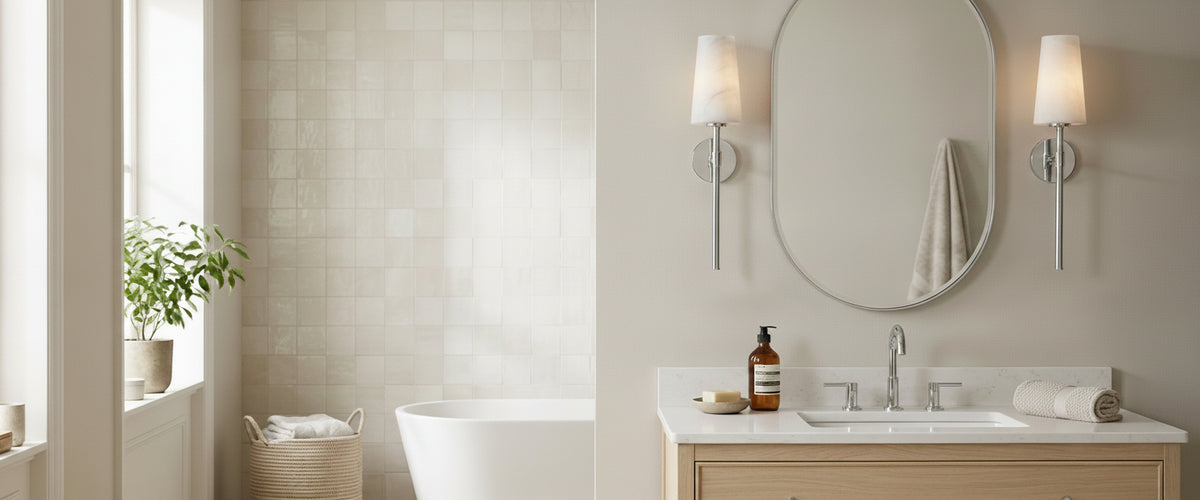

Chrome photographs beautifully and behaves badly. In a catalogue shot it reads clean, cool and quietly expensive; at 7am on a wet Tuesday, in a room with three reflective surfaces and one small window, the same fitting throws hard specular highlights straight back at you. chrome bathroom wall lights are among the most bought and most misjudged fittings in a British home, mostly because buyers choose the finish from a thumbnail and worry about the light afterwards. Reverse that order and the room changes.

Key Takeaways
- Finish first, then form. Polished plating amplifies contrast; brushed or satin chrome softens it and hides water spotting far better.
- IP ratings are zone-specific, not room-specific. A fitting beside a basin mirror sits under different rules to one above a bath.
- Height beats wattage. Fittings flanking a mirror at roughly eye level do more for a face than a brighter fitting mounted too high.
- Diffusion is the fix for glare. Alabaster, opal glass or marble shades tame chrome's hard edge without dulling the metal.
- Get the spec sheet checked. IP rating, zone suitability, lamp type, dimmability and driver location all need confirming before installation by a qualified electrician.

Why Chrome Reads So Differently Against Wet-Room Tiles
Chromium plating is a mirror. That is its whole personality. Brass diffuses a little warmth back into the room and pewter absorbs light; chrome returns almost everything it receives, including your tiles, your towel rail and the window opposite. In a bedroom that is a pleasant sparkle. In a bathroom, where gloss ceramic, a glass screen, a mirror and polished stone sit within two metres of each other, the reflections compound.
This is why a bathroom can feel cold even when the tiles are warm grey. Nothing in the room is absorbing light. The correction is not to abandon the metal; it is to break up the reflective run with one matt or translucent element. A pair of chrome bathroom wall lights with alabaster or opal shades does exactly that: crisp plating at the back plate and arm, soft light where it lands. We shipped alabaster-shaded fittings to a Georgian townhouse conversion in Bath last spring, where the owners had already laid full-height Carrara. Their first attempt was bare-bulb chrome and the room read like a showroom; a stone shade dropped the contrast and the marble finally looked like marble rather than a light source.
Polished Versus Brushed Chrome Under a Warm Bulb
Type bathroom wall lights chrome into a search bar and you get a wall of near-identical thumbnails. The differences that decide the room, finish, IP rating, projection, rarely show up in the photograph.
Polished chrome is bright, slightly blue in tone and unforgiving of limescale. Every splash from a basin tap eventually leaves a mark, and in hard-water regions across the South East and Midlands you will wipe more often than you expect. It suits period bathrooms with white sanitaryware, chrome taps and a black-and-white floor, where the shine is part of the language.
Brushed or satin chrome scatters light rather than mirroring it. Fingerprints and water spots disappear into the grain, and under a warm 2700K lamp the metal takes on a faintly pewter-like softness that flatters skin. If the room is used for shaving or make-up, brushed is usually the better call. Reserve high polish for decorative positions: a run down the corridor to an en suite, or above a guest cloakroom mirror.
Where you do want polish, keep the mirror-bright metal to the frame and let stone carry the light. A two-light fitting such as the Mona 2 Light Wall Light in Polished Chrome works on that principle. Cool plating and warm alabaster also balance each other, which is why we keep chrome and nickel detailing in the alabaster lighting collection rather than defaulting to brass on everything.
IP Zones Beside a Mirror: What the Numbers Restrict
British bathroom lighting is governed by the zones set out in BS 7671, and the numbers restrict less than most buyers assume. Zone 0 is the interior of the bath or shower tray and demands immersion-rated fittings on low voltage. Zone 1 runs above the bath or shower to 2.25m and typically requires IP44 as a minimum, with IPX5 where water jets are used for cleaning. Zone 2 extends 0.6m horizontally beyond Zone 1 and around a basin, where IP44 is the working standard. Beyond those zones there is no blanket requirement, though a splash-rated fitting is still sensible near a basin. Confirm the framework and any amendments through the IET's wiring regulations guidance, and have the installation signed off by a qualified electrician working to Part P.
In practice, a mirror over a basin in a family bathroom usually sits in or adjacent to Zone 2, so chrome bathroom wall lights need to be IP44 rated at minimum. A cloakroom with no bath or shower has no zones at all, which is why decorative, unrated fittings appear there so often. Many bathroom chrome wall lights are sold on looks alone and rated for general interior use only; moving one into a Zone 2 position is not a judgement call to make yourself.
The Mounting Height and Spacing That Make or Break Morning Light
Ceiling downlights above a mirror do one thing reliably: they cast shadow into the eye sockets and under the chin. Wall fittings at the sides fix it, and the geometry matters more than the lumen output.
- Height to centre: around 1.6m to 1.7m (roughly 5ft 3in to 5ft 7in) from finished floor level, adjusted to the height of the people using the room.
- Spacing: for a pair flanking a mirror, 750mm to 900mm (about 30in to 36in) apart is a common working range, with the fittings just clear of the mirror edge.
- Single fitting above a mirror: mount so the source sits above eye line but angles down onto the face rather than the top of the head.
- Projection: check how far the fitting stands off the wall. In a narrow ensuite, a deep arm at shoulder height becomes something you walk into.
Scale should follow the mirror. Beside a slim cloakroom mirror the standard size holds its proportion; against a wide double vanity, a bigger body such as the Mona 2 Light Large Wall Light in Polished Chrome keeps a flanking pair from looking undersized. For a Victorian terrace ensuite in Leeds, the mirror was 1400mm wide and the first plan put the chrome bathroom wall lights hard against the frame. Moving each one out by 60mm removed a reflected hotspot in the glass entirely. Small distances, large difference.
Pairing Chrome with Stone, Metro Tile and White Sanitaryware
Chrome and metro tile pair easily because both are cool, glossy and slightly clinical; the risk is a room that reads like a well-appointed public convenience. Introduce one natural material with visible variation, honed marble on a vanity top, a travertine shelf, or an alabaster shade, and the eye has somewhere irregular to settle.
Against grey-veined marble, polished plating disappears politely. Against warm limestone or travertine, brushed sits more comfortably than polished, which can look like a mistake next to a beige floor. Where the stone leans genuinely warm, consider the same silhouette in a warmer metal, as with the Mona 2 Light Wall Light in Polished Brass. With white sanitaryware and no stone at all, chrome bathroom wall lights carrying translucent shades become the warm element in the scheme, which is useful in north-facing rooms that never get direct sun.
A word on alabaster. It is a gypsum stone and soluble in water over time, which is why conservation guidance treats it as an interior material needing dry conditions; Historic England's building materials guidance is clear on that sensitivity. In a well-ventilated bathroom, away from direct spray and dried after steam, alabaster performs well. In a small unventilated shower room, choose marble, onyx or opal glass instead.
Bulbs, Colour Temperature and Dimming
Most chrome bathroom wall lights with stone or glass shades take G9 or small E14 lamps. Choose 2700K for soft domestic warmth, or 3000K if the room doubles as a grooming space and you want cleaner definition. Anything above 3500K tips into hospital territory quickly.
Look for a colour rendering index of 90 or above; low-CRI lamps make skin look grey, and a chrome-and-white bathroom offers nowhere for that to hide. If you want dimming, confirm the lamp, driver and switch are compatible as a set before ordering, and remember that dimmer switches are generally not permitted inside bathroom zones. The control usually sits outside the door or on a pull cord specified by your electrician.
What the Spec Sheet Must Confirm Before Installation
Before chrome bathroom wall lights go up, get these confirmed in writing:
- IP rating and the zone the fitting is approved for
- Overall projection from the wall and back plate dimensions
- Lamp cap type, maximum wattage and whether a lamp is included
- Dimmable or non-dimmable, and driver location if integrated LED
- Finish description: polished, brushed or satin, and whether it is plated or coated
- Shade material and whether replacements can be sourced later
- Fixing method and whether the wall build-up (tile over board) needs specific anchors
- Whether the fitting is class I (earthed) and the earthing arrangement required
Care is refreshingly simple. Wipe the metal with a soft damp cloth and dry it immediately; skip abrasive creams and anything acidic, which attacks plating over time. Stone shades want a dry microfibre cloth and nothing else. Never spray cleaner directly at a fitting, and switch off at the circuit first.
Chrome earns its place in a bathroom when it is treated as a frame rather than a light source. Get the finish right for the way the room is used, put the fittings where they do something for a face, confirm the zone rating with your electrician, and let a diffusing shade do the softening. Browse the wider lighting range to see how chrome, brass and stone behave alongside each other, and ask for a tailored quote if you are specifying a whole scheme; cost depends on material, scale, engineering and installation rather than any fixed list.