
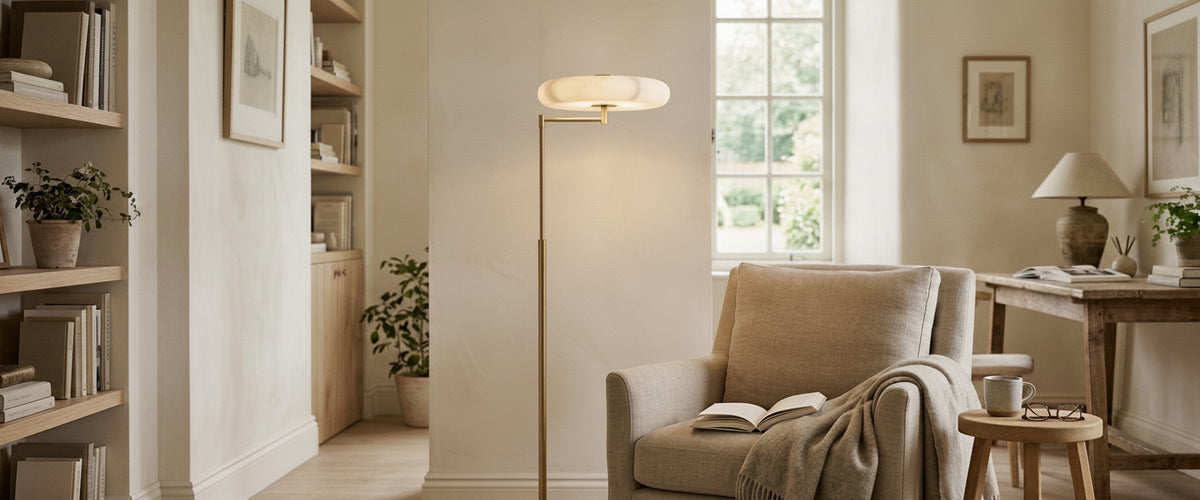

Most people shop for a shade floor lamp by studying the base. Slim brass stem, weighted marble foot, arc or straight. Then the lamp arrives, the switch goes on, and the corner still looks flat. The reason is almost always the shade. A shade floor lamp is a light-shaping device with a stand attached, and the shade is the part that decides whether you get a warm pool of light you want to sit inside or a hard bright disc that bounces off the ceiling and flattens everything below it.

Key Takeaways
The shade sets the mood. Material, opacity and open or closed top matter far more than the stand's silhouette.
Size by relationship, not by instinct. A full-height floor lamp shade usually measures around 40 to 50cm (16 to 20in) wide; short reading lamps take less.
Bottom edge at seated eye level. Roughly 100 to 115cm (40 to 45in) from the floor keeps the bulb hidden.
Translucent stone behaves differently from fabric. Alabaster glows across its whole surface rather than throwing light only up and down.
Measure three things before buying a replacement floor lamp shade: top diameter, bottom diameter and slant height, plus the fitting type.

Why the Shade Sets the Room and the Stand Merely Holds It Up
Think about what a shade floor lamp actually does. It sits at roughly the same height as a standing person, which means its light source lands in the exact band of the room your eye scans most. Anything glaring at that height is uncomfortable, and anything too shielded makes the lamp decorative rather than useful. The shade is the only component negotiating between those two problems.
Fabric shades work by blocking sideways light and directing it up and down. Stone and glass shades work by transmitting light through the material itself, so the shade becomes a soft luminous object in the room rather than a screen. That difference is why a shade floor lamp in translucent alabaster reads as ambient light while a linen drum reads as task light with a bit of spill. Both are useful. They are not interchangeable.
The clearest way to see it is to swap one for the other on the same stand. Put an opaque black drum on a shade floor lamp in a high-ceilinged room with dark timber and the corner behaves like a black hole: light goes up into nothing, down onto the floor, and the middle stays dead. Swap to a translucent shade and you have added no extra watts, but the corner gains depth, because the shade itself becomes a soft light source instead of a lid.
Opaque, Translucent and Open-Topped Shades at Floor Level
Three floor lamp shade behaviors cover almost everything on the market, and each one carves the room differently.
Opaque Shades
Lined card, dense fabric or metal. Light escapes only from the top and bottom apertures, producing two clean cones and a dark band across the middle. Excellent for reading, precise beside an armchair, and rather severe as the only light in a room. Dark linings such as gold or bronze warm the downward beam noticeably. A dense black drum at 35 x 25cm, such as the Curino Large Round Fabric Lampshade, is the clearest expression of this behavior on a lower stand: crisp light up and down, and a deliberate dark band at seated eye level.
Translucent Shades
Alabaster, onyx, opal glass, unlined linen or parchment. The whole surface lights up, giving you glow plus spread. Alabaster is the most interesting of the group because its natural mineral veining varies in thickness, so the surface lights unevenly in a way that looks like candlelight rather than a lightbox. This is the floor lamp shade type that makes a room feel occupied.
Open-Topped Shades
Most drums and empires are open at the top, which sends a strong wash onto the ceiling. In a room with a 2.4m (8ft) ceiling and white plaster, that uplight bounces back generously and softens everything. Under a dark-painted or beamed ceiling it disappears, and you will need the shade to do more work sideways. Check your ceiling color before you commit to an uplight-heavy shade floor lamp.
Linen, Alabaster, Glass and Metal Compared
Choosing the material for a shade floor lamp is really choosing how much of the light you want to see and how much visual weight the lamp should carry when it is switched off.
Linen and cotton: warm, forgiving, familiar. Wide spread at top and bottom, dim body. Light in weight, which suits slim stems. Fabric fades and yellows over years, particularly in a south-facing bay window.
Alabaster: the warmest diffusion of any material we work with. Light travels a short distance into the stone and scatters, so the surface glows amber-white with visible veining. Substantial in appearance even unlit, which makes it a genuine sculptural object during the day. Heavier, so the base and fixings must be engineered for it.
Onyx and figured marble: more dramatic banding, stronger color, often more contrast between dense and translucent zones. Better as a feature piece than as neutral background light.
Opal and alabaster-effect glass: even, predictable diffusion with no variation. Cleaner and more modern in feel, less character.
Metal: pure directional light and strong graphic presence. Perfect over a reading chair or a desk corner, poor as ambient light. Watch heat at the shade edge with older lamp types.
If you are weighing a fabric shade floor lamp against a stone one, ask what the corner needs. A room already rich in soft light sources can take a crisp opaque drum. A room that goes dead after sunset needs something that glows. Niori builds around the second answer: our alabaster lighting collection exists because translucent stone gives a warmth that fabric can imitate but never quite reproduce. Alabaster has been carved for lamps, windows and reliefs for centuries precisely because it passes light so kindly, something you can see in the carved alabaster panels held by the V&A.
What Size Lamp Shade for a Floor Lamp? Getting Proportion Right
This is where most shade floor lamp purchases go wrong, and the fix is a set of relationships rather than a single magic number.
Diameter: for a standard shade floor lamp of roughly 150 to 180cm (59 to 71in), a shade of about 40 to 50cm (16 to 20in) across looks right. Under 35cm (14in) on a full-height stand reads as a hat on a pole.
Height or drop: aim for the shade depth to be somewhere near one-quarter to one-third of the visible lamp height above the base. Too shallow and the fitting shows; too deep and the lamp looks bottom-heavy.
Bottom edge: keep it at 100 to 115cm (40 to 45in) from the floor so a seated person never sees the lamp source. Test it by sitting in the chair you actually use before deciding where the lamp lives.
Bulb clearance: the shade should extend past the fitting at the bottom, and the widest point of the bulb should sit comfortably inside it.
Room scale: a 45cm shade that looks generous in a Victorian terrace can look mean in a double-height extension. Scale up with the ceiling, not just the furniture.
Tapered profiles buy your floor lamp shade a little forgiveness at either end of that range. A shade measuring 36cm at the top and 40cm at the base with a 26cm drop, along the lines of the Willow Lampshade in white, sits at the lower edge of the full-height band while still balancing a slim stem, and the flare pushes more light down onto a reading position.
To measure an existing floor lamp shade for replacement, take three figures: top diameter, bottom diameter and slant height measured down the sloping side rather than vertically. Then identify the fitting. A spider fitting sits on a harp and takes a finial; a UNO fitting sits directly on the lampholder; a duplex uses a gimbal ring. Getting the fitting wrong is the most common reason a correctly sized shade still will not go on.
Corners, Arcs and Bedsides: Placement Changes Shade Behaviour
The same shade floor lamp performs differently depending on where it lands.
In a corner, two walls reflect back at you, so a translucent shade floor lamp gains brightness for free. This is the position where alabaster earns its keep: the stone glows, the walls carry that glow outward, and the corner stops being a void. Keep the lamp about 30cm (12in) clear of both walls so the shade is not scorching one plane.
Beside a sofa or reading chair, you want downward control. An opaque or lined floor lamp shade with a defined bottom aperture keeps light on the page and off the television. Position the lamp slightly behind the shoulder rather than directly beside the head.
Under an arc, the shade hangs over the seating rather than sitting next to it, so the bottom edge matters more than the diameter. An open-bottomed shade at 130 to 150cm (51 to 59in) above the floor lights a coffee table beautifully. Any lower and it glares at anyone who leans back, so check sightlines from every seat.
Not every corner wants one big shade floor lamp throwing a single cone. Where the room needs height and light scattered across several points, a multi-globe fixture such as the Global 3 Light Globe Floor Lamp at 170cm answers the same brief differently, spreading three small diffused sources through the space rather than concentrating everything behind one large drum.
In a bedroom, side matters. A shade floor lamp on the side you read from should shield the partner's side, which argues for a deeper, more enclosed shade. Pair it with proper dimming and you can drop the room to a low glow without switching to overheads. Browse the wider lighting range if you want the bedroom pieces to speak to the pendants and wall lights already in the room.
Construction Details That Separate a Good Shade from a Sagging One
Two shade floor lamps can look identical in a photograph and behave completely differently after a year.
Frame gauge and ring count. Large drums need a heavy top and bottom ring plus vertical struts, or the floor lamp shade slowly goes oval.
Lamination quality on fabric. Hand-rolled shades bonded to a styrene backing hold shape; cheap adhesives lift at the seam and show a visible ridge when lit.
Seam placement. A well-made shade has one discreet seam that you can turn to the wall. If you can see three, look elsewhere.
Stone thickness consistency. Alabaster and onyx shades are hand-worked, so wall thickness varies. Good makers keep that variation controlled; poor ones leave thin patches that appear as hot spots when lit.
Mounting hardware. Stone shades carry real weight. Look for machined brass collars and threaded fixings rather than glued joints.
Heat management. Enclosed shades need adequate air space around the lamp and an appropriate maximum wattage. Respect it.
Bulbs, Dimming and Wiring
Alabaster and stone want a warm source. We recommend LED lamps at 2700K for living rooms and as low as 2200K for bedrooms and snugs, with a color rendering index of 90 or above so the veining keeps its warmth rather than turning gray. Frosted or opal LEDs diffuse better inside a translucent shade than clear filament styles, which can print a bright spot onto the stone. Choose dimmable lamps and a trailing-edge dimmer matched to the load; guidance from the Energy Saving Trust is a useful starting point on LED efficiency and lifespan. If a shade floor lamp is being converted, rewired or hard-wired into a switched socket circuit, use a qualified electrician.
Buyer's Checklist
Decide the job first: ambient glow, reading task light or sculptural feature.
Choose shade behavior (opaque, translucent, open-topped) before choosing color.
Check the ceiling color if you are relying on uplight.
Confirm floor lamp shade diameter against total lamp height and room scale.
Sit down and check the bottom edge clears your eye line.
Measure top diameter, bottom diameter, slant height and fitting type for replacements.
Specify a warm, high-CRI, dimmable LED and a compatible dimmer.
Ask about base weight and cable routing if the lamp sits in a walkway.
Check care requirements: stone is not cleaned the same way as linen.
Living With a Stone Shade
Alabaster is a gypsum stone, softer than marble and sensitive to water. Dust it dry with a soft cloth or a clean makeup brush for carved edges. Do not use vinegar, bathroom sprays or anything acidic, and never soak it. Fabric shades are the opposite problem: they take a soft brush and a light vacuum on low suction, but they yellow with age and eventually want replacing. Stone does not yellow. Handled sensibly, an alabaster shade floor lamp outlives several rounds of upholstery, which is a fair part of the argument for buying one in the first place.
On budget: the cost of a stone shade floor lamp varies with the stone block, the size of shade being cut, hand-finishing time, metalwork and the engineering behind the base. A large, thin-walled stone shade takes far longer to work than a small one and carries more risk in production. Rather than guess, ask us for a tailored quote against your dimensions and finish.
Get the shade right and the stand becomes a supporting act, which is exactly what it should be. Start with what you want the light to do, then let the material follow. If you would like a considered starting point, the Niori range is built around alabaster and natural stone precisely because those materials turn a shade floor lamp into something the room notices even before anyone reaches for the switch.