
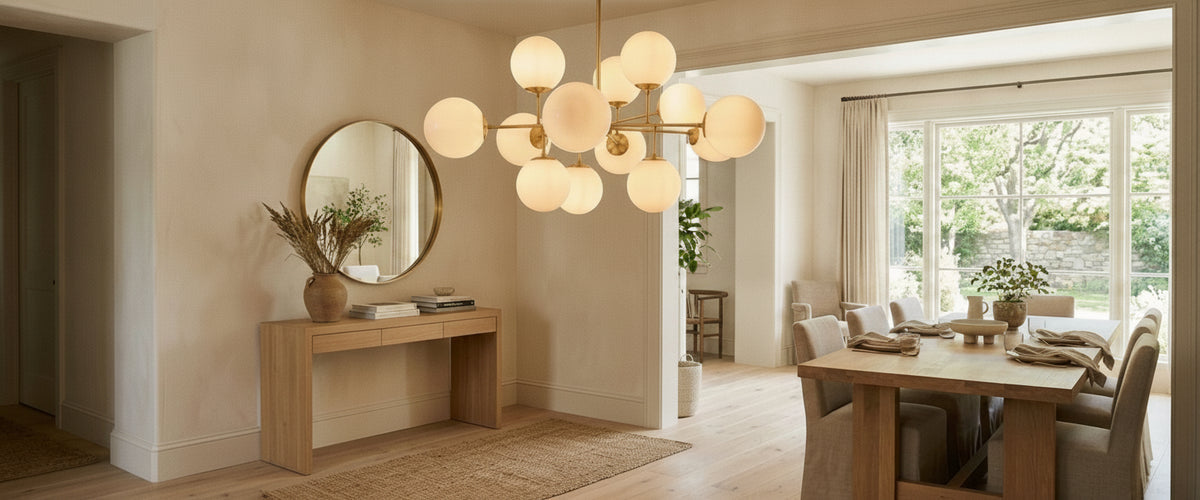

A glass globe chandelier is one of the easiest fixtures to buy badly. The form looks forgiving, all soft spheres and clean geometry, so buyers focus on the frame finish and the number of arms and forget the one thing that decides how the room feels at night: what the glass does to the bulb inside it. Get that wrong and you own a beautiful object that stings the eye every time you sit down to dinner. Get it right and the fixture does what alabaster does naturally, which is turn a hard point of light into something you can look at.

Key Takeaways Before You Shop
Enclosure changes everything. A glass globe chandelier wraps the bulb, so light leaves in every direction at once rather than being aimed down by a shade.
Clear glass shows the bulb. If the filament is visible, the filament becomes the design. Choose the bulb as carefully as the fixture.
Opal, seeded, smoked and ribbed glass all soften glare differently, and each shifts the color of the light in the room below.
Globe count is a scale decision before it is a brightness decision. More globes rarely means more usable light; it means more sparkle and more visual weight.
Dimming and color temperature matter more than wattage. Aim for warm, high-quality light on a compatible dimmer.
Cleaning glass chandelier globes is a routine job, and painting or waxing them is almost always a mistake.

How an Enclosed Globe Distributes Light Differently
Most chandeliers with open arms or fabric shades push light in a controlled direction. A candle-style arm throws upward and sideways; a drum shade cuts the sides and drops a pool onto the table. A glass globe chandelier does neither. It radiates a full 360 degrees, bouncing light off the ceiling, the walls, the backs of chairs and the glass in your windows.
That has two consequences worth planning for. First, a glass globe chandelier lights the volume of a room rather than a surface, which is why it looks so good in an entry hall and so mediocre as the only source over a kitchen island. Second, because the light source sits at eye level in many installations, glare control is entirely down to the glass. In a shaded fixture the shade protects you. In a globe, the sphere is the shade.
This is where the material conversation starts to matter. At the studio we spend our days with alabaster, which diffuses light through the stone body itself so the glow builds from within and the veining reads like a slow watermark. Glass is quicker and brighter; stone is softer and warmer. Plenty of projects want both in the same house, and clients often pair a glass globe chandelier in a stairwell with alabaster wall lights along the landing so the two register as one family of light rather than two competing ideas. You can see how that softer diffusion behaves across the alabaster lighting range.
Clear, Seeded, Smoked and Ribbed: What Each Glass Does to the Glow
The glass on a glass globe chandelier is not a single material decision. It is five, and each one lands differently once the switch is on.
Clear Glass
Sharp, jewel-like and unforgiving. Clear glass chandelier globes give you reflections and highlights, which is why they photograph so well, but they also give you a naked light source. Only choose clear if you are committing to a decorative bulb with a soft, warm filament and a dimmer that lets you run it low.
Opal and Frosted Glass
The safest choice for anywhere people sit for long stretches. Opal glass turns the bulb into an even luminous sphere, which is the closest a glass globe chandelier gets to the behavior of alabaster. It loses the sparkle, but it gains comfort.
Seeded Glass
Tiny trapped air bubbles break the light into a fine scatter. Seeded glass reads warmer than clear and hides a bright bulb better than people expect. We shipped a seeded glass globe chandelier to a dining room with a mirrored end wall, and the bubbles multiplied across that mirror into something far more atmospheric than a clear sphere would have managed.
Smoked and Bronze-Tinted Glass
Beautiful in daylight, dimmer at night. Smoked glass absorbs a real portion of the output, so budget for extra light elsewhere in the room. A smoked glass globe chandelier suits paneled rooms, dark joinery and evening spaces such as bars and studies.
Ribbed and Fluted Glass
Ribbing bends light into vertical streaks and gives a globe more presence when it is off. Its softening power sits between clear and seeded, and it flatters brass and bronze detailing.
Cluster Count Versus a Single Globe
The number of spheres on a glass globe chandelier should follow the architecture, not the room's function. A single large sphere suits a tight hallway, a cloakroom, or a spot where you want one calm gesture. Clusters of six, eight or more suit double-height volumes, stairwell drops and long dining tables where the eye needs something to travel across.
The failure mode is a mid-size cluster in a mid-size room with an eight-foot (2.4 m) ceiling. Every globe sits at head height, every globe reflects in every window, and the fixture starts competing with itself. If your ceiling is standard height, choose fewer, larger globes or a linear arrangement that follows the table rather than spreading in all directions. Where a long rectangular table is the anchor, a fixture such as the Giro 6 Light Linear Globe Glass Chandelier keeps the light running along the axis of the table instead of pushing it out into the circulation space around it.
For dining, a good working rule is to allow roughly 30 to 36 inches (76 to 91 cm) between the tabletop and the lowest point of the fixture, and to keep the overall width comfortably narrower than the table so nobody meets a glass sphere with their forehead when they stand. In double-height spaces, hang the lowest globe so it is visible from the floor below and from the landing above; a wide multi-globe drop on the scale of the Estro 8 Light Globe Glass Chandelier, 160cm only earns its diameter when it reads from both levels, and a glass globe chandelier that reads from the ceiling alone is money spent on nothing.
Rooms Where a Glass Globe Chandelier Works Hardest
Entry halls and stairwells. The natural home. The 360-degree spread fills a vertical volume, and a cluster reads as sculpture from several floors at once. In a narrower hall where a wide spread would crowd the walls, a tighter three-globe cluster such as the Atom 3 Light Globe Glass Chandelier holds the same design language at a workable diameter.
Dining rooms. Excellent, provided you add a second layer. Globes light the room, not the plates. Wall lights or a discreet downlight over the center line of the table do the task work.
Living rooms. Works when the fixture is treated as decoration and the real light comes from lamps. A glass globe chandelier plus one alabaster table lamp beside a sofa gives you both sparkle and a low warm anchor.
Bedrooms. Choose opal or seeded. Nobody wants a visible filament in their sightline from a pillow.
Kitchens. Fine over a breakfast table, weak over a work surface. Task lighting under the cabinets is still doing the heavy lifting.
Bathrooms. Only with the correct rating for the zone and a qualified electrician signing off on the installation.
Hospitality clients ask about this constantly, and the honest answer is that a glass globe chandelier belongs in circulation spaces and lounges rather than over restaurant tables where guests look up. If you are comparing formats across a whole project, the wider lighting collection makes it easier to see pendants, chandeliers and wall lights side by side before you commit to a scheme.
Bulb Choice and Fitting Position
This is the internal decision that tips a glass globe chandelier from warm to clinical, and it takes about thirty seconds to get wrong.
Color temperature: stay at 2700K or below. 3000K starts to feel commercial inside clear glass, and anything higher turns a decorative fixture into a utility fitting.
Color rendering: look for a high CRI. Skin tones, timber and stone all suffer under low-quality LEDs, and glass does nothing to hide it. The US Department of Energy's guidance on LED lighting is a useful primer on what the numbers on the box actually mean.
Shape and position: in clear glass, center the bulb in the sphere. A bulb sitting low in the globe puts the brightest part of the filament right in the eyeline of anyone seated.
Dimming: confirm the driver or lamp is compatible with your dimmer before installation. Mismatched pairs flicker at low output, and flicker is far more obvious in a room full of reflective spheres.
Consistency: use identical bulbs across every globe. One replacement of a slightly different tone is visible from across the room.
Caring for Glass Chandelier Globes
Glass dulls quietly. Dust builds as a film, output drops, and a glass globe chandelier looks tired long before anyone works out why.
Switch off at the wall and let the bulbs cool completely.
Dust with a dry microfiber cloth first, working around the sphere rather than across it.
For fingerprints, dampen the cloth with warm water and a trace of neutral detergent. Wring it almost dry; liquid should never run toward a lamp holder.
Dry immediately with a second clean cloth to avoid water spotting.
Keep metal polish, ammonia sprays and abrasive creams away from painted or plated frames.
Conservation bodies such as the American Institute for Conservation make the same point about historic glass: gentle, dry, repeated cleaning beats occasional aggressive cleaning every time. That rule matters even more for our natural-stone pieces, where alabaster should only ever meet a dry soft cloth and never a wet one, since the stone is porous and marks easily.
A Short Buyer's Checklist
Measure ceiling height and drop before you look at anything.
Decide whether you want sparkle (clear, seeded, ribbed) or calm (opal, alabaster, frosted).
Check whether the bulb will be visible, and buy the bulbs at the same time as the fixture.
Confirm dimmer compatibility with your electrician.
Plan a second light layer so the glass globe chandelier never has to do everything.
Ask about weight and mounting requirements for multi-globe clusters; heavier fixtures need proper support above the ceiling.
Ask about replacement globes and spares before ordering, not after a breakage.
For custom sizing or finishes, ask for a quote rather than an estimate. Glass, scale, metalwork and finishing all move the price.
Niori works mainly in alabaster, marble and onyx, with glass and brass detailing, and the reason we keep returning to stone is simple: it forgives. Stone diffuses without needing the right bulb, the right dimmer and the right seating position to look good. Glass rewards precision. Choose it knowingly, plan the bulb, and a glass globe chandelier will carry a room for decades. Browse the full range from the Niori homepage if you want to compare stone and glass in the same project.