
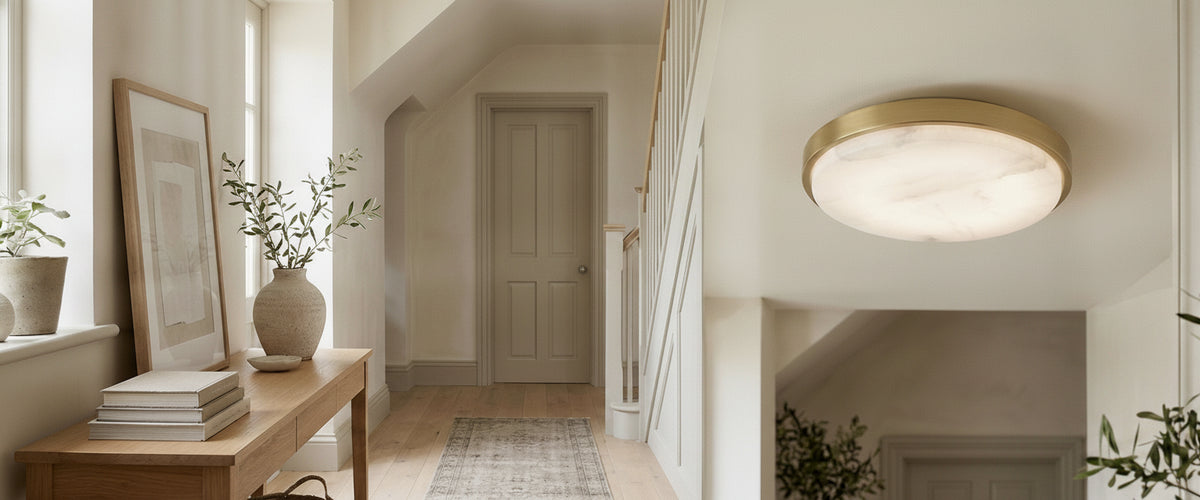

Most rooms that need a brass flush mount do not have the ceiling height to argue about it. A 2.2 metre landing, a top-floor corridor under the eaves, a bathroom where anything with a drop becomes a head injury waiting to happen. The fitting has one job: to light the space properly without announcing that the ceiling is low. Get the finish, diameter and diffusion right and nobody notices the compromise. Get them wrong and the brass flush mount becomes a dinner plate that glares at everyone walking underneath.

At a Glance
- Finish drives mood. Antique brass absorbs light and warms it, brushed brass diffuses reflections, polished brass throws them straight back at you.
- Shade material drives comfort. Alabaster and opal glass soften the source; clear glass and fabric behave very differently at close range.
- Sizing rule: add the room's length and width in metres, multiply by roughly 8 for a sensible shade diameter in centimetres.
- Clearance rule: keep at least 2.1m (about 7ft) of headroom under a brass flush mount in any walkway.
- Bathrooms need an IP rating and a qualified electrician, not a decorative fitting borrowed from a hallway.
- Cost tracks material and scale, not fitting type: metal quality, shade material, diameter and driver specification are what move the figure.

Antique, Satin, Polished: How the Brass Finish Changes the Light
Brass is not a single colour. An antique or aged brass has been chemically darkened, so it swallows some of the light that hits it and reflects back a low, amber warmth. It suits period properties, dark paint colours and rooms lit mostly after dark. A brushed or satin brass sits in the middle: the fine grain of the finish scatters reflections instead of mirroring them, which is why it photographs well and why it stays looking calm under daylight from a landing window.
Polished brass is the one that catches people out. On a ceiling directly below a rooflight, or in a hallway with recessed downlights nearby, a mirror-polished backplate picks up every bright point in the room and reflects it as a hard highlight. We have seen it go wrong in a converted warehouse stairwell with a glazed roof: the fitting looked immaculate in the studio and behaved like a small sun at three in the afternoon. Brushed brass solved it without changing anything else about the design. Where daylight is unpredictable and the backplate of a brass flush mount sits in view from below, a grained finish such as the Gemini Brushed Brass Flush Ceiling Light, 42.5cm keeps the metal reading as warm tone rather than a bright reflection.
There is also the question of what happens over years rather than weeks. Unlacquered brass develops a patina, which is a genuine oxide layer rather than dirt. Museum conservation guidance on caring for metals makes the point that over-polishing removes material every time, so if you like the look of aged metal, buy it aged rather than trying to hurry a lacquered piece along. Lacquered brass holds its colour, needs only a dry microfibre cloth, and is the sensible choice for a bathroom or a busy family hallway.
Shade Material and Diffusion at Low Ceilings
At 2.9m the shade is scenery. At 2.2m the shade of a brass flush mount is directly in your field of vision, and the material decides whether the light feels comfortable or clinical.
Alabaster. Stone is the most forgiving diffuser at close range. Light travels a short distance into the crystalline structure and comes back out spread and warmed, with the veining showing as soft shadow rather than pattern. A carved alabaster disc in a slim brass frame gives you glow rather than glare, which matters enormously when the fitting sits a metre above head height. It is the reason so many of the pieces in our alabaster lighting collection read as luminous objects rather than light sources.
Opal and etched glass. Consistent, clean and slightly cooler in character than stone. Good for utility spaces and bathrooms where you want even output and easy wiping down. It lacks the depth of natural stone, which some buyers prefer and some find flat.
Clear or ribbed glass. Beautiful with a decorative filament, punishing with a bright LED. If the lamp is visible from below, expect glare unless the output is modest and dimmed.
Fabric. Warm, quiet, absorbs a good deal of light and casts most of it downwards. Fine in a bedroom, poor in a windowless corridor where you need the ceiling to bounce some light back.
Hallway, Landing, Bathroom: Where a Brass Flush Mount Earns Its Ceiling Space
Entrance halls. This is the natural home for a brass flush ceiling lights. Coats swing, doors open inward, and the last thing you want is a pendant in the arc of a front door. Warm brass against a dark hallway colour gives an immediate sense of arrival, and a stone shade keeps the light kind on faces at the mirror.
Landings and stairwells. Ceiling heights on a landing are often lower than the rooms leading off it, and the fitting is seen at eye level from the stairs below. Diffusion matters more here than anywhere else in the house. Two smaller brass flush mounts along a long landing usually beat one large one; a single central light leaves the ends of the corridor in shadow. Where the run is too narrow to take two discs, a slim linear form such as the Oracle Brass Slim Flush Ceiling Light 3000K, 150cm spreads light along the length of the corridor instead of pooling it in the middle.
Bathrooms. A brass flush mount works well over a bath or in a shower room where a drop fitting is not permitted, provided the IP rating suits the zone it sits in. UK installations follow BS 7671, and the IET's wiring guidance is the reference your electrician will be working from. Never treat a bathroom light as a DIY job; use a qualified electrician who can certify the work.
Bedrooms and dressing rooms. Excellent as ambient light with the switching split so the flush fitting handles general illumination and lamps do the rest. Alabaster shines here because the light it throws at low dim levels stays warm rather than sliding grey.
Why a Brass Flush Mount Fails in Certain Rooms
The most common mismatch is a tall room. Above roughly 2.7m, a brass flush mount stops feeling deliberate and starts looking like a compromise the ceiling did not need. The light source is too far from the task surfaces, the void above the fitting reads as empty, and the room loses the vertical anchor a pendant or chandelier would have given it. In a double-height hallway it is simply the wrong tool.
The second failure is a dining table. Flat, high, ambient light flattens food, faces and glassware. Dining wants a low, concentrated pool of warm light, which means a pendant or a stone chandelier, not a ceiling-hugging disc. If a low ceiling rules out a drop, a semi-flush with a shallow stem and a stone diffuser is the better compromise.
Third is the kitchen worktop. A single central brass flush mount puts you between the light and your chopping board, so you work in your own shadow. Perimeter or under-cabinet lighting has to do that job, with the flush fitting supplying background light only.
Watch for one more mismatch: hardware clash. Brass reads beautifully with warm woods, plaster pinks, deep greens and unlacquered taps. Against cool grey schemes with chrome or brushed nickel ironmongery, it can look like a leftover from a different project. Hold a sample against the door handles before committing.
Diameter, Depth and the Sizing Calculation That Actually Works
To size a brass flush mount, add the room's length and width in metres and multiply by about 8. A 3m by 4m hallway gives 7, so a shade around 56cm (roughly 22in) is proportionate. Stock sizes rarely land exactly on the number, so round to the nearest one that fits the space: 42cm, 61cm and 81cm bracket most real rooms sensibly. For a hallway of those proportions, a 61cm disc such as the Gemini Brushed Brass Flush Ceiling Light, 61cm sits comfortably within the calculation rather than fighting it. Narrow corridors are the exception. Never let the fitting exceed about a third of the corridor width, or it will look wedged in.
For depth, the number that matters is the clearance underneath, not the drop itself. Keep 2.1m (about 7ft) clear in any circulation route. On a 2.3m ceiling that leaves you roughly 20cm (8in) of fitting depth, which is true flush territory. At 2.4m to 2.6m a shallow semi-flush becomes possible and often looks better, because the small gap between shade and ceiling lets light wash upward and stops the ceiling reading as a lid.
Weight is the quiet constraint with natural stone. Alabaster and marble are considerably heavier than glass of the same size, so a large stone flush fitting may need fixing into a joist or a supporting batten rather than plasterboard alone. Confirm the fitting weight with us before your electrician books the day, because it changes the fixings they bring.
Specification Checks Before Any Brass Flush or Semi-Flush Order Is Confirmed
- Measure the finished ceiling height, after flooring and any skim, not the builder's drawing.
- Confirm the brass finish in person or from a sample, and decide lacquered or unlacquered based on the room's humidity and traffic.
- Check the ceiling construction and the fixing method for the fitting's weight.
- Match the colour temperature to the room. Around 2700K to 3000K for halls, landings and bedrooms; 4000K only where the space is genuinely task-driven, such as a utility room or a workshop.
- Confirm dimming compatibility. Integrated LED versions need a driver matched to the dimmer, and mixing brands is where flicker comes from.
- Check the IP rating against the bathroom zone, and confirm your electrician is certifying to current UK regulations.
- Order the same finish family across the room so wall lights, switch plates and the brass flush mount agree with each other.
- Ask for a tailored quote once size, shade material and driver specification are settled, since those are what move the figure.
Living With Brass and Stone
Care is undramatic. Dust the metal with a dry microfibre cloth; skip anything abrasive or ammonia-based, which strips lacquer. Alabaster and marble are porous, so keep water and household sprays away from the stone entirely and lift dust off with a soft dry brush. If a shade needs more than that, ask us rather than experimenting.
A brass flush mount is a specification decision more than a styling one. Height, clearance, diffusion and finish do the work; the aesthetic follows once those are right. If you are weighing a flush fitting against a shallow semi-flush or a compact pendant for the same ceiling, browsing the wider niori lighting range side by side is usually quicker than debating it on paper. We ship alabaster and natural-stone lighting worldwide, and we would rather talk through a tricky landing before you order than after.