
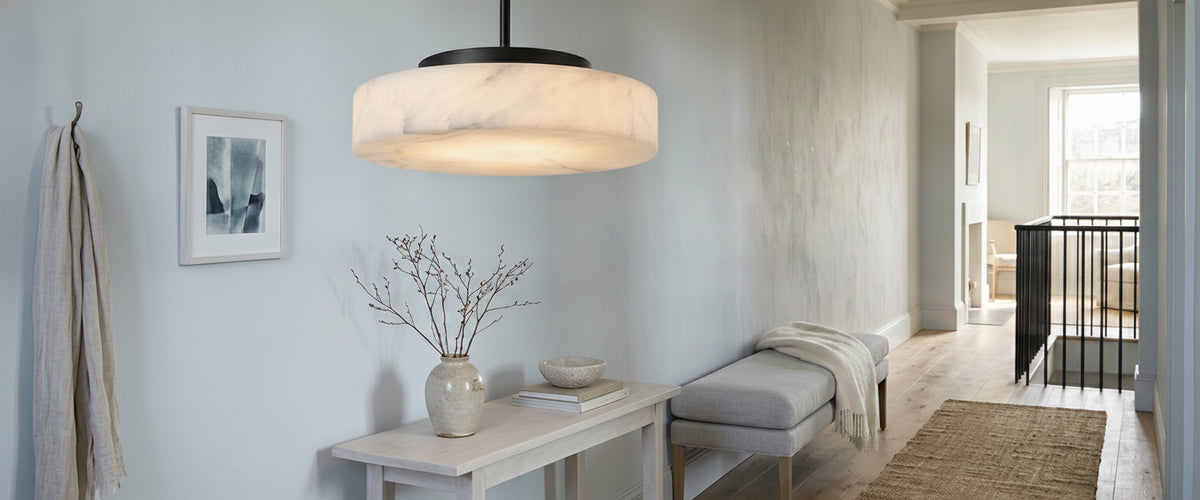

Black ceiling lights are the fastest way to give a pale, freshly plastered room some spine. They are also the fastest way to deaden it. A dark fitting reads as a solid object against the ceiling rather than a glowing shape, which means scale, drop height and the material sitting inside the shade carry more weight than they would with a white or polished brass fixture. Buyers rarely regret the colour. They regret choosing something too small, hung too high, with nothing luminous at its centre.

At a Glance: Black Ceiling Lights in Six Lines
- They anchor, they do not illuminate on their own. Plan a second and third light layer in the same room.
- Go one size up. Dark fixtures visually shrink; a black shade looks smaller than a pale one of identical diameter.
- Matt absorbs, gloss reflects. Matt black is quieter and more forgiving; gloss and lacquered black pick up highlights and feel more formal.
- The interior finish decides the mood. A black shade with a warm interior, or an alabaster diffuser inside a blackened frame, throws light instead of swallowing it.
- Dim everything. Contrast lighting only works when you can pull the level down at night.
- Pair with stone, not more metal. Alabaster, marble and onyx soften dark metalwork better than another brushed steel surface will.

What Black Ceiling Lights Suit, and Who They Are For
Dark fittings do their best work in rooms with plenty of light-coloured surface area to push against. Limewashed walls, oak floors, pale linen, plaster ceilings. In those spaces a black ceiling lights behaves like punctuation. It gives the eye something to land on and stops a neutral scheme drifting into blandness.
They suit period homes where the joinery, ironmongery or window frames already carry black, and they suit warehouse conversions and new-build extensions where the architecture is confident enough to hold a graphic shape. Hospitality clients like them for the same reason: a row of dark pendants over a bar reads clearly from the door and photographs well without needing to be enormous.
Where a dark fitting struggles is in small, low, already dim rooms finished in mid-tone colours. A north-facing box room with grey-green walls and a 2.3 m (7 ft 6 in) ceiling does not need a dark disc floating overhead. In that situation a translucent stone fitting with a black or bronze collar gives you the same discipline without the heaviness. That is often the compromise we end up recommending when a client sends photographs of a compact landing or a basement kitchen.
Sizing, Height and Placement That Works
Scale errors cause more disappointment than anything else. Because dark objects recede less and read as mass, a black fitting has to be generous to look deliberate rather than accidental. In a wide open-plan room where a pendant would simply float, a genuinely large flush disc such as the Cardona LED Round 62cm Ceiling Light, Matt Black holds the ceiling plane in a way that a 30 cm fitting never will.
Over a Dining Table
Aim for a fixture roughly one third to one half the width of the table. A 90 cm (35 in) wide table sits comfortably under a 35 to 45 cm (14 to 18 in) shade; a long refectory table usually wants either a wide linear fitting or two or three matched pendants spaced evenly. Hang the base around 75 to 85 cm (30 to 33 in) above the tabletop. Higher than that and the pool of light spreads thin; lower and tall guests will duck.
Kitchen Islands and Runs
Space multiple pendants by their own width or a little more, and keep the outer fittings at least 30 cm (12 in) in from the island ends so the composition does not look crowded. Islands are where downward glare gets punished, because you are standing over the worktop, not sitting beneath it. Choose a shade with a diffuser or an opaque lower rim.
Hallways, Landings and Bedrooms
Keep 2.1 m (7 ft) of clear headroom under any hanging fitting in a circulation space. Below that, a flush or semi-flush black ceiling light is the sensible answer, and a low-profile round like the Ascari LED Round Ceiling Light, Matt Black keeps the graphic dark outline without eating into headroom. On a stairwell, hang the pendant so it is visible and pleasing from both the lower and upper landing rather than centring it purely on plan. In bedrooms, resist a heavy central fitting directly over the bed; the view from a pillow is unforgiving.
One more placement note. Black ceiling lights sit against the ceiling plane, so any wobble in the plasterwork or a rose that is 4 cm off centre becomes obvious. Check the true centre of the room against the ceiling joists before anyone drills, and have a qualified electrician confirm the fixing and the circuit. The Society of Light and Lighting publishes useful guidance on lighting levels and layering if you want a technical reference point for a larger project.
Materials, Finishes and Light Quality
"Black" covers a wide range in practice. Powder-coated matt black is the workhorse: even, low sheen, good at hiding fingerprints, and it recedes politely in a busy room. Textured or sand-cast black has a slight grain that catches light along its edges and feels more crafted. Blackened or patinated brass carries warmth under the darkness and shifts colour as the light changes through the day, which is why it ages more gracefully than flat black in a room with a lot of natural light. Gloss black and lacquered finishes are the most formal and the least forgiving; every smear shows.
The finish you can see is only half the decision. What sits inside the fitting determines whether the room feels lit or merely decorated. Where a room needs a soft, spread glow rather than a hard downlight, an opal glass shade held in a dark frame, as on the Clarimo LED Glass Ceiling Light, Matt Black, is closer to the right design language than an open-bottomed dark shade. This is also where natural stone changes the equation. Alabaster is mildly translucent, so a slab or bowl of it glows from within rather than acting as a bright point source, giving the warm, honeyed diffusion that no frosted acrylic really imitates. Set that inside a black or bronze frame and you get the graphic outline people want from black ceiling lights, plus light that flatters skin and timber. If you want to see how the material behaves across pendants, flush fittings and chandeliers, the alabaster lighting collection is the clearest place to compare forms.
Darker stones behave differently again. Nero Marquina marble and black onyx are dense and largely opaque, so they work as sculptural bodies, collars and bases rather than as diffusers; light escapes around them instead of through them. Backlit onyx panels are the exception, and they need careful engineering to avoid hot spots. Honey and vein-cut alabaster remains the material of choice when the goal is glow rather than silhouette.
Bulbs, Dimming and Colour Temperature
Specify warm. Between 2400K and 2700K suits alabaster and dark metal; anything above 3000K turns warm stone slightly grey and makes matt black look dusty. Look for a colour rendering index of 90 or above so veining reads properly and food on the table looks like food. Every dark fitting in a living or dining space should be on a dimmer, and the dimmer module must be matched to the LED driver, or you will get flicker at low output. Where a fitting takes visible lamps, choose a shape that suits the shade opening and check whether the lamp will be seen from a seated position.
Common Mistakes and How to Avoid Them
- Buying one light to do everything. A single dark pendant in the middle of a ceiling produces a bright island and dim corners. Add wall lights, a table lamp and a floor lamp on the same dimming scheme.
- Choosing too small. If you are hesitating between two diameters with a black fitting, take the larger one.
- Mixing five different blacks. Matt black pendants, gloss black handles and a warm black window frame rarely agree. Pick two black tones for a room and stick to them.
- Forgetting the view from below. Open-bottomed dark shades expose the lamp, the driver and the dust. Check the underside in the photographs before you buy.
- Ignoring ceiling height. Semi-flush and flush versions exist for a reason. A drop pendant in a 2.3 m room is a head injury waiting to happen.
- Wet-cleaning alabaster. Gypsum alabaster is soft and water-sensitive. Museum conservation practice for stone objects favours dry dusting and controlled handling over washing, and the same logic applies at home; see the Smithsonian's Museum Conservation Institute for background on stone care.
A Quick Buying Checklist for Black Ceiling Lights
- Measure ceiling height, and note it against the required clearance for the room's use.
- Measure the table, island or hallway width and calculate the target fixture diameter.
- Decide matt, textured or patinated, and check it against the ironmongery already in the room.
- Confirm what the light passes through: alabaster, glass, a diffuser, or nothing at all.
- Choose 2400K to 2700K, CRI 90 or above, and a dimmer matched to the driver.
- Plan the second and third light layers before you order the ceiling fitting.
- Confirm fixing points, ceiling weight loading and installation with a qualified electrician.
- Ask about lead times and finishing options if the piece is made to order.
Care That Keeps the Contrast Sharp
Matt black powder coat wants a dry microfibre cloth and nothing abrasive. If a kitchen fitting picks up grease film, a barely damp cloth followed immediately by a dry one is enough; solvents will dull the finish permanently. Patinated brass will lighten slightly where hands touch it, which most people come to like. Polished marble and onyx take a soft dry cloth and no acidic cleaners, ever.
Alabaster deserves its own routine. Dust it with a soft dry brush or cloth, keep it away from steam and splashing, and never let a cleaning spray reach it. In our studio the pieces that come back looking tired are almost always the ones somebody tried to clean properly with a wet cloth. Left alone and dusted, alabaster holds its glow for decades.
How Niori Can Help With Lighting Projects
Niori works in alabaster and natural stone, so our advice on black ceiling lights tends to be about balance: where the dark metalwork should sit, and where a translucent stone element should take over so the room still feels warm at night. That balance is easier to judge with real measurements in front of us. Send ceiling heights, table dimensions, wall colours and a couple of photographs, and we will tell you what will work and what will fight the room.
Designers, architects and venue owners can talk to us about scaling a design across a scheme, matching finishes between pendants, wall lights and floor lamps, and coordinating drop heights across rooms with different ceiling heights. Browse the full lighting range to see how forms translate between pendants, chandeliers and flush ceiling fittings, then ask for a tailored quote. Cost depends on material, scale, complexity, engineering, installation and finishing, so a considered quote is more useful than a headline figure.