
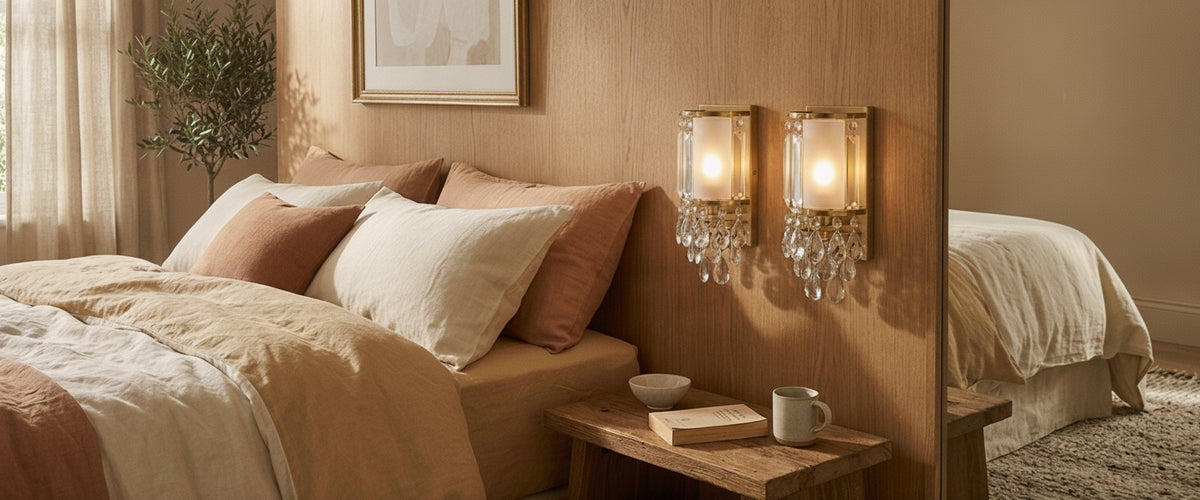

Crystal is designed to break light apart and fling it around a room. That is exactly what you want above a dining table and exactly what you do not want 40cm (16in) from your pillow. Most disappointing bedroom crystal wall lights are not badly made; they are badly placed, badly dimmed, or fitted with a bulb that turns every facet into a pinprick of white light on the ceiling. Get the height, diffusion and dimming right and the same fitting becomes the calmest thing in the room. Everything below is about making bedroom crystal wall lights behave like candlelight rather than a camera flash.

Key Takeaways
Height matters more than looks. Aim to keep the brightest part of bedroom crystal wall lights above or below seated eye level in bed, never level with it.
Bare crystal needs a hidden source. A visible filament behind faceted glass creates hard sparkle and reflected glare on headboards, mirrors and glazing.
Warm and dimmable, always. 2700K or lower, high color rendering, and a dimmer matched to the driver or lamp.
Cut quality decides longevity. Hand-cut lead crystal and good optical glass keep their edge definition; soft pressed glass looks tired sooner.
Consider stone as the quieter alternative. Alabaster and marble give a soft internal glow with none of the scatter, which is why so many schemes end up pairing stone with bedroom crystal wall lights rather than choosing one or the other.

Why Crystal Behaves Differently in a Bedroom
A bedroom is the only room in the house where you regularly look at your lighting from a lying-down position. Every other room is judged standing or sitting upright. That single fact changes everything about how crystal bedroom wall lights should be specified, because a fitting that reads beautifully as you walk past it can sit directly in your line of sight when you settle back against the pillows.
Crystal also multiplies whatever you feed it. Cut glass refracts and splits light, and lead crystal does it more strongly than ordinary soda-lime glass because the lead oxide content raises the refractive index and lets the cutter take deeper, crisper facets. The trade body British Glass sets out how those compositions differ, and the effect is easy to see: the better the optical quality, the sharper the sparkle. In bedroom crystal wall lights, sharp sparkle means bright specular points bouncing off a lacquered headboard, a mirrored wardrobe door or a television screen.
Bedrooms are also darker overall. Your eyes adapt to low light in the evening, so contrast becomes uncomfortable much faster than it would in a bright hallway. A crystal sconce running at full output next to a dark wall is a small floodlight surrounded by shadow. The fix is rarely a different fitting; most bedroom crystal wall lights simply need a lower mounting position, a lower output and a properly matched dimmer.
Mounting Height Around the Bedhead
The centimeters here decide whether you love the fitting or squint at it. Three positions work for bedroom crystal wall lights in most rooms:
Reading height, mounted low. Roughly level with the top of the headboard or a little above it, so light lands on the page and the source sits below the eyeline of someone sitting up in bed. This suits shaded or partially enclosed bedroom crystal wall lights best.
Decorative height, mounted high. Around 1.5m to 1.6m (about 5ft to 5ft 3in) from the floor, the classic sconce line. This puts the fitting above your seated eyeline and turns it into a soft glow on the wall rather than a reading light. Pair with a table lamp for actual reading.
Flanking a mirror or dressing area. Slightly above eye level for a standing adult, spaced wide enough to light the face from both sides rather than from directly overhead.
Scale follows from that decision. At reading height beside a headboard, a compact fitting such as the Astro 1 Light Glass Wall Light, 25cm keeps the light close to the page without projecting into the walkway, while a wider two-light version like the Astro 2 Light Glass Wall Light, 40cm reads better on a broad dressing wall where it has room to spread. A fitting that is too generous for a narrow bedside gap is the most common reason well-chosen bedroom crystal wall lights end up feeling wrong.
Two practical points that cost people money. First, decide the headboard height before the electrician sets the back boxes, because a tall upholstered headboard swallows a low sconce and leaves you with a warm patch of fabric and no usable light. Second, if there is glazing or a mirror on the opposite wall, sit on the bed and look at the reflected position. We had a client in a Georgian conversion near Bath who specified a pair of faceted crystal wall lights for the bedroom beautifully, then found the mirrored wardrobe doors opposite gave them four fittings instead of two, all of them in view at bedtime. Moving the sconces 15cm lower and switching to a fitting with a fabric shade solved it without changing the design intent.
Wiring and back box positions for bedroom crystal wall lights are work for a qualified electrician following the current wiring regulations. Mark centers on the wall with masking tape and check them from the bed before anything is chased into plaster.
Shade Versus Bare Crystal: When Diffusion Earns Its Place
Bare crystal is the point of crystal. Cover it entirely and you have paid for optics you cannot see. The question with bedroom crystal wall lights is where the light source sits, not whether the crystal is visible.
Bare crystal works when the lamp itself is concealed. Look for fittings where the light enters the crystal from behind a metal cup, a stone body or an opal inner diffuser, so what you see is glowing glass rather than a naked filament. Frosted, opal or satin-finished lamps help enormously. A clear candle lamp behind clear cut glass will always produce hard sparkle, and that is where most bedroom crystal wall lights lose people.
A shade earns its place when bedroom crystal wall lights sit at reading height, when the room has a lot of reflective surfaces, or when the occupants are light sleepers who use wall lights late. Silk, linen and parchment shades keep the crystal drops visible below the shade line while cutting direct glare towards the bed. Half-shades and back plates that throw light up the wall are another route to the same result. Where the bedhead wall needs a wash of light rather than a visible bright point, an up-and-down fitting such as the Adriano LED Up Down Glass Wall Light is closer to the right design language, and it pairs well with faceted crystal placed further from the pillow.
There is a third option that we see specified more and more in bedroom schemes: swap the diffusing element for stone. Alabaster transmits light through its own body, so the glow comes from inside the material rather than off its surface. Put an alabaster wall light on the bedhead wall and your bedroom crystal wall lights on the dressing wall, and you get both moods without the glare problem. Our alabaster lighting collection exists largely because clients wanted crystal-level presence with candlelight behavior.
Which Crystal Cuts and Grades Hold Up at Home
Crystal quality shows itself over years, not in the showroom. A few markers are worth checking before you commit to bedroom crystal wall lights:
Cut and Finish
Hand-cut lead crystal has crisp edges, slight variation between drops and a polished, almost wet-looking surface. Pressed or molded glass has softer edges and visible mold seams, and it reads flatter once dust settles into the facets. Optical glass grades such as K9 sit between the two and perform well when the cutting is good.
Drop Design
Long faceted drops and pear shapes carry light down the fitting elegantly and are easy to wipe. Dense clusters of tiny beads look impressive on delivery and become a cleaning chore in a bedroom, where textile fibers and dust drift constantly. If you want a beaded fitting in a bedroom, accept that it needs attention two or three times a year.
Metalwork
Crystal is only as good as the frame holding it. Solid brass with an unlacquered or well-lacquered finish outlasts plated steel, and antique brass hides fingerprints better than polished. Check that drops hang from proper pins or rings rather than wire loops that can splay over time.
Repairability
Ask whether individual drops can be replaced. This matters far more for bedroom crystal wall lights than for reception-room fittings, because duvets, headboards and cleaning cloths all make contact with wall lights at that height.
Dimming Range and Colour Temperature After 9pm
A crystal wall light bedroom scheme lives or dies on its dimming. Crystal is unforgiving at full output, so it needs a control range that goes properly low rather than one that stalls at a stubborn 20 percent.
Specify 2700K as your ceiling and consider 2400K or a dim-to-warm lamp that drops towards 2200K as it dims, which mimics the way candles and incandescent lamps behaved. Color rendering matters too. Choose CRI 90 or better so skin tones, timber and bed linen look right rather than washed out. Evening light exposure has a measurable effect on sleep timing, and Harvard Health summarizes why bright, cool light late at night is worth avoiding in a bedroom.
On the hardware side, match the dimmer to the load. Mains-voltage LED lamps generally prefer trailing-edge dimmers; low-voltage fittings need a driver rated as dimmable and a compatible control. Ask before you buy rather than after, because flicker and buzz at low levels are the most common complaints we hear about bedroom crystal wall lights, and they are almost always a compatibility issue rather than a fault in the fitting. Put the bedhead wall lights on their own circuit so you can drop them to a glow while the rest of the room stays off. Browse the wider lighting range if you are building a layered scheme with pendants and table lamps on separate controls.
Buying Checklist for Crystal Bedroom Wall Lights
Sit on the bed and check sightlines before fixing back box positions for bedroom crystal wall lights.
Confirm headboard height and mattress depth first; both change the effective mounting height.
Decide whether the fitting is for reading or atmosphere, and light the other function separately.
Choose concealed or frosted lamps behind bare crystal; choose a shade if the fitting sits at eye level.
Check the metal is solid brass or similarly durable, and that drops are replaceable.
Specify 2700K or lower, CRI 90+, and confirm dimmer compatibility in writing.
Allow for a switched circuit at the bedhead, ideally with two-way control at the door.
Ask a qualified electrician to install and test, and keep the certification with your house paperwork.
Where scatter is a genuine worry, consider an alabaster or marble alternative on the bedhead wall.
Keeping Crystal and Stone Looking Right
Bedroom crystal wall lights want dry, gentle attention. Switch off, let the fitting cool, then wipe drops individually with a lint-free microfiber cloth. A barely damp cloth with distilled water lifts stubborn film; skip ammonia-based sprays, which attack lacquered brass and leave residue in cut grooves. Never spray liquid at a live or warm fitting.
Stone is a different discipline. Alabaster is a gypsum mineral, soft enough to scratch with a fingernail and porous enough to mark permanently if water sits on it, so dry dusting with a soft brush is the whole routine. Marble and onyx tolerate slightly more but still dislike acidic cleaners. That difference in care is worth knowing before you specify, and it is one of the questions we field most often at Niori, where alabaster and natural-stone lighting is the core of what we do. If you are weighing stone against bedroom crystal wall lights, the Niori collections are a useful place to compare how each material handles light before you commit to a scheme.
One last observation from the studio: bedrooms reward restraint. A pair of well-dimmed bedroom crystal wall lights with a shade, a stone table lamp on one side and nothing else on that wall will read more considered than four competing decorative fittings. Crystal is loud by nature. Give it space and it behaves beautifully.