
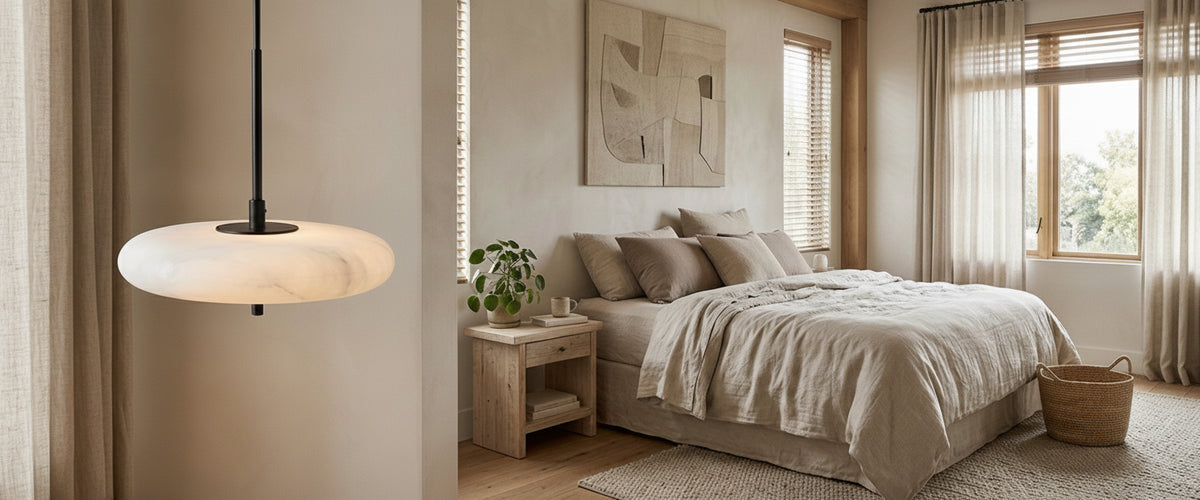

A bedroom chandelier above a bed has one job most people never test before buying: it has to look good from flat on your back, at eleven at night, with tired eyes. That single condition rules out half the fixtures shortlisted for bedrooms. Exposed filaments, mirror-polished metal and clear crystal all behave beautifully in a hallway and badly overhead. Bedroom chandeliers need diffusion built into the material rather than bolted on afterwards, which is exactly why alabaster and natural stone have quietly taken over this corner of the market.

Key Takeaways
Diffusion beats brightness. The best bedroom chandeliers use stone and alabaster to soften the source, so you never see a hot point of light from the pillow.
Size by room, not by bed. Add the room's length and width in metres, multiply by 10, and treat that as a starting diameter in centimetres.
Hang high enough to forget about it. Around 2.1m (7ft) of clearance in walking zones; you can go lower directly over a bed.
Dim it or regret it. Warm 2400K to 2700K lamps on a trailing-edge dimmer, CRI 90 or above.
Check the ceiling before the cart. Stone bedroom chandeliers weigh substantially more than glass and often need a joist or a proper support plate.

Who Bedroom Chandeliers Are For, and When to Skip One
Not every bedroom wants one. A low-ceilinged loft conversion with sloping eaves is usually better served by a pair of wall lights and a stone table lamp. But where the ceiling gives you height, a chandelier does something no other fixture manages: it fills the vertical space above the bed so the room reads as designed rather than furnished.
The rooms that benefit most from bedroom chandeliers are principal bedrooms in period properties with generous ceiling heights, new-build main suites where a flat plasterboard ceiling needs a focal point, and hotel and boutique guest rooms where the fitting has to photograph well and behave well. We ship a lot of stone pendants and chandeliers into hospitality projects for precisely that reason. Guests remember the light quality even when they cannot name what caused it.
Designers tend to specify bedroom chandeliers as the anchor of a three-layer scheme. The chandelier gives the room its shape and its low-level ambient glow. Wall lights or slim pendants either side of the bed handle reading. A floor lamp in the corner covers the space nobody thought about, usually the armchair by the window. Skip the layers and the chandelier ends up doing work it was never designed for, which is when people start complaining that it is too dim or too harsh.
Sizing and Hanging Height for Bedroom Chandeliers
Sizing bedroom chandeliers starts with arithmetic, so get that out of the way first. For diameter, add the room's length and width in metres and multiply by 10 for a sensible centimetre figure: a 4m by 5m room suggests something around 90cm across. The imperial version of the rule adds length and width in feet and reads the total as inches, which lands a little smaller. Treat either figure as a floor, not a ceiling. Under-scaling is the single most common error we see in photographs clients send us, and it makes an expensive fitting look apologetic.
Height is where bedrooms differ from dining rooms. In circulation space, keep the lowest point of the fixture at roughly 2.1m (7ft) from the finished floor so nobody tall clips it. Directly over a bed, you have more freedom, because nobody walks there. Bedroom chandeliers hung lower over the mattress give a more enclosing, canopy-like effect and bring the diffused glow closer to where you actually are. Just leave enough room to make the bed without knocking the stone, and think about whether anyone will ever stand on the mattress to change a bulb.
Placement is the third variable. Centring bedroom chandeliers on the room and centring them on the bed are frequently two different points, especially in older houses where the ceiling rose was set for a Victorian floor plan. Decide which line matters more visually, then commit. In a symmetrical room with the bed centred on one wall, align to the bed. In an irregular room, align to the ceiling and let the bed sit where it sits. Half-measures read as a mistake.
Form follows that decision. A round fixture wants a square-ish room and a centred bed; a bed pushed along a long wall, or a wide king footprint, is usually better answered by a linear bedroom chandelier that follows the mattress rather than fighting it, which is the logic behind something like Zaya 6 Light LED Linear Chandelier, Matt White. Where the ceiling is a plain plasterboard field and the bed is the obvious centre, Mandala 6 Light LED Round Chandelier, Matt White sits closer to the right geometry.
For rooms under about 2.4m (8ft), think of bedroom chandeliers as flush or semi-flush stone fittings rather than drops. A shallow carved alabaster dish that sits close to the plaster still gives you the material's glow without anyone ducking. You can browse form and proportion across the wider lighting range to see how drop lengths change the feel of a fitting at different heights.
Materials, Finishes and Light Quality
Alabaster is a fine-grained gypsum stone, soft enough to carve and translucent enough that light passes through the wall of the shade rather than only out of its opening. The CAMEO materials database from the Museum of Fine Arts, Boston is a good primer on how gypsum and calcite alabasters differ in hardness and workability, which matters more than most buyers expect: it dictates how thin a panel can be cut and therefore how much light it will pass.
In practice, thickness is the tuning dial. Thinner sections glow more openly and show veining as a warm amber tracery. Thicker sections read as solid ivory with light spilling from the edges. In the studio we hold offcuts against a lit lamp before a slab is committed to a fitting, because two blocks from the same quarry can behave completely differently once light gets behind them. That is also why no two alabaster bedroom chandeliers are truly identical, and why we prefer to describe pieces by character rather than by a color code.
Marble and onyx sit at the other end of the spectrum. Onyx has strong banded figuring that turns theatrical when backlit, which suits bedroom chandeliers built for a darker, heavier palette. Marble is generally more opaque and works best as structure and counterweight, in a base or a canopy, with alabaster or glass carrying the luminous parts. Brass detailing pulls all three together and warms the perceived color of the whole fitting, especially in an unlacquered finish that will age.
Glass has its place, but be honest about which glass. Clear glass with a visible lamp is unkind overhead. Opal or acid-etched glass diffuses well and costs less to freight than stone. What it does not give you is depth. Stone has thickness you can see into; glass has a surface. Where a darker scheme calls for a graphic frame and the glass is doing the softening, a bedroom chandelier such as Tarifa 6 Light Glass Chandelier, Matt Black is a fairer comparison than clear crystal. Compare the two lit side by side and the decision usually makes itself.
Bulbs, Dimming and Getting the Colour Right
The light from bedroom chandeliers should get warmer as the evening goes on. Aim for lamps at 2400K to 2700K and a color rendering index of 90 or above, so skin tones and timber both look right rather than washed gray. Higher CRI also does the veining a favour; poor-quality LEDs flatten the minerality that made you choose stone in the first place.
Specify dimming at the design stage, not after the electrician has left. Most LED lamps want a trailing-edge dimmer, and the combination of driver, dimmer and lamp needs to be checked as a set rather than assumed. Warm-dim lamps, which shift towards amber as they lower, are worth the extra outlay in a bedroom. If the room has a smart control system, put the bedroom chandelier on its own circuit so it can drop to a low glow while the bedside wall lights stay usable for reading. Where rewiring for a wall dimmer is not realistic, an integrated fixture with its own control, such as Ovela 6 Light LED Remote Control Chandelier, Matt White, avoids the compatibility guesswork entirely and lets you dim from the pillow.
One quiet detail: match the lamp position to the shade geometry. A lamp sitting too high inside a bowl leaves a bright band at the top and a dull base. Fixtures designed around stone usually account for this, but retrofitting a random LED with a different bulb length can undo it.
Common Mistakes and How to Avoid Them
Buying too small. The fitting looks enormous in a photograph and shrinks the moment it is up. Mock the diameter out on the floor with newspaper before ordering.
Ignoring the ceiling build-up. Plasterboard alone will not carry a stone bedroom chandelier. You need a joist, noggin or a properly engineered support, confirmed before delivery.
Forgetting the view from the bed. Find a photograph of the shortlisted fitting lit and shot from underneath. If you can see the lamp, you will see it every night.
No dimmer. Full output over a bed is an interrogation, not an atmosphere.
Over-cleaning the stone. Alabaster is water-sensitive and soft. Dry dusting is the default.
Treating it as the only light. Bedroom chandeliers set the mood; wall lights, table lamps and floor lamps do the tasks.
Leaving too little drop in a tall room. A 3.5m ceiling with a short stem leaves the fitting stranded near the plaster.
Installation and Care Checklist
Confirm the fixing point and structural support with your builder or electrician before the bedroom chandelier ships.
Use a qualified electrician for all wiring and connection work. In the UK, checking that your installer is registered with a competent person scheme such as NICEIC is a five-minute job worth doing.
Unpack stone components on a soft surface. Edges chip against hard floors.
Fit lamps with clean cotton gloves; finger oils show on pale alabaster and are stubborn to remove.
Dust with a dry, soft brush or lint-free cloth. Skip household sprays, alcohol and anything acidic.
For marks, use a barely damp cloth with distilled water and dry immediately. Never let water sit on the surface.
Keep the fitting away from direct radiator heat and steam. Bedrooms with en suites without extraction are the usual culprit.
Check the suspension and fixings every couple of years, and always after building work nearby.
How Niori Can Help with Your Lighting Project
Niori works with alabaster and natural stone as the starting point rather than a finish applied at the end, across pendants, chandeliers, wall lights, table lamps and floor lamps. For bedroom schemes, that usually means matching a bedroom chandelier to bedside pieces so the stone reads as one family through the room. Our alabaster lighting collection is the best place to see how veining and thickness change the character of a lit piece.
We ship worldwide and work with interior designers, architects, developers and hotel operators on projects where the same fitting has to repeat across many rooms with consistent quality. Bespoke sizing, alternative stones and adjusted drop lengths are all possible. Budget depends on the stone selected, scale, the complexity of the carving, engineering, installation and finishing, so the sensible route is a tailored quote rather than a guess from a category page. Send us plans, ceiling heights and a room elevation and we will come back with options.
If you are still comparing bedroom chandeliers and want to see the full spread of stone fixtures before narrowing down, start at the Niori homepage and work through by room.