
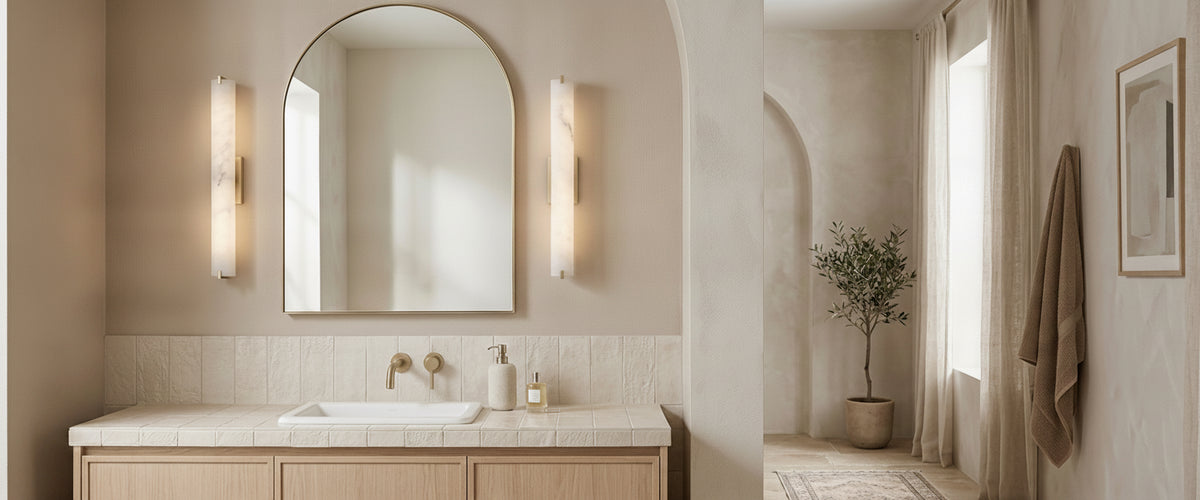

A bathroom is the hardest room in the house to light well and the easiest to light badly. Hard surfaces bounce every lumen back at you, mirrors double whatever you install, and a single downlight above the sink will carve shadows under the eyes of anyone standing at it. That is exactly why an alabaster wall light bathroom scheme works so well: the stone softens output before it ever reaches a face, and it does that without the flat, plastic quality of a diffuser panel. The catch is placement. Where you mount those alabaster wall lights decides whether the room flatters you or exposes you.

At a Glance
Mount in pairs, flanking the mirror, roughly at eye level rather than overhead. Cross-lighting kills under-eye shadow.
Check the IP rating against the zone, not against the room. Every alabaster wall light bathroom plan starts there, because a bathroom alabaster wall light half a meter from a shower has different demands from one across the room.
White or lightly veined alabaster stays neutral against cool tile; heavily veined stone reads warmer and busier when lit.
2700K, CRI 90 or higher, on a dimmer. Skin tones and stone both suffer under cold light.
Alabaster is gypsum, so it is sensitive to standing water and steam over time. Sealing, ventilation, and sensible placement matter.
Budget for an alabaster bathroom wall light depends on stone size, carving, metalwork, driver quality, and installation. Ask for a tailored quote rather than assuming a band.

What Steam and Reflective Tile Actually Do to Alabaster Light
Alabaster is a semi-translucent gypsum stone. Light does not pass through it cleanly; it enters, scatters through the crystalline structure, and leaves as a soft, warm wash. In a living room with fabric, rugs, and plaster walls, that glow gets absorbed and stays gentle. Put an alabaster wall light in a bathroom lined with polished porcelain, marble, and a large mirror, and the room hands the light straight back. Output that felt restrained in a bedroom can feel a full step brighter against gloss tile.
The practical response with any alabaster bathroom wall light is to specify lower lumen output than you think you need and put it on a dimmer. In a compact powder room finished in honed marble with a full-height mirror, halving the wattage you first had in mind is usually the right instinct. Reflective rooms do the amplifying for you.
Polished stone and glass hand light straight back, so an alabaster wall light bathroom scheme should run lower output than the room size suggests.
Steam is the other variable. Warm moist air condenses on cool surfaces, and stone is a cool surface. Repeated condensation on unsealed gypsum can dull the finish and, over years, leave faint watermarks. Gypsum is a soft, slightly water-soluble mineral, which is why alabaster carvings were historically kept indoors and away from wet conditions. For a bathroom alabaster wall light, good extraction, a sealed stone surface, and sensible distance from the shower head solve almost all of it.
Alabaster Wall Light Bathroom Zones: IP Ratings Decoded
The IP code is two digits. The first covers solids and dust, the second covers water. IP44 means protection against splashing water from any direction; IP65 means protection against low-pressure water jets. Those numbers are defined by an international standard rather than any single country's rules, and the IEC publishes the classification that manufacturers test against.
Most bathroom regulations divide the room into zones based on distance from the bath and shower, so every alabaster wall light bathroom layout should start with the zone the chosen wall position falls into. Inside the shower enclosure or directly above a bath, you need a sealed fitting with a high water rating. Immediately adjacent to those areas, splash protection is the usual minimum. Beyond that boundary, on a dry wall well away from the tub, standard indoor fittings are typically acceptable. Rules vary by country and by local wiring regulations, so treat this as orientation and have a qualified electrician confirm what applies to your project before anything gets wired.
This matters more than usual with stone. An alabaster wall light in a bathroom is often a low-voltage LED assembly with a driver, and where that driver sits (integral to the fitting, or remote in a ceiling void) affects both the rating and future maintenance. Ask before you buy. Ask also about the gasket and the back plate, because a fitting can carry a rating on paper and still be installed in a way that voids it. No alabaster wall light bathroom install is protected simply because the box said IP44, and a fixture screwed onto a tiled wall without the correct seal proves it.
Veined or White Alabaster? What Each Does Under Bathroom Light
Alabaster is not a single look. White or ivory stone with faint cloudy movement lights evenly and reads as a calm, luminous panel. It sits comfortably against cool grays, Carrara, and white tile without fighting them. If your bathroom is already busy with pattern, this is the safer alabaster bathroom wall light specification.
Heavily veined alabaster behaves differently. Those honey, amber, and caramel bands become far more visible when backlit, and the stone throws a warmer, more variegated glow. Against warm travertine or a limewashed wall, that is a genuine asset. In an alabaster wall light bathroom scheme built on cool blue-gray tile, it can look mismatched. Onyx pushes this further again, with dramatic banding and a stronger color cast, which suits a statement powder room more than a family bathroom used at seven in the morning.
Metalwork changes the read of an alabaster wall light in a bathroom too. Brushed brass warms the whole fitting and flatters honey-veined stone, which is why a piece like the Averin LED Alabaster Wall Light in Brushed Brass tends to suit travertine and warm limewash rather than a cool marble scheme. Satin nickel and matte black hold a quieter line and stop white alabaster from tipping yellow. If you are comparing finishes side by side, the alabaster lighting range is a useful way to see how the same stone shifts depending on the metal wrapped around it.
Mirror Position, Mounting Height, and the Sightline That Flatters
The single most common specification error with an alabaster wall light in a bathroom is putting all the light above the mirror. Overhead light drops shadows into eye sockets and under the nose and chin. Side light does the opposite. It hits the face horizontally, fills the shadows, and gives you an even wash for shaving or applying makeup.
Fittings set near eye height on either side of the mirror cross-light the face and fill under-eye shadow.
As a working rule for any alabaster wall light bathroom layout, mount the fittings so the center of the light source sits between 60 and 66 inches (152 to 168 cm) from the finished floor, near average eye height. Space them 28 to 40 inches (about 71 to 102 cm) apart, flanking the mirror rather than sitting far outside it. If the mirror is wide, bring the fittings in tight to its edges rather than pushing them to the far corners of the wall.
Vertical column-style alabaster fittings are especially good here because they distribute light along their length instead of concentrating it at one point. Where a vanity wall needs that even vertical wash rather than a single bright point, a slim column such as the Aurelian LED Alabaster Column Wall Light in Matte Black does the job a small sconce cannot. Carved sconces still earn their place, though they work better on the wall opposite the vanity or beside a freestanding tub, where they read as atmosphere rather than task light.
Why Symmetrical Pairs Beat a Single Fitting
One wall light next to a mirror lights half a face. That sounds obvious written down, and it still happens constantly, usually because a plumbing run or a window made the second position awkward. If a matched pair genuinely will not fit, put a single alabaster bathroom wall light on the side away from the window so daylight and lamplight balance each other, and add a soft ceiling source to fill the other side.
In a twin-basin alabaster wall light bathroom layout, three fittings usually beat two: one between the basins and one to the outside of each, rather than a single light centered over every bowl. For a bath alcove, a single larger fitting on the end wall gives a beautiful raking glow across the stone or tile without lighting the room like a task area; something with a generous stone face, such as the Caldera LED Alabaster Wall Light Large, carries that wall on its own where a small sconce would look stranded.
Placement Mistakes That Turn Soft Stone Into a Spotlight
Mounting too high. Above 70 inches (178 cm) you are back to overhead shadowing, with none of the benefit.
Ignoring the mirror's reflection. A fitting placed opposite a mirror appears twice. Stand where you will actually stand and check the sightline before drilling.
Over-lumening. Bright output through thin alabaster creates hot spots and shows every internal flaw in the stone. Lower output plus dimming is almost always better.
Mixing color temperatures. A 2700K alabaster bathroom wall light beside 4000K downlights makes the stone look dirty. Match everything.
Cheap dimming. Flicker and drop-out are driver and dimmer compatibility problems. Confirm the pairing with your electrician rather than assuming.
Fitting a wet zone with a dry-rated product. The most expensive alabaster wall light bathroom mistake on this list, and the easiest to avoid.
A Quick Specification Checklist
Confirm the zone your chosen wall position falls into and the IP rating your alabaster bathroom wall light needs there.
Choose stone character: white and even, or veined and warm, against your tile palette.
Pick metalwork that supports the stone tone rather than fighting it.
Set the mounting height at eye level and space fittings to flank the mirror.
Specify 2700K, CRI 90 or above, and confirm dimmer compatibility.
Ask where the driver sits and how it is accessed for future service.
Check the stone is sealed and ask for the maker's cleaning guidance in writing.
Have a qualified electrician handle the alabaster wall light bathroom installation and confirm local regulations.
Keeping Alabaster Looking Right in a Damp Room
Care for an alabaster wall light bathroom fitting is simple but non-negotiable. Dust with a dry, soft cloth. If you need more, use a barely damp cloth and dry the stone immediately afterwards. Never use vinegar, bleach, bathroom descalers, or anything acidic, because gypsum reacts badly to all of them. Keep spray cleaners away from the fitting entirely; overspray from a nearby mirror does more damage than steam.
Run the extractor fan during and for a good while after showering. Well-ventilated bathrooms rarely cause stone problems. Poorly ventilated ones cause problems for everything, from paint to grout to alabaster.
Specified properly, an alabaster wall light bathroom scheme does something no other fixture type quite manages: it gives a hard, wet, reflective room a genuinely soft light source with real material depth. If you are still weighing pendant, sconce, or ceiling options across a whole renovation, browsing the wider lighting collection at Niori is a sensible way to plan the scheme as one piece rather than room by room.