
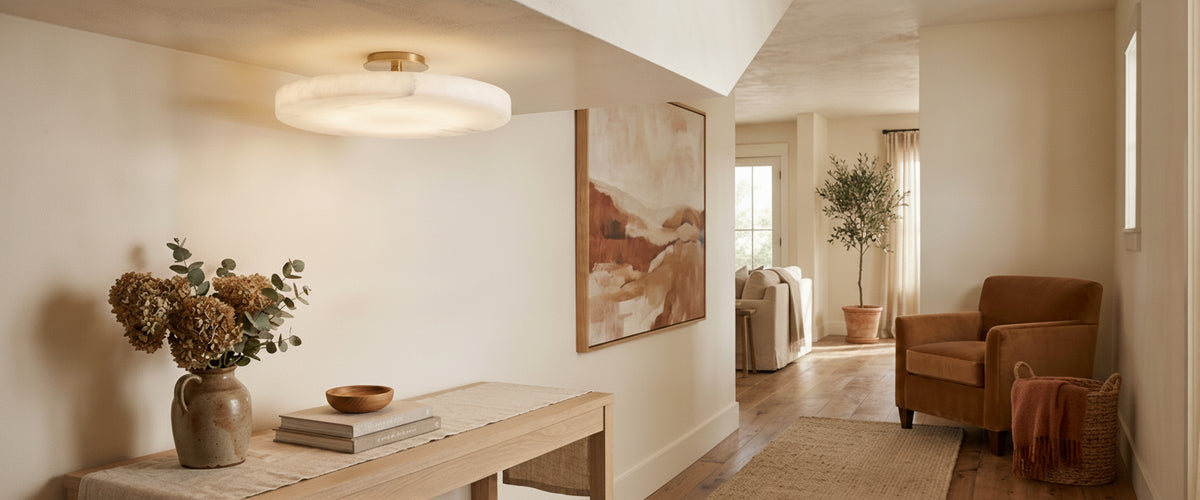

An alabaster semi flush solves a problem most ceiling lights ignore: what to hang in a room that will not take a pendant. Not every ceiling gives you the height for a hanging fixture, and a flat flush mount pressed against the plaster often looks like an afterthought. An alabaster semi flush sits in between, dropping a few inches so light can escape above the shade as well as below it. Done in stone, that small gap turns a functional ceiling light into something the eye actually wants to look at.

Key Takeaways
An alabaster semi flush hangs a few inches below the ceiling, giving you soft uplight and downlight where a flush mount gives you neither.
Alabaster diffuses the bulb into a warm, even glow instead of a hard bright spot, which suits low ceilings and close viewing.
It works best in hallways, bedrooms, kitchens, and bathrooms where ceiling height rules out a pendant.
Warm bulbs (around 2700K) and dimming are what let the stone glow rather than glare.
Budget for an alabaster semi flush depends on stone size, cut, and metalwork, so ask for a tailored quote rather than assuming a fixed price.

What a Semi Flush Does That Neither a Pendant nor a Flush Mount Manages
A pendant hangs on a rod or cable and needs headroom; anywhere under about eight feet (2.4 m) and people start ducking. A flush mount solves the height problem by sitting flat against the ceiling, but it traps light against the plaster and gives you a bright disc with nowhere to soften. The alabaster semi flush takes the middle ground. The shade drops a few inches, so light spills up onto the ceiling and down into the room at the same time.
That upward spill matters more than people expect. Light bouncing off a pale ceiling reads as ambient glow, which stops a room feeling flat and over-lit. With stone, you get a second layer on top of that: the shade itself lights up. Instead of a fitting that merely delivers light, you get a soft, warm object overhead that reads almost like frosted stone lit from within. You can see the whole range of ceiling fixtures across our lighting collection if you want to compare an alabaster semi flush against a low pendant side by side.
The Gap Below the Ceiling: Why Those Few Inches Change the Whole Glow
The single most underrated feature of an alabaster semi flush is the void between the shade and the ceiling. On a flush mount there is no void, so light has nowhere to go but straight down. Add that small gap and the fixture starts working in three dimensions. The top of the stone catches light, the ceiling reflects it back, and the edges of the shade glow where the alabaster thins out.
Alabaster is a naturally translucent stone, which is why it has been carved into window panels and lamps since antiquity; the Metropolitan Museum of Art holds alabaster vessels and lighting-related objects that show how long people have valued the way it passes light. In a modern alabaster semi flush, that translucency is doing the same job. The bulb never shows as a hard point because the stone spreads it. On a low ceiling, where the fixture sits close to eye level, that diffusion is the difference between a comfortable glow and a light you keep glancing away from.
Hallways and Bedrooms: Where the Low Drop Flatters and Where It Crowds
Hallways are where an alabaster semi flush earns its keep. Corridors rarely have generous ceilings, and a pendant in a hall is asking to be clipped by a tall guest or a raised arm. A run of matching stone fittings down a landing gives you even, warm coverage without anything hanging into the walking space. The alabaster reads as a series of soft glowing markers rather than a row of bright bulbs.
Bedrooms are more nuanced. Over the center of a room with an eight-foot ceiling, an alabaster semi flush is ideal; it lights the space without dominating it, and the warm stone glow suits a room you wind down in. Where it crowds is directly over a bed on a very low ceiling, especially if you already have bedside lamps and wall lights. In that case the fixture can feel like too much hardware in a small vertical space. The fix is usually to move it off-center, toward the foot of the bed or the dressing area, so the glow washes the room without sitting inches above your face.
Kitchens and Bathrooms: Reading the Light Against Tile, Gloss, and Steam
Kitchens and bathrooms throw a curveball at any ceiling light because of their surfaces. Gloss cabinets, polished tile, mirrors, and worktops all bounce light, so a hard bright source doubles up as glare across every reflective plane. An alabaster semi flush helps here precisely because it softens the source before it ever hits those surfaces. Instead of a sharp reflection dragging across a splashback, you get a diffuse warm wash. Where a scheme leans crisp rather than warm, a metal-framed fixture such as the Taylor 3 Light Semi-Flush Ceiling Light in polished chrome sits more comfortably against gloss cabinetry and cool tile than a golden finish would.
Bathrooms bring the added issue of moisture. Alabaster is a form of gypsum and is porous, so it does not belong in a shower enclosure or directly above a bath where it will be hit by steam and splashing. In a bathroom, keep an alabaster semi flush over the drier zones, well clear of the shower, and make sure the fixture is rated appropriately for the position. If you want lighting close to water, that is where sealed, correctly rated fittings come in, and a qualified electrician should confirm the rating for the zone. Guidance from bodies such as NICEIC is worth checking before finalizing any bathroom layout. In a kitchen, this style of stone fitting works beautifully as the general ceiling light above a table or island, with task lighting handled separately underneath cabinets.
Bulb Warmth and Dimming That Let the Stone Glow Rather Than Glare
An alabaster semi flush is only ever as good as the bulb behind it. A cool white LED turns warm stone gray and kills the veining that gives it character. Aim for around 2700K, sometimes a touch warmer, so the light reads golden and the natural markings stay visible. A high color rendering index (look for CRI 90 or above) keeps skin tones and materials looking true, which matters in bedrooms and bathrooms where you see yourself in the light.
Dimming is not optional in our view. An alabaster semi flush sits low and close, so at full output it can feel brighter than the same wattage in a high pendant. Put it on a dimmer and you can drop it to a low, candle-like glow for evenings, when the stone really comes alive, and lift it for cleaning or getting ready. Use dimmable LEDs matched to a compatible dimmer, since a mismatched pair is the usual cause of flicker or buzz. Wattage should stay within the fixture's stated limit; overloading a small stone shade with a too-bright bulb makes the glow patchy rather than even.
Placement Mistakes We Keep Fixing on Client Jobs
The most common one is centering the fixture on the room when the room and the furniture disagree. We shipped a pair of alabaster semi flush fittings to a client refitting a narrow London hallway who had marked the ceiling position dead center of the corridor. The trouble was the runner rug and the console table both sat to one side, so the light was landing on empty floor. Shifting each fixture to sit over the used part of the hall fixed the whole feel in an afternoon.
A second recurring mistake is treating the alabaster semi flush as the only light in the room. Because the stone glows so pleasantly, people expect it to do everything, then wonder why the corners feel dim. It is an ambient layer and it wants company: a table lamp, plus a couple of wall lights to build depth lower down. Third, people forget to check the ceiling above. These fixtures need a solid fixing point and a mounting box that can carry the weight of stone, so a flimsy fixing or a hollow spot will not do. Always have a qualified electrician confirm the fixing and the wiring.
The last one is spacing. In a long hall or open-plan run, two fittings set too far apart leave a dark pool between them, while too close together they read as a cluster. As a rough starting point, space each alabaster semi flush by roughly the height of the ceiling and adjust from there. Where a hall calls for a warmer, more decorative note rather than a run of matching fittings, a compact brass-detailed piece such as the Kieran Semi-Flush Ceiling Light reads well at that low drop against a pale ceiling. If you want to see how different stone shades and metal finishes read at close range, our alabaster lighting range is the place to compare warm white stone against brass, chrome, and black detailing.
Choosing the Right Alabaster Semi Flush
Start with ceiling height and use. Under eight feet, an alabaster semi flush almost always beats a pendant. Match the finish to your existing metalwork: brass warms a scheme, while chrome and polished steel keep it crisp. Black grounds a paler room. Think about scale next, because a small shade suits a hallway or a compact bathroom, while a wider or multi-light fixture holds a kitchen or a bedroom. Since the shade of every alabaster semi flush is cut from natural stone, no two vein the same way, so treat the pattern as part of the appeal rather than a defect. Budget depends on the size of the stone, how it is cut and finished, and the complexity of the metalwork, so the honest answer is to request a tailored quote for the size and finish you want. Niori works only in alabaster and natural stone, which is why the light quality is the first thing we design around, not the last.