
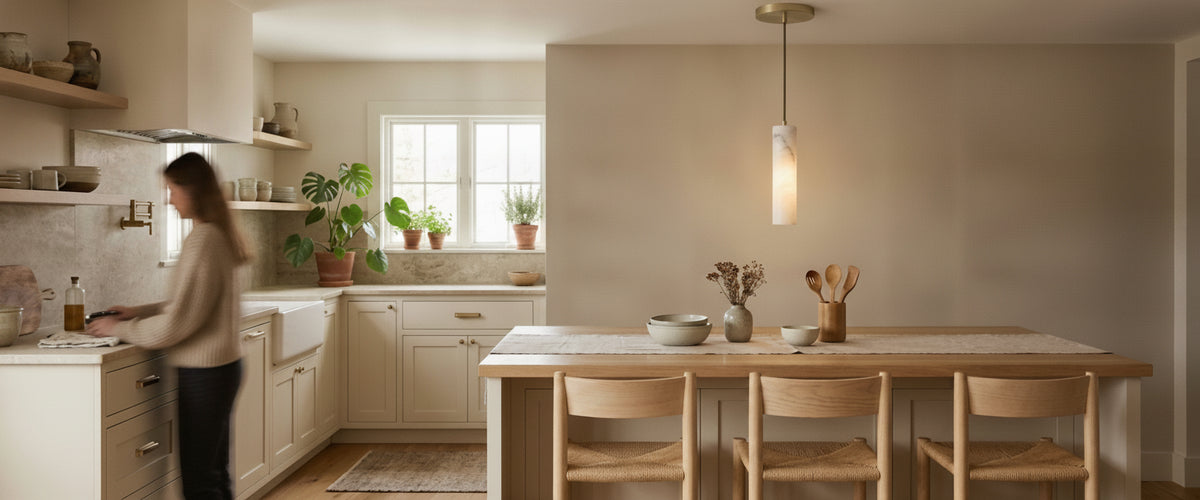

Most people fall in love with alabaster pendant lights in a photograph, then hang them four inches too high and wonder why the room looks flat. The stone is doing its job. The install is not. Alabaster is one of the few materials that genuinely changes character when lit from within, and that makes it unforgiving of lazy decisions about veining, drop height, diameter and bulb color. Get those right and a single pendant can carry an entire kitchen island. Get them wrong and you have an expensive shadow.

Quick Answer: What Actually Matters
- Veining: tighter, more consistent veining glows evenly. Dramatic banding looks beautiful switched off and blotchy switched on.
- Height: plan for roughly 30 to 36 inches (76 to 91 cm) from the countertop to the bottom of the shade over an island.
- Spacing: multiple pendants want 24 to 30 inches (61 to 76 cm) between centers, with at least 6 inches (15 cm) of breathing room from each end of the island.
- Diameter: ceiling height drives scale. Higher ceilings need a wider stone body, not just a longer cord.
- Bulb: 2700K is the safe default. Anything above 3000K bleaches the warmth out of the stone.
- Dimming: specify a compatible dimmer at the design stage, not after the plaster goes up.

Why Alabaster Diffuses Light in a Way Glass and Ceramic Cannot
Glass scatters light at its surface. Ceramic blocks it entirely and throws everything downward. Alabaster does something different: light enters the stone, bounces around inside the crystalline structure, and leaves softened and warmed by the mineral itself. That subsurface scattering is why an alabaster pendant reads as a glowing object rather than a lit object. The shade becomes the light source.
Alabaster is a fine-grained gypsum stone, soft enough to carve into thin translucent walls and dense enough to hold a polished finish. That softness is also its limit; it is water sensitive and scratches more easily than marble, which is why the Natural Stone Institute warns against acidic and abrasive cleaners on gypsum-based stone. The reward for that fragility is a quality of light no manufactured diffuser reproduces convincingly. Frosted acrylic gives you evenness with no depth. Alabaster gives you depth, and every piece gives it slightly differently.
There is a practical consequence for buyers. Two alabaster pendant lights from the same collection will never be identical twins, because the stone is quarried, not printed. That variation is the point. If your specification demands perfect matching across six fixtures over a hotel bar, stone is the wrong instinct and you should say so early.
Veining Decides Whether Your Pendant Glows or Blotches
This is the part almost nobody thinks about until the light goes on. Alabaster veining is mineral density variation, and denser bands transmit less light. Hold an unlit slab and heavy caramel banding looks like the best piece on the bench. Backlight the same slab and those bands turn into dark stripes with hot spots between them.
In our studio we backlight stone before it is cut for exactly this reason. A blank that photographs beautifully in daylight can read as uneven once it is wrapped around an LED module. What you want for a pendant hanging at eye level over a dining table is fine, diffuse veining with gentle movement: honey, gray or soft brown threads rather than hard geological stripes.
Where dramatic veining does earn its place is in larger surface areas viewed from below, such as a wide disc pendant over a long island, where the eye reads the pattern as texture rather than as interruption. Onyx follows the same logic but pushes it further, with stronger color and more theatrical banding. It suits a bar or a powder room better than a family kitchen. If you are weighing stone types, it helps to compare pieces side by side across the alabaster lighting collection and note how differently a translucent white body behaves next to a heavily figured one.
Alabaster Kitchen Pendant Lights: The Height and Gap Rules Buyers Ignore
The kitchen island is where most alabaster pendant lights end up, and where the most avoidable mistakes happen. Three rules cover most of it.
1. Measure From the Countertop, Not the Ceiling
The number that matters is the gap between the worktop and the bottom edge of the shade. Aim for 30 to 36 inches (76 to 91 cm). Lower than 30 inches and tall guests are looking straight into the fixture across the island. Higher than 36 inches and the pendant floats away from the counter, losing the intimacy that made you choose stone in the first place. Sightlines matter too: if the island sits between a kitchen and a seating area, check that the pendants do not cut across the view from the sofa.
2. Space by Center, Not by Edge
For two or three kitchen alabaster pendant lights in a row, work from center to center, typically 24 to 30 inches (61 to 76 cm) apart depending on shade diameter. Leave at least 6 inches (15 cm) between the outermost pendant and the end of the island so the arrangement sits inside the stone rather than spilling off it. Mark the positions on the ceiling with tape and live with them for a day before drilling.
3. Sort the Electrics Before the Ceiling Closes
Alabaster is heavier than it looks, and ceiling boxes and mounting points need to be specified for the actual fixture weight. Junction positions, dimmer circuits and driver locations all get decided before plastering. Always use a qualified electrician for installation, and give them the fixture weight and driver details in advance rather than on the day.
One kitchen we specified for had a 10-foot (3 m) island and a client set on three small pendants. We talked them into two wider discs instead, in the shallow, graphic profile of something like the Aurevia LED Disc Alabaster Pendant Light, where the brass edge keeps the stone from reading as heavy. Three would have chopped the island into segments; two let the stone read as a pair of glowing planes with clear counter space between them. In the photograph they sent afterwards, the veining picked up the warm tone of the oak cabinetry, which was the part they had not expected.
When One Pendant Beats a Cluster of Three
Over a dining table, a cluster is often the reflex choice and often the wrong one. Three small pendants create three sources, three sets of shadows and three cords competing for attention above the table. A single generous alabaster pendant creates one pool of light with a soft falloff, which is what makes a dinner table feel enclosed.
Use a single pendant when the table is round or square, when the ceiling is under about 9 feet (2.7 m), or when the room already has visual activity from art, joinery or a strong rug. Use a cluster or a linear arrangement when the table is long and rectangular, over roughly 7 feet (2.1 m), and you need even coverage from end to end. A linear alabaster bar or a row of matched cylinders handles that better than three unrelated pendants at staggered heights; a slim vertical form such as the Velmora Slim Cylindrical Alabaster Pendant Light repeats cleanly along a run without crowding the table below.
The other argument for one large piece is material. A single wide alabaster body shows off the stone's translucency at a scale that small shades cannot. It becomes an object in the room during the day, when the light is off, which is half the value of buying stone at all.
Matching Diameter to Ceiling Height So the Fixture Anchors
Undersized fixtures are the most common scale error in tall rooms. A rough working method: add the room's length and width in feet, and use that number in inches as a starting diameter for a single pendant. A 12 by 14 foot room suggests something around 26 inches across. Treat that as a floor rather than a ceiling in double-height spaces.
For ceilings above 10 feet (3 m), increase the diameter as well as the drop. Lengthening the cord alone leaves a small shade dangling in a large volume of air, which reads as an accident. In a stairwell or vaulted kitchen, a wide disc or a substantial dome holds the space; a slim cylinder will vanish. Where the volume needs mass rather than a thin silhouette, a rounded body like the Aurevia LED Dome Alabaster Pendant Light carries the height better, because the depth of the shade pushes glow sideways into the room instead of only down. Conversely, in a standard 8-foot (2.4 m) ceiling, a slim capsule or a compact dome keeps the headroom feeling generous.
Depth matters as much as width. A shallow disc reads as light and graphic; a deeper dome or globe has real physical presence and fills more of the volume it hangs in. If you are comparing forms across the wider lighting range, look at the shade profile in elevation, not just the diameter on the spec sheet.
Bulb Temperature and Dimming: Bringing the Stone Alive
Alabaster has warmth built into it. Push cool light through it and you fight the material. Stay at 2700K for living and dining spaces, and consider 3000K only where the kitchen has a cool palette of white quartz and pale gray cabinetry that needs the crispness. Above 3000K the honey and cream tones in the stone go chalky.
Color rendering is worth checking too. A CRI of 90 or above keeps the mineral tones honest; cheap sources with poor rendering flatten the veining into gray mush. Both figures are defined under standards maintained by the International Commission on Illumination, and any reputable manufacturer publishes them.
Dimming is non-negotiable in a kitchen. The same alabaster kitchen pendant lights that read as bright task light at full output become the entire evening ambience at 20 percent. Integrated LED fixtures need a driver and dimmer that are confirmed compatible; mismatched pairings cause flicker and buzzing that no amount of beautiful stone excuses. Ask for the driver specification before you order, and pass it to your electrician alongside the fixture weight.
Pre-Order Checklist
- Confirm the countertop-to-shade gap and mark pendant positions on the ceiling with tape.
- Ask whether the stone is backlit and inspected before cutting.
- Request veining guidance for your specific application: even glow versus figured character.
- Check fixture weight and confirm the ceiling structure and mounting box suit it.
- Specify 2700K, CRI 90+, and a confirmed compatible dimmer.
- Ask about lead times for cut-to-order stone and whether cord or rod length can be adjusted.
- Accept that natural variation between pieces is inherent, and brief your client accordingly.
Living With Alabaster Long Term
Dust with a dry, soft cloth. Skip the glass cleaner, the vinegar and anything abrasive; gypsum stone reacts badly to acids and marks easily. In a kitchen, cooking residue is the real enemy, so pendants over a hob or close to a cooktop will need wiping more often than pendants over a dining table. A light buff with a barely damp cloth followed immediately by a dry one handles most of it.
Keep pendants out of direct spray from steam ovens and away from open windows where rain can reach them. Handle by the metalwork rather than the stone when a bulb needs changing. Done sensibly, alabaster ages well, and the surface softens slightly over years of handling rather than degrading.
Budget for alabaster pendant lights tracks the size of the stone body, the complexity of the carving, the metalwork finish and the integrated LED engineering, so the sensible move is to ask for a quote against your specific room and ceiling. If you want a starting point, browse the range at Niori and tell us the island dimensions and ceiling height; that is usually enough for us to narrow the shortlist to two or three sensible options.