
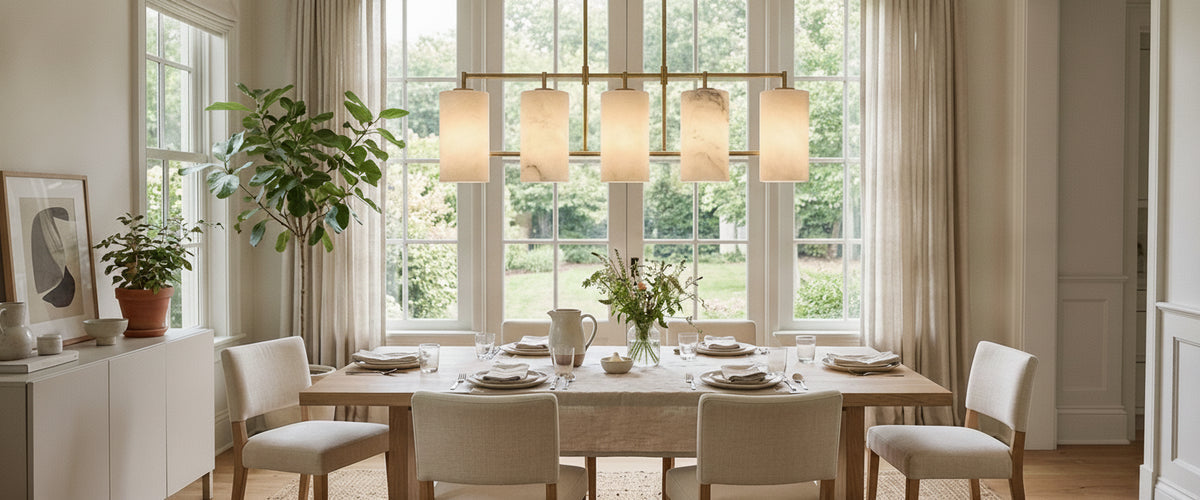

A dining table is the one place in a home where people sit still, face each other for two hours, and spend a fair amount of that time looking up. That is why alabaster dining room chandeliers are judged more harshly than any other fitting in the house. Stone that looks handsome in a hallway can turn chalky over a table, and a fitting hung 15cm too low will irritate everyone long after they have stopped noticing why. Get the thickness, the drop and the dimming right, though, and alabaster does something no glass or metal shade manages: it puts a warm, low-glare pool of light on the food and the faces, and none of it in anyone's eyes.

At a Glance
- Alabaster is translucent, not transparent. Light scatters inside the slab, so the shade becomes the light source rather than a cover over one.
- Slab thickness drives everything. Thinner stone reads bright and honeyed; thicker stone reads dense and quiet. Veining changes the reading again.
- Hang the lowest point roughly 75 to 90cm (30 to 35 inches) above the tabletop with standard ceilings, and size the shade to about half to two thirds of the table width.
- 2700K is the reliable default. 2400K suits deeply veined or amber stone in evening-only rooms.
- Specify dimming before you buy. Driver, dimmer and lamp have to be compatible as a set.

Why Overhead Alabaster Behaves Unlike a Wall or Table Fitting
Wall lights and table lamps in alabaster are forgiving. You see them from the side, often against a wall that bounces light back. A chandelier is seen from underneath, lit from within, with nothing behind it but ceiling. Every flaw in the stone is backlit and on display, and so is every strength.
In a wall light, the stone is a detail. Over a table it is the entire optical system. The lamp inside is invisible; what diners experience is light that has travelled through several millimetres of gypsum, bounced off crystal boundaries inside it and come out softened and slightly warmed. That fine crystalline structure is what made the material a favourite of medieval carvers working on tomb effigies and altarpieces, as the V&A collections show. The practical lesson: never judge alabaster dining room chandeliers from an unlit photograph. Ask to see them lit, and lit at low output, because that is where cheap stone shows its hand.
Slab Thickness and Veining Decide the Light Your Guests Sit Inside
Two alabaster dining room chandeliers cut from the same block can behave completely differently depending on how thick the shade walls are. Thinner slabs transmit more light and push amber and caramel tones forward, so the fitting glows generously and lifts the table. Thicker slabs hold light back, read as illuminated sculpture, and send more working light downward through the open aperture.
Veining changes the reading again. Densely figured stone breaks the glow into visible rivers and clouds, which looks superb against plain walls and a simple table. Calmer, more uniform stone gives an even wash that suits a decorated room where a busy shade would compete with wallpaper, art and a laid table.
One lesson from the studio: a client hung a lightly veined, thin-walled shade over a rough-sawn oak refectory table and it simply vanished against the pale plaster wall behind it. A denser, more strongly figured stone finally gave the fitting the visual weight to hold the room. Match the stone to the table and the wall behind it, not to the photograph.
The Drop and Diameter Numbers That Anchor a Room Rather Than Overwhelm It
Start with the table, not the ceiling. As a working rule, the fitting should measure roughly half to two thirds of the table's narrowest dimension. On a 100cm (39 inch) wide table, that means somewhere between 50 and 66cm (20 to 26 inches) across. Narrower and it looks like an afterthought; wider and people knock their heads reaching for the salt. An eight-light island fitting such as the Alvera 8 Light Crystal Island Chandelier sits in the width class most tables of that size want.
For drop, aim for 75 to 90cm (30 to 35 inches) between the tabletop and the lowest point of the fitting with ceilings around 2.4m (8 feet). That keeps the source above sightlines when people are seated. Add roughly 7 to 8cm (about 3 inches) for every additional 30cm (1 foot) of ceiling.
Long tables change the maths. Past about 2m (6.5 feet), a single round shade struggles to cover the ends, and a linear stone bar or a pair of matched pendants spaced at even thirds works better. A twelve-light linear form such as the Crystal Skye 12 Light Island Chandelier has the right geometry for that job. If you are planning an alabaster chandelier dining room scheme from scratch, browse the alabaster lighting range with the table dimensions written down beside you rather than shortlisting by looks alone.
Why 2700K Is the Right Starting Point, and When to Go Warmer
Stone already warms light on its way through. Feed alabaster dining room chandeliers 3000K and the output usually lands somewhere pleasant but faintly clinical. Feed them 2700K and the shade reads the way most people picture it: honeyed, soft, flattering to skin and to food.
Push to 2400K when the room is used almost exclusively in the evening, when the stone is heavily veined in amber and rust, or when candlelight is part of the scheme. Be careful in kitchen-diners: 2400K next to 3000K task lighting over a worktop looks like a mistake rather than a choice. Keep colour temperature consistent across sightlines, and specify CRI 90 or above, because a poor-rendering lamp turns caramel veining into muddy grey-brown.
Ceiling Heights Where Alabaster Earns Its Place, and Where It Fights Back
Between about 2.4m and 3m (8 to 10 feet), stone is at its best. There is enough air above the table for the fitting to read as an object, and the drop keeps the glow intimate.
Above 3.5m (11.5 feet), in a double-height extension or a converted chapel, a single modestly scaled shade looks lost. You need a multi-tier design with stone at several levels, a substantial linear form, or a cluster of pendants on long suspensions; something on the scale of the Star 103.3cm Dimmable LED Chandelier is closer to the right order of size. Stone is heavy, so at those drops the ceiling fixing matters as much as the design. Get a qualified electrician and, where necessary, a structural check before ordering.
Under 2.3m (7.5 feet), alabaster dining room chandeliers fight back: a pendant that hangs into head height is a daily annoyance. There, a flush or semi-flush stone fitting with wall lights doing the atmospheric work is the better answer, and both formats appear across the wider niori lighting range.
Dimming Matters More Over a Dining Table Than Almost Anywhere Else
A dining room does three jobs: paperwork at 4pm, a family meal at 7pm, a long dinner with wine at 10pm. One fixed output cannot serve all three, and stone is unusually sensitive to being run at the wrong level. At full output, thin slabs look bleached; at 15 per cent they look like a lit lantern.
The engineering has to be planned as a set. Driver, dimmer module and lamp must be compatible, and pairing an unspecified retrofit lamp with an old rotary dimmer is the usual cause of flicker, buzz and a dimming range that stalls at half output. UK guidance from the Lighting Industry Association is worth reading before you commit to a control system. Ask which dimming protocol the fitting uses (trailing edge, DALI and 0-10V are the common ones) and hand that answer to your electrician early.
One point specific to stone: alabaster dining room chandeliers reward smooth, deep dimming curves. Cheap controls step visibly, and a visible step across a glowing slab is far more obvious than the same step across a metal shade.
Specification Checks Before the Stone Leaves the Workshop
Run this list past the supplier before you commit, whatever else is on the quote:
- Lit photography of the actual piece, not a catalogue render. No two blocks match.
- Slab thickness and finish. Honed, polished and lightly textured surfaces transmit light differently.
- Total weight and fixing requirements against your ceiling construction. Plasterboard alone will not carry stone.
- Lamp type, colour temperature and CRI, and whether lamps are replaceable or integrated.
- Dimming protocol in writing before your electrician first fixes.
- Suspension adjustability. Rods are cleaner but often fixed length; cable allows on-site fine tuning.
- Spare stone and delivery access. A matched offcut is worth having, and crated stone does not go up a tight Victorian staircase without planning.
Alabaster, Onyx or Marble Over a Table?
Alabaster is gypsum-based, soft and the most reliably translucent of the three, which is why it dominates lit applications. Onyx is harder and more dramatically banded, theatrical in a way that suits hospitality more than family kitchens. Marble is largely opaque at usable thicknesses, so it works as a structural element rather than the glowing part. Whichever you choose, unlacquered brass sits especially well against backlit stone, picking up the amber in the veining.
Living With Stone Above a Dining Table
Alabaster scratches with a fingernail and reacts badly to water, so treat it as you would fine plaster. Dust with a dry soft brush or microfibre cloth, and avoid vinegar, citrus cleaners, abrasives and damp cloths, all of which leave dull marks. Grease is the real dining room enemy: over a kitchen-diner island, cooking vapour settles on the underside of the stone over the years, so good extraction does more for longevity than any cleaning routine.
Cost varies with stone grade, scale, metalwork, engineering and installation, so the honest answer to "what should I budget" is to describe your table, ceiling height and control system and ask for a tailored quote. Niori works in alabaster and natural stone across pendants, chandeliers, wall lights, table lamps and floor lamps, and with alabaster dining room chandeliers the specification conversation is usually the part that saves buyers money, not the browsing.