
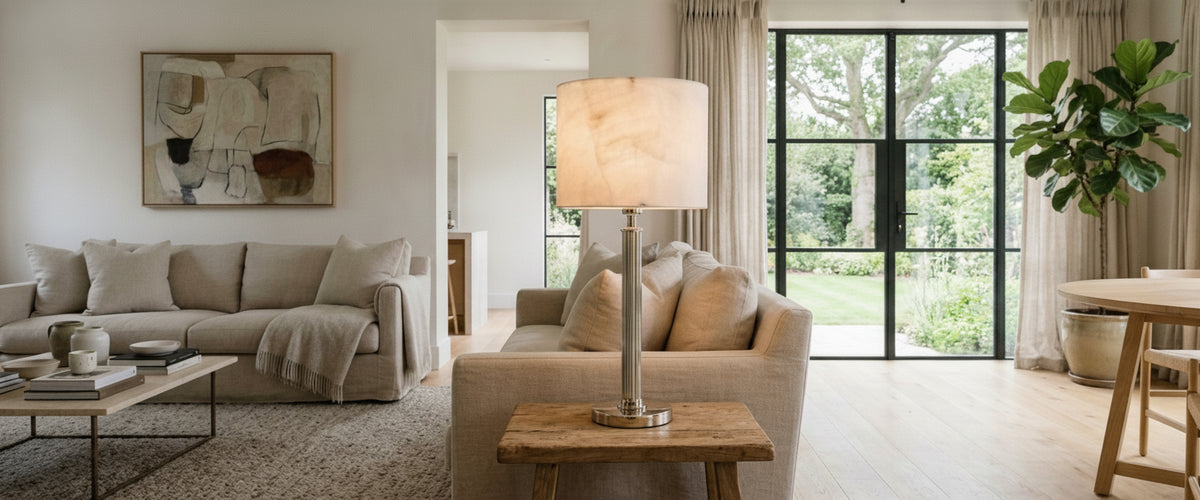

Polished nickel gets blamed for a lot of cold rooms it did not cause. Nine times out of ten the metal is behaving perfectly and everything around it is working against it: a brilliant-white wall, a hard opal shade, a 5000K lamp pushed in by a builder, and not a single warm surface within a metre. A polished nickel table lamps is a mirror before it is anything else, so it hands back whatever colour you feed it. Get the surroundings right and it reads soft, silvery and quietly expensive. Get them wrong and it reads like bathroom hardware.

Key Takeaways
- Polished nickel is warmer than chrome. It carries a faint yellow-brown cast that chrome, with its blue edge, does not have.
- It reflects, so give it something worth reflecting. Warm plaster, clay, oak, wool and stone all flatter it. Cool grey and stark white do not.
- The shade decides the outcome. A translucent alabaster or stone shade turns a nickel base from hardware into a light source with body.
- Proportion beats price. Base width and overall height matter more on a console or bedside than the metal itself.
- Fingerprints are real but shallow. Polished nickel marks easily and cleans easily; a dry microfibre cloth handles almost everything.
- Dim it. A polished nickel table lamp at full output is glare; at 30 to 50 per cent it is atmosphere.

What Polished Nickel Actually Does to Light
Nickel plating has a slightly warm undertone in the metal itself. Under a 2700K lamp it picks up a soft champagne cast and turns amber at the edges of curved surfaces. Chrome, plated over the same brass casting, stays blue-white and throws hard specular highlights that read almost clinical against fabric. Satin nickel sits in the middle: the brushed surface scatters light instead of bouncing it back, so it looks matte and calm but loses the depth that makes polished plating interesting at low light levels.
The practical difference shows up at night. A satin finish goes flat once the room dims. Polished nickel keeps working, because it catches the small remaining light sources in the room and holds them as tiny points of brightness along the neck and base of the lamp. That is why a polished nickel table lamp photographs so well in evening interiors and why it can look severe under midday daylight in a north-facing room. Judge the finish at the hour you will actually use it.
One more thing worth knowing: nickel plating is a thin electrodeposited layer over a base metal, usually brass or steel. Quality varies enormously with the thickness of that layer and the polish of the substrate beneath it. Cheap plating over a poorly prepared casting shows orange-peel texture in the reflection. Before you commit to a polished nickel table lamp, hold it so a straight line reflects across the surface. If the line ripples, the plating is thin.
The Colours, Textiles and Surfaces That Let the Finish Land
Polished nickel needs warmth around it, not more coolness. Limewash and clay plaster in bone, oatmeal or soft putty are close to ideal because their texture breaks up the reflection and their pigment feeds warmth back into the metal. Deep colours also work well: an inky blue-green library wall makes nickel look like jewellery. The finish struggles most against builder's brilliant white and against the fashionable cool greys, where it has nothing to borrow and defaults to grey itself.
Textiles do heavier lifting than most buyers expect. Wool bouclé, linen with slub, aged leather and a decent rug will all soften a nickel base by scattering warm light onto it from below. Hard, glossy surroundings do the opposite. A polished nickel table lamp on a high-gloss lacquered console under downlights is a recipe for glare from three directions at once.
Stone is the quiet fix. Set a polished nickel table lamp on a honed marble or travertine surface and the veining introduces warmth and irregularity that the metal reflects. This is where the finish and our own material bias meet: at Niori we work primarily in alabaster and natural stone, and nickel is one of the few cool metals that sits comfortably against pale calcite without either material looking like an accident. Brass flatters warm honey alabaster; nickel flatters the whiter, greyer, more crystalline stones.
Shade Material and Opacity: Where a Polished Nickel Table Lamp Is Won or Lost
You can buy a beautifully made base and ruin it with the wrong shade in about four seconds. A polished nickel table lamp is only ever as good as the light its shade drops back onto the metal, and three failure modes come up again and again.
Hard White Opal Glass
Bright, even, and completely inert. Opal glass gives you a uniform white disc of light with no variation, and next to reflective nickel the pairing tips cold and commercial. It suits task lighting in a kitchen; it rarely suits a drawing room.
Dense Opaque Card or Dark Fabric
All the light goes up and down in two hard cones, and the base sits in shadow. The nickel never gets lit, so the finish you paid for disappears after dark.
Translucent Stone
This is the one that works. Alabaster is genuinely translucent, and when it is machined thin the light passes through the calcite grain and picks up the veining as it goes. You get a warm, uneven, slightly golden glow that lands directly on the nickel and softens it. The metal reads silver and warm at the same time, which is exactly the register most buyers of a polished nickel table lamp are chasing without being able to name it. If you want to see how different stones behave at different thicknesses, our alabaster lighting collection is the clearest way to compare how veining reads once a piece is lit.
Woven linen in a natural or oyster tone is the reliable fabric alternative. It transmits enough light through the sides to keep the base illuminated, and the texture stops the shade competing with the polish of the metal.
Proportion on a Console, Bedside or Side Table
Finish is a five-second decision. Proportion is what you live with.
Bedside
The bottom edge of the shade wants to sit at roughly seated eye level when you are propped up reading, which for most beds means a polished nickel table lamp of around 60 to 70cm (24 to 28in) overall. Too tall and you get filament glare straight in the eye. Base width matters as much: a heavy stone or nickel base that eats more than about a third of the table leaves nowhere for a book and a glass of water. Slim column forms with a modest footprint solve this better than wide urn shapes, which is why a narrow cylinder such as the Raster 1 Light Cylinder Table Lamp tends to work on a shallow bedside where a wider base would take the whole surface.
Console or Hall Table
Go taller and more sculptural. Around 70 to 80cm (28 to 32in) overall reads correctly against a mirror or a piece of art, and a pair is almost always better than one. Where the console can carry some visual weight and you want the metalwork to be part of the composition rather than a stem holding up a shade, something like the Astro 3 Light Crystal Table Lamp, 30cm is closer to the right design language than a plain drum. If the console sits below a large mirror, remember that a polished nickel table lamp will be doubled in the reflection, so the back of the fixture needs to be as well finished as the front. That is a genuine quality tell when you are comparing pieces.
Side Table Beside Seating
Lower and wider works here. The shade should sit below the eyeline of someone sitting in the adjacent chair, which rules out most column lamps and favours compact globe forms in the region of the Global Globe Table Lamp, 20cm, where the light is diffused in every direction rather than aimed. A stone or marble base earns its keep on a side table because the weight stops the lamp being knocked by a passing sleeve, which is the single most common way table lamps get damaged in family houses.
We shipped a pair of stone-based lamps to a client renovating a Georgian townhouse in Bath last year who had specified them for a hall console 15cm too shallow. The lamps were right; the table was wrong. Measure the surface before you fall for the fixture. If you are still weighing pendant, wall and table options for the same room, it helps to look at the full lighting range together rather than choosing pieces one at a time.
Bulbs and Dimming
Reflective metal punishes a bad bulb, and a polished nickel table lamp is nothing if not reflective. Three rules cover most situations:
- 2700K, never higher. 3000K is acceptable in a kitchen or study. Anything at 4000K or above turns nickel grey and alabaster lifeless.
- CRI 90 or better. High colour rendering keeps the warm undertone in the plating and the mineral colour in stone shades visible.
- Dim everything. Pair a dimmable LED with a compatible trailing-edge dimmer or an inline dimmer switch on the flex. LED dimming compatibility is not universal, and the Energy Saving Trust is a useful starting point on choosing lamps that behave properly at low output.
For clear or lightly frosted shades, choose a lamp with a soft or opal envelope rather than a naked filament. A bare LED filament reflected in polished nickel produces a bright pinpoint that follows you around the room.
Fingerprints and Care: Does Polished Nickel Hold Up?
Honestly, yes, better than most people fear. The plating on a polished nickel table lamp is harder and more corrosion-resistant than the silver or chrome it is often compared with, and unlike unlacquered brass it does not develop a patina you have to either love or polish away. What it does do is show every fingerprint, particularly on flat or gently curved surfaces near the switch.
The good news is that fingerprints on nickel are surface oils, not damage. General conservation guidance on metals, including the Getty Conservation Institute, consistently favours the gentlest effective cleaning method and avoiding abrasives on plated surfaces, which is exactly the right instinct at home.
Care Checklist
- Dust weekly with a dry microfibre cloth. This handles 90 per cent of marks.
- For stubborn fingerprints, breathe on the surface and buff dry. Water alone, sparingly, if needed.
- Never use metal polish, scouring cream, or anything containing ammonia or bleach on plated nickel. Abrasives cut through the plating layer.
- Keep cleaning products away from any stone element entirely. Alabaster is a gypsum stone and is soluble in water, so it takes a dry soft brush or a barely damp cloth followed immediately by drying, and no vinegar, no citrus, no proprietary sprays.
- Wipe the flex and switch occasionally; skin oils accumulate there fastest.
- Avoid siting a nickel and stone lamp in a bathroom or directly beside an open window in a coastal property. Salt air and constant humidity are harder on both materials than daily use ever is.
- Switch off and unplug before cleaning, and use a qualified electrician for any rewiring, replacement flex, or hard-wired installation.
Buyer Mistakes We See Most Often
Mixing polished nickel with chrome in the same sightline is the big one. The two finishes read as a mistake rather than a layered scheme because their undertones fight. Nickel with unlacquered brass, by contrast, is a well-established pairing and works beautifully when one metal clearly leads.
The second mistake is buying a single lamp for a space that wanted a pair. Console tables, wide sideboards and symmetrical bedheads almost always want two. The third is treating a table lamp as the only light in the room. A polished nickel table lamp is a layer, not a lighting scheme; it needs a wall light, a pendant or a floor lamp doing quiet work elsewhere so the room has depth after dark.
Finally, buyers underestimate weight. Solid stone bases with plated metal fittings are heavy by design, and that heft is what stops a lamp tipping. If you are shipping internationally or fitting to a wall-mounted shelf, ask about weight before you commit. Costs across natural-stone lighting vary with the stone selected, the scale of the piece, the complexity of the metalwork and the plating quality, so the sensible route is to describe the project and request a tailored quote rather than assume a figure.
Choose the surroundings first, the shade second, the proportion third. Do that and your polished nickel table lamp will do exactly what you hoped it would: catch the light, hold it, and give a room a bit of quiet shine at eight o'clock in the evening. You can see how we approach the balance of stone, glass and metal across the full Niori range.