
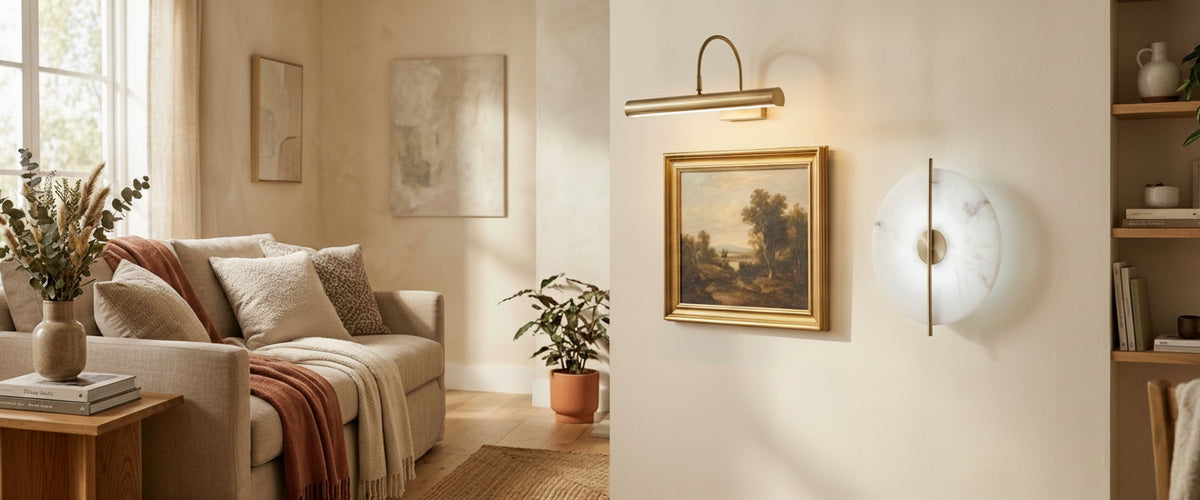

Most badly lit paintings in British homes are not victims of cheap fittings. They are victims of the wrong length, mounted at the wrong height, throwing a bright band across the top third of the canvas and leaving the bottom in gloom. A picture lighting has one job, and it is a narrow one: to put even, honest light across a flat surface without glare, without heat damage, and without drawing attention to itself. Get the geometry right and a modest fitting looks expensive. Get it wrong and the most beautifully made brass arm in the country will still make your art look tired.

Key Takeaways Before You Buy
- Length: aim for a fitting roughly half to two thirds the width of the artwork, measured across the visible image rather than the outer frame.
- Colour temperature: 2700K to 3000K for oils, warm-toned works and gilt frames; nudge cooler only for cool-palette contemporary pieces.
- CRI: 90 or above, ideally 95, or reds and skin tones will read flat and muddy.
- Projection: the arm must carry the lamp far enough forward to clear the frame's top rail, or you will light the moulding and shadow the canvas.
- Power: hardwired is the right answer for permanent hangs; a battery operated picture light earns its place on plaster, panelling and listed walls you cannot chase.
- Fixings: confirm whether the fitting loads the wall or the frame before you order. Gilt frames and stretcher bars are rarely happy carrying weight.

A Picture Light Is a Different Brief from a Wall Light
Wall lights are decorative first. They wash plaster, create pools of warmth, and are allowed to be beautiful objects in their own right. At Niori we spend most of our time on exactly that kind of piece, where an alabaster shade turns a bare lamp into something soft and slightly cloudlike. A picture light works to the opposite brief. It is a task light dressed in good manners, and the measure of success is that visitors notice the painting and not the fitting.
That distinction matters commercially, because buyers routinely shop for both from the same shelf. Someone falls for a wide alabaster wall light, mounts it above a watercolour, and ends up with a lovely glowing shade and a picture that is barely brighter than the wall around it. Diffused light is exactly what you want beside a bed or along a hallway. It is the wrong tool for illuminating a flat plane at close range, because diffusion scatters output in every direction and very little of it lands where the art is. Keep the two jobs separate and both perform better. Browse the decorative side of the range through our alabaster lighting collection and treat art lighting as its own line item in the specification.
Fitting Length Versus Artwork Width: The Maths Buyers Skip
A picture light does not project a rectangle. It throws a broad oval, so the illuminated area is always wider than the fitting itself. That is why a compact 26cm (10in) arm such as the Felix Antique Brass LED Picture Light 2.5W 3000K can comfortably cover a small portrait, while a large landscape needs the reach of something like the 81cm (32in) Luminous Brass LED Picture Light 18W 3000K rather than anything approaching mural scale.
The working rule: choose a fitting between half and two thirds of the visible image width. Under half and you get a hotspot in the middle with visible fall-off at the edges. Over two thirds and light spills past the frame onto the wall, which flattens the whole composition because the eye no longer separates the art from its background.
Two exceptions worth knowing. Tall narrow works, such as a portrait in a deep frame, often do better with a shorter fitting and greater projection, because you need throw down the canvas rather than spread across it. Wide panoramic pieces above 1.5m (5ft) sometimes need two fittings spaced at the quarter points instead of one long one; a single very long arm can look like scaffolding.
Colour Temperature and CRI: The Two Numbers That Decide the Colours
Colour temperature sets the mood of the light. Colour rendering index (CRI) sets its honesty. They are not interchangeable, and buyers regularly specify the first while ignoring the second.
For oils, gilt frames, antique prints and anything with warm earth pigments, 2700K to 3000K is the safe band. It matches the tungsten light most traditional interiors still use and keeps golds looking gold rather than greenish. Cool-palette contemporary work, monochrome photography and blue-heavy abstracts can take 3000K to 3500K without looking clinical. Go above that in a domestic room and the painting starts to feel like a hospital exhibit.
CRI is where cheap fittings fail. Below CRI 80, reds collapse first: a crimson robe reads brown, skin tones go waxy. Specify CRI 90 as a minimum and CRI 95 where the art justifies it. If a supplier cannot tell you the CRI, that silence is your answer.
Light exposure is also a conservation question. Cumulative light does permanent damage to watercolours, textiles and works on paper, which is why museums keep sensitive pieces at low lux levels and limit display hours. The Getty Conservation Institute publishes accessible research on how light exposure ages pigments and supports. In practical terms: put the fitting on a dimmer, keep it low, and switch it off when the room is empty. A dimmed lamp also flatters the work more than one running flat out.
Projection and Mounting Height: The Geometry That Makes or Breaks It
Projection is the horizontal distance from the wall to the centre of the lamp. It is the single most overlooked specification on the page.
We had a client near Bath hanging a heavy Victorian portrait in a deep gilt frame on a chimney breast. She had chosen a well-made brass fitting, but the frame's top rail stood proud by several centimetres. The lamp sat behind that rail, so the moulding cast a hard shadow band across the top of the canvas and lit its own gold profile beautifully. The fix was not a better fitting; it was a longer arm. The frame's depth, not the picture's size, dictated the answer.
The target is a beam striking the artwork at roughly 30 degrees from vertical. Steeper and you light the top and starve the bottom. Shallower and you risk glare bouncing straight off varnish or glazing into the viewer's eyes. Deep frames, canvases with heavy impasto and anything under reflective glass all need more projection than a flat mounted print.
On mounting height, wall-mounted fittings usually sit a hand's width above the top of the frame. Frame-mounted fittings sit on the frame itself and follow whatever the manufacturer specifies. If the picture is destined to move around the house, favour wall mounting; the fixing holes stay put and the artwork can change.
Battery Operated Picture Light or Hardwired?
Cordless has moved on considerably. A modern battery picture lighting with a rechargeable pack and magnetic mount gives real light, real dimming, and in many cases app or remote control, with no cable and no chasing.
Choose a rechargeable model when you are dealing with lime plaster, original panelling, a listed property, a rented flat, or a gallery wall you expect to rearrange within a year. It is also the sensible choice for a chimney breast where there is nowhere to run a cable without opening up the wall. The trade-off is upkeep: batteries need recharging, and how often depends on brightness and hours of use. For a piece you light every evening, that becomes a chore.
Hardwire when the artwork is permanent, when the fitting will run for hours at a time, and when you want it on the same circuit and dimmer as the rest of the room's scheme. Any hardwired installation should go to a qualified electrician working to the current UK wiring regulations; Electrical Safety First is a useful starting point on competent-person schemes. If you are already planning wall lights or a chandelier for the same room, add the art lighting circuit to that first-fix drawing rather than bolting it on later.
Bulbs, LEDs, and Lighted Frames for Pictures
Almost all quality art lighting is now integrated LED, chosen for its low heat output and tight optical control. Plenty of buyers still search for a light bulb picture setup, meaning a fitting with a replaceable lamp rather than a sealed LED module. Both approaches are legitimate. Replaceable lamps let you tune colour temperature later and keep an older fitting serviceable; integrated LEDs give better beam control, slimmer profiles and far less heat near the canvas surface.
Whichever you choose, avoid halogen near art. It runs hot and pushes a great deal of energy into the frame's microclimate.
Light frames for pictures, meaning frames with lighting built into the moulding, are a growing category and can look superb on contemporary work. Two cautions. First, they tie the lighting to that specific frame forever. Second, they load the frame with weight and, in some designs, with a small heat source. For antique or gilded frames, keep the lamp on the wall and leave the frame alone.
Frame Weight, Fixings, and Finish Compatibility: A Pre-Purchase Checklist
- Confirm the load path. Does the fitting fix to the wall or to the frame? Never clamp a fitting to a gilt frame or a stretcher bar without checking with a framer or conservator.
- Identify the wall build-up. Solid brick, plasterboard on dabs, lath and plaster, or panelling each need different fixings. Lath and plaster in particular rarely holds a standard plug well.
- Measure the frame depth, not just the width. Depth drives your projection requirement.
- Check glazing. Glass and acrylic reflect. Anti-reflective glazing, a steeper beam angle, or greater projection may all be needed.
- Match the metal to the room, not to the frame. Antique brass beside gold leaf can read muddy. Against a pale wall, a quiet white profile such as the Helion White LED Picture Light 13.5W 3000K tends to disappear more gracefully than a warm metal competing with the frame.
- Specify dimming early. Confirm the driver, dimmer type and whether trailing edge or leading edge is required before the electrician arrives.
- Test at night. Light the piece after dark with the room lights down. Daytime tests hide every hotspot.
Where Picture Lighting Meets Alabaster and Stone
The best-lit rooms we ship into treat art lighting as one layer among several. A directional art fitting does precise, aimed work. Alabaster pendants, wall lights and table lamps do the opposite: they glow rather than aim, because light travels a short way into the stone before it scatters, giving that warm veined luminosity you cannot fake with frosted glass. Put both in a room and the picture reads clearly while the space around it stays soft.
One practical note from the studio. When you dim an alabaster wall light, the stone keeps looking lovely because the shade itself is the visible feature. Dim an art fitting too far and the artwork simply goes dull, since there is no glowing surface to compensate. Set your art level first, then bring the decorative layers up or down around it. If you are specifying a whole scheme, our full lighting collection is a reasonable place to see how directional and diffused pieces sit together.
Budget for art lighting the way you would for any other specified fitting. Cost depends on materials, scale, optical quality, driver and dimming spec, finish and installation, so ask for a tailored quote rather than working from a headline figure. What consistently pays back is the boring stuff: correct length, correct projection, CRI 90 or better, and a dimmer. That is the whole discipline of choosing a picture light.