
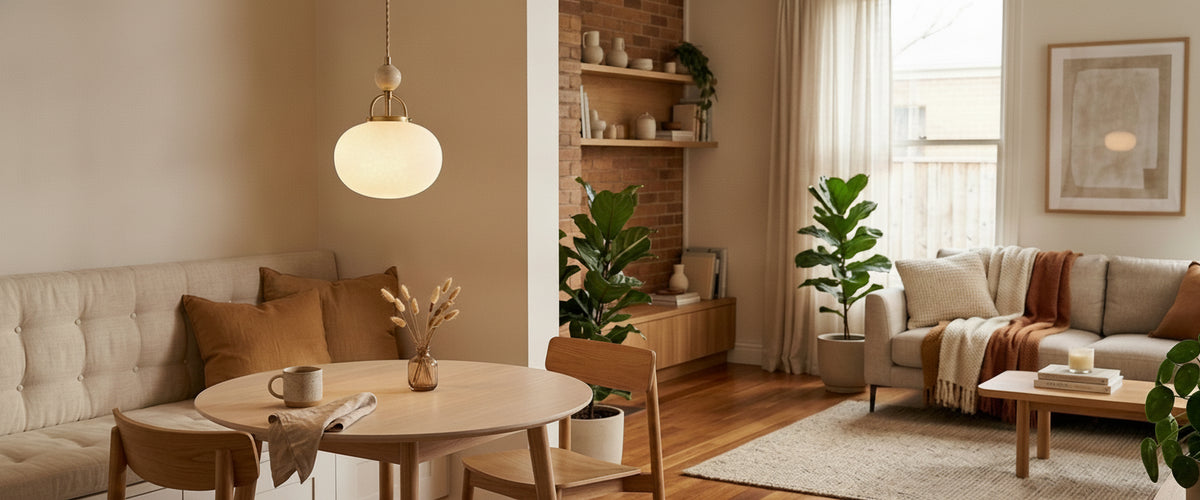

Hang a crystal ball pendant over a glossy dining table and you will learn something fast: crystal does not soften light, it edits it. The sphere splits a single filament into dozens of bright points, throws caustic patterns across the ceiling, and puts a hard glint exactly where someone's eye happens to be. Done well, that sparkle is the best thing in the room. Done carelessly, it is a glare machine hanging over your soup. The difference comes down to a handful of decisions you make before you buy.

At a Glance
Crystal refracts, alabaster diffuses. A crystal ball pendant gives you points of light and pattern; a stone shade gives you an even, warm wash.
Glass type sets the mood. Clear optical crystal is bright and busy. Smoked, bronze and champagne tints calm the sparkle and flatter warm interiors.
Diameter is the first decision. Under 15cm (6in) reads as jewelry; 30cm (12in) and up reads as a feature and needs room to breathe.
The bulb is half the fixture. A visible point source creates sparkle. A frosted globe kills it. Choose deliberately.
Dimming is non-negotiable if the crystal ball pendant sits in eyeline over a table or island.
Care is simple but specific: lint-free cloth, minimal moisture, no abrasives, and never a household spray straight onto the glass near metalwork.

Refraction, Scatter, and Hot Spots: What a Crystal Sphere Does to the Light Below
A solid or thick-walled crystal ball behaves like a lens. Light entering the glass bends, travels through, and exits at a new angle, which is why a single small filament can paint a whole ceiling with moving highlights. Lead crystal and high-refractive optical glass bend light more sharply than ordinary soda-lime glass, which is why the sparkle from a well made crystal ball pendant looks brighter and more prismatic than a cheap copy. The Corning Museum of Glass has good background on how glass composition changes refractive behavior, and it explains a lot about why two spheres of identical size can perform so differently.
The practical consequence is glare. Refracted light is directional, so a crystal ball pendant does not distribute illumination evenly across a table the way a shaded fixture does. You get bright focal points, deep shadow between them, and a hot spot directly beneath the sphere. That is fine for atmosphere and terrible for reading a recipe. Treat a crystal sphere as decorative and accent lighting first, then build task light around it with downlights, wall lights or a lamp nearby.
Surfaces matter more than most buyers expect. A polished marble island, a lacquered table or a glazed splashback will bounce those caustics back up at you and double the visual noise. Matt oak, honed stone, linen and textured plaster absorb the excess and let the sparkle read as a highlight rather than a headache. One customer loved a clear sphere in photographs and disliked it the moment it went up at home; the culprit was a mirrored splashback a meter away, not the crystal ball pendant itself.
Clear versus Tinted Crystal: How Glass Type Shifts the Mood on a Dimmer
Clear optical crystal is the loudest option. It has the highest sparkle, the most obvious prismatic fringing, and the least forgiveness at full output. It suits high ceilings, cooler palettes, and rooms where the crystal ball pendant is meant to be the event. Clear crystal also changes character across a dimmer curve: at full brightness it is brilliant and slightly clinical, and pulled down to roughly a quarter of output it settles into something warmer and more jewel-like.
Smoked and bronze-tinted crystal absorbs part of the beam before it exits the glass, which cuts glare and shifts the color of the scatter toward amber. A tinted crystal ball pendant is often the safer call in a lower-ceilinged room. Champagne and cognac tints sit between the two and tend to work best with brass, bronze and walnut. Ribbed, fluted or lightly frosted spheres split the difference again: you keep some optical interest but lose the pinpoint glare, because the surface texture scatters light before it can focus.
Compare that behavior with stone. Alabaster does not refract, it transmits. Light travels a short distance through the mineral, scatters internally against the crystalline structure, and leaves the surface as a soft, honey-toned glow with visible veining. A crystal ball pendant gives you drama; alabaster gives you calm. Plenty of projects use both in the same house, and if you want to see how the two material families read side by side, our alabaster lighting collection is the clearest way to judge the difference in light quality. Where the surfaces below are already reflective and more sparkle would be one thing too many, a stone-bodied fixture such as the Corano Travertine Cylinder Pendant Light keeps the material interest but sends the light down as a warm, contained wash rather than scattered points.
Diameter and Drop: The Numbers That Separate Jewel from Clutter
Sphere diameter drives everything else about a crystal ball pendant. Small spheres of roughly 10 to 15cm (4 to 6in) read as jewelry and almost always want to be hung in a cluster or a run. Mid-size spheres around 20 to 25cm (8 to 10in) work as single pendants over a bedside, a console or a compact table. Anything from 30cm (12in) upward becomes an object in its own right and needs clear air around it, or the room starts to feel crowded.
For drop over a dining table, aim for roughly 75 to 90cm (30 to 35in) between the tabletop and the bottom of the sphere. Over a kitchen island, most people are standing rather than seated, so hang the crystal ball pendant a little higher and check sightlines across the room, not just at the island. In a stairwell or double-height hall, position the fixture so it reads well from the upper landing as well as the ground floor; a sphere seen from above is a different composition entirely.
Clusters and Runs
Three spheres at staggered heights over a long table look considered. Five at the same height look like a shop fitting. If you are running several crystal ball pendants over an island, keep at least the diameter of one sphere as clear space between them, and align the group to the island rather than centering it in the room. Mixing two diameters within a cluster usually reads better than mixing three, because the eye finds a hierarchy instead of a pattern. For the smallest positions in a run, or for a narrow console where a full-size sphere would dominate, something on the scale of the Celestia Small LED Pendant Light in brass holds the line without adding bulk.
Where a Crystal Ball Pendant Earns Its Place, and Where It Fights Back
Entrance halls are the easiest win. There is no task requirement, ceilings are often generous, and the sparkle does real work as a first impression. Stairwells are equally strong because you see the sphere from multiple angles as you move. Over a bar or drinks cabinet, a small crystal ball pendant is excellent: reflective bottles and glassware amplify the refraction, and the light level is meant to be low anyway.
Dining rooms sit in the middle. A crystal ball pendant works when the table finish is matt, the fixture is dimmed, and the sphere hangs low enough to be below eyeline rather than glaring straight at seated guests. It fails when the table is high-gloss and the pendant runs at full output.
Two rooms genuinely fight back. Bedrooms are the first: a crystal ball pendant seen from a pillow puts the source directly in your field of view, and no dimmer fully fixes that. Home offices are the second, because screen reflections and scattered highlights are a bad combination for long working hours. In both cases a stone or opal-glass shade behaves far better. Where you still want a rounded glass form over a bedside or a reading corner but need a soft diffused glow rather than pinpoint glare, the Bon Pendant Light in white glass is closer to the right design language, and the broader lighting range is worth browsing before you commit to crystal in a room where people lie down or stare at screens.
Filament versus LED Globe: Choosing the Bulb Inside a Crystal Ball Pendant
The bulb is not an afterthought here; inside the transparent sphere of a crystal ball pendant it is fully visible and it dictates how the fixture performs. A compact filament LED with a tight, bright coil acts as a point source and produces the sharpest refraction, the most defined caustics, and the most sparkle. It also produces the most glare, so it needs a dimmer and a sensible drop.
A frosted or opal LED globe does the opposite. It spreads the source across a larger emitting area, which softens the scatter into a gentle wash and largely removes the prismatic effect. If you bought the sphere for its optics, this is a waste of the fixture. If you bought it for its shape and you want a quieter result, it is a smart move.
On color temperature, stay at 2700K or warmer for domestic interiors; 3000K can look slightly cold through the clear glass of a crystal ball pendant. Check the color rendering figure too, since anything below CRI 90 tends to make warm woods and skin tones look flat under a sparkling fixture. Match the dimming technology to the driver, and if you are changing a ceiling rose, adding a dimmer module or working on anything beyond a straightforward bulb swap, use a qualified electrician. Running LED lamps on old leading-edge dimmers built for incandescent loads is the most common cause of the flicker people blame on the fixture.
Keeping Crystal Clear Without Scratching or Hazing the Surface
Dust is the enemy, not dirt. A film of household dust scatters light before it reaches the glass and dulls the refraction within weeks, especially in kitchens where airborne grease binds it to the surface. Dry-dust the sphere monthly with a clean microfiber or lint-free cloth. That alone keeps most crystal ball pendants performing.
For a deeper clean, dampen the cloth with distilled water and a trace of pH-neutral detergent, wipe, then dry immediately with a second dry cloth. Never spray liquid onto the fixture, because it runs into lampholders and metalwork; spray onto the cloth instead. Avoid ammonia-based glass cleaners on anything with plated brass or antiqued finishes, and avoid paper towels, which can leave fine surface scratches over time. Museum guidance on caring for glass from the V&A is a sound reference for handling and cleaning principles.
Two extra habits pay off. Always switch the crystal ball pendant off and let it cool before cleaning, because thermal shock on warm glass is a real risk. And support the sphere from below with your free hand rather than gripping the stem, since the stress point on most pendants is the joint between the sphere and its collar.
Buyer's Checklist Before You Order
Measure ceiling height and confirm the fixture drop can be adjusted at installation.
Check the finish of the surface directly below. Gloss multiplies glare; matt absorbs it.
Decide whether the crystal ball pendant is decorative or task lighting, and plan a second layer if it is decorative.
Confirm the circuit is dimmable and that the dimmer suits the lamp and driver.
Choose the bulb before you finalize the fixture: point source for sparkle, opal globe for calm.
Check sightlines from seated positions, from the stairs, and from adjoining rooms.
Ask about fixing weight and ceiling substrate; a heavy crystal ball pendant needs a proper anchor, not a standard rose.
Consider whether an alabaster or natural-stone shade would serve the room better before committing to crystal.
Crystal, Stone, or Both
Plenty of the best schemes we see use crystal where sparkle is the point and stone where comfort is the point: a crystal ball pendant in the hall, alabaster over the dining table, marble table lamps in the sitting room. The two materials are not competitors so much as different tools. Crystal is punctuation. Stone is the paragraph. If you are weighing up which belongs where, start with how long people will sit under the fixture and how reflective the surfaces around it are; those two answers usually settle whether a crystal ball pendant belongs in that spot at all. You can see how the material families work together across the range at Niori, where alabaster, marble and natural stone sit alongside glass and brass detailing.