
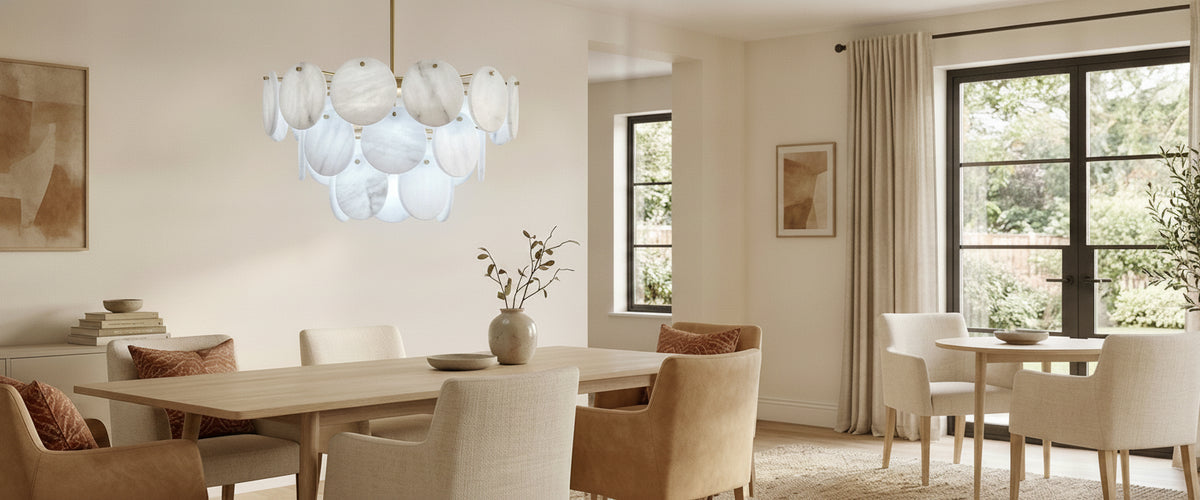

Brass is the finish people fall for on a screen and then quarrel with in the hallway. The photograph shows a soft, honeyed metal catching candlelight; the delivered piece can read orange under the wrong lamp, or flat and brownish against cool grey walls. That gap is almost never a quality problem. It is a finish and light-source problem, and it is entirely avoidable if you know what to ask before you buy. Choosing a brass chandeliers well comes down to four decisions: which brass finish you are actually getting, what colour of light you will run through it, how big it needs to be for the room, and whether the metal is sealed or left to age.

At a Glance: Choosing a Brass Chandelier
- Finish first. Polished, satin (brushed), antique and lacquered brass behave like four different metals on a ceiling, even when the alloy underneath is identical.
- Colour temperature matters more with brass than with chrome. Stay in the 2400K to 2700K range for warmth without pushing the metal towards orange.
- Scale rule of thumb: add the room's length and width in feet, and treat that number in inches as a starting diameter. A 14 x 16 ft room suggests roughly 30 in (76 cm).
- Over a dining table, hang the lowest point about 76 to 90 cm (30 to 35 in) above the tabletop and keep the fixture narrower than the table by at least 30 cm (12 in) on each side.
- Confirm lacquered or unlacquered in writing. Unlacquered brass is a living finish and will patinate; that is a feature, not a fault, but only if you chose it.
- Brass pairs unusually well with stone. Alabaster and onyx shades warm the metal from within instead of bouncing hard highlights off it.

Polished, Satin, Antique, Lacquered: Four Ways One Metal Reads
Polished brass throws highlights. It is reflective, slightly theatrical, and it needs a room with something to reflect: a window, a mirror, a decent amount of daylight. In a dim north-facing space it can look hard and a little brassy in the pejorative sense. Satin or brushed brass scatters light instead of bouncing it, which softens the whole fixture and makes fingerprints far less obvious. It is the safest choice for a family home.
An antique brass chandeliers is a different animal again. The finish is chemically darkened and then relieved on the raised edges, so the piece reads brown-gold in shadow and bright gold where the light catches. That contrast is what makes a vintage brass chandelier look settled rather than new, and it is why antique brass sits comfortably beside old timber, worn stone and darker paint colours. Buyers searching for a retro brass chandelier are usually after this quality: a metal that looks like it has been in the house a while. If you are furnishing a Victorian terrace or a converted mill, a brass antique chandelier will slot in where polished brass would shout.
Lacquered brass is not a colour, it is a coating. A clear protective layer is applied over any of the finishes above to lock the tone in place. It resists tarnish and fingermarks, and it also means the piece will look the same in five years as it does on day one. That is either exactly what you want or precisely what you do not.
Warm-White LEDs and Brass Are Not an Automatic Pairing
Most people assume warm white is warm white. It is not. A 3000K lamp is technically warm on paper but has enough blue content to make antique brass look slightly grey and dead. Push to 2700K and the metal comes back to life. Drop to 2400K and polished brass starts to glow the way it does under candlelight, which is what most buyers are unconsciously chasing.
Colour rendering is the second half of the equation. Look for a CRI of 90 or above; below that, the subtle red and amber content in brass gets flattened out and the finish loses depth. If the chandelier takes exposed candle lamps, a filament LED with a lightly tinted glass envelope will do more for the metal than any amount of polishing. Dimming is worth paying for too. A brass chandelier at full output in the evening is rarely flattering; the same fixture at 30 per cent is where the finish does its best work. Choose lamps with warm dimming if you can, so the colour temperature drops as the level drops, and check the driver and dimmer are a matched pair before installation.
One practical note from the studio: we had a client in Edinburgh who was convinced a shipment of antique brass wall lights had arrived in the wrong finish. The lights were correct. The room was running 4000K downlights from a previous refit. Swapping those to 2700K fixed a problem that had nothing to do with the fittings themselves.
Diameter and Drop: The Scale Rules That Keep a Brass Chandelier in Proportion
Undersized chandeliers are the most common mistake we see, and brass makes it worse, because a small gold fixture on a large ceiling reads as an ornament rather than a light. Start with the room dimensions: add the length and width in feet, then read that figure as inches for a workable diameter. A 12 x 14 ft (3.7 x 4.3 m) sitting room lands around 26 in (66 cm).
Ceiling height governs the drop. A common working figure is 6 to 7.5 cm of chandelier height for every 30 cm of ceiling height (roughly 2.5 to 3 in per foot). In a room with a standard 2.4 m (8 ft) ceiling, keep the lowest point at least 2.1 m (7 ft) off the floor in any circulation route. Over a table you can go much lower, because nobody walks under it. Over a stairwell, measure from the highest tread, not the landing, and remember that a chandelier seen from below and from the side needs to be interesting from both angles.
Weight is the quiet constraint. Solid brass frames with stone or crystal elements can run well past 15 kg (33 lb), which is beyond what a standard ceiling rose or plasterboard fixing will safely carry. Any chandelier of that class needs to be fixed into a joist or a properly specified support, and the installation should be signed off by a qualified electrician working to the current wiring regulations. The IET publishes the standards UK installers work to; this is not a job to improvise on a Saturday.
Room by Room: Where a Brass Chandelier Earns Its Place
The Dining Room
A brass chandelier in the dining room is the most forgiving placement in the house, because the fixture hangs at eye level and you get to appreciate the finish properly. Keep the fixture narrower than the table so nobody knocks their head reaching for the salt, and hang it low enough to create a pool of light rather than washing the whole room. On a compact four-seater, a fixture in the region of 50 cm such as the Global 4 Light Bubble Chandelier holds the proportions where a wide-armed frame would crowd the table and the people around it. Warm metal above a table also does something useful for skin tones, which is why so many restaurants use it. Add dimming and a couple of alabaster wall lights on the flanking walls and you have a room that works for a Tuesday supper and a long Saturday dinner without touching a single other fitting.
Hallways and Stairwells
Hallways are usually where brass gets seen first and lit worst. The finish needs a light source close to it to come alive, so a chandelier with shades or diffusers around the lamps will always outperform a bare-armed frame in a windowless hall. Where the hall carries artwork, a close-range fitting like the Felix Antique Brass LED Picture Light gives the metal something to do at eye level rather than leaving all the work to the ceiling. Alabaster shades are particularly good here too: the stone glows rather than glares, and the warm cream tone sits naturally against gold-toned metal. You can see how that combination behaves across our alabaster lighting collection, where brass detailing is used to frame the stone rather than compete with it.
Bedrooms
Bedrooms ask for the least reflective option. Satin or antique brass, low output, deep dimming. Avoid polished brass directly above the bed, where it will catch every scrap of light from a bedside lamp and glint at you at midnight. If the ceiling is low, a compact chandelier with upward-facing shades will light the ceiling plane and make the room feel taller without any hard downward glare.
Black and Brass Chandeliers and Linear Forms
A black and brass chandelier works on contrast: the dark frame reads as structure, the brass as detail. It is a strong look and it needs a room with some other dark note to answer it, whether that is joinery, a fireplace, window frames or a rug. Drop a black and brass fixture into a scheme of pale oak and off-white and it will float on the ceiling like a graphic sticker. Give it a partner and it anchors the room.
A brass linear chandelier solves a different problem: long tables, kitchen islands and narrow rooms where a round fixture leaves the ends unlit. The proportions are the thing to watch. Aim for a fitting roughly two-thirds the length of the surface below it, and make sure the arms or drops are aligned along the table axis rather than fighting it. On a 1.4 to 1.6 m table, that puts you at around 90 cm, the span of a frame such as the Astro 3 Light Linear Drop Crystal Chandelier, where the dark bar carries the structure and the drops do the glinting. Linear forms also suit hospitality settings well, where a single continuous fixture reads cleaner than three separate pendants. Our wider lighting range includes both round and linear formats if you want to compare how the two behave over the same table footprint.
Living Finish or Lacquered: What to Confirm Before It Leaves the Warehouse
Ask the supplier one direct question: is the brass lacquered or unlacquered? Unlacquered brass is a living finish. It oxidises, darkens unevenly around handled areas, and develops the mottled warmth that antique dealers charge a premium for. Some buyers love it. Others open the box eight months later and think the piece has failed.
If you want the tone locked, specify lacquered and treat it accordingly, because polish will strip the coating. If you want the patina, accept that the change is uneven and largely uncontrollable. Brass alloys tarnish through reaction with sulphur compounds and humidity, and conservation guidance from the Canadian Conservation Institute is consistent on the point that aggressive repeated polishing removes metal, not just tarnish. Also worth confirming before dispatch: whether the arms are solid brass or brass-plated steel, whether the finish is applied by hand (in which case slight variation between arms is expected), and whether replacement parts can be matched later.
How to Clean a Brass Chandelier Without Ruining the Finish
- Isolate the circuit at the consumer unit before touching the fixture, and let the lamps cool completely.
- Dust dry first with a soft, lint-free cloth or a clean makeup brush for detailed sections. Most dulling is dust, not tarnish.
- Test any product on the top of an arm where nobody looks before you go near the visible surfaces.
- Lacquered brass: warm water, a drop of pH-neutral soap, wrung-out cloth, then dry immediately. No polish, no abrasives, no vinegar.
- Unlacquered brass: if you want it brighter, use a proprietary brass polish sparingly and buff with a separate clean cloth. Polishing a brass chandelier every few months is fine; polishing it monthly will wear the surface over time.
- Stone and glass elements: alabaster and marble are porous and should never meet glass cleaner, ammonia or anything acidic. A barely damp cloth and a dry buff is the whole method.
- Check the fixings annually while you are up there. Loose arms and slack canopy screws are far more common than finish problems.
Are Brass Chandeliers in Style?
Yes, and the question itself tells you something. Brass has been in continuous use for lighting since well before electricity, which puts it in a small group of finishes that never fully leave. What cycles is the version. Bright polished brass carried the 1980s and then fell out of favour hard. Antique and satin brass came back through the 2010s and have stayed, largely because they read as warm and handled rather than showroom-shiny.
If you are worried about a brass chandelier dating, the hedge is simple: choose a restrained form, a satin or antique finish, and pair the metal with a material that has its own longevity. Stone is the obvious partner. At Niori we build most of our pieces around alabaster, marble and onyx, with brass used as a frame, a stem or a fitting rather than as the main event, and that balance ages far better than metal alone. You can see the approach across the full collection. Buy for the light quality and the proportions, and the finish debate takes care of itself.
Budget, for what it is worth, depends on scale, the complexity of the metalwork, whether the stone is hand-selected for veining, and how involved the installation is. A quote based on your actual ceiling height and table size is worth more than any published range.