
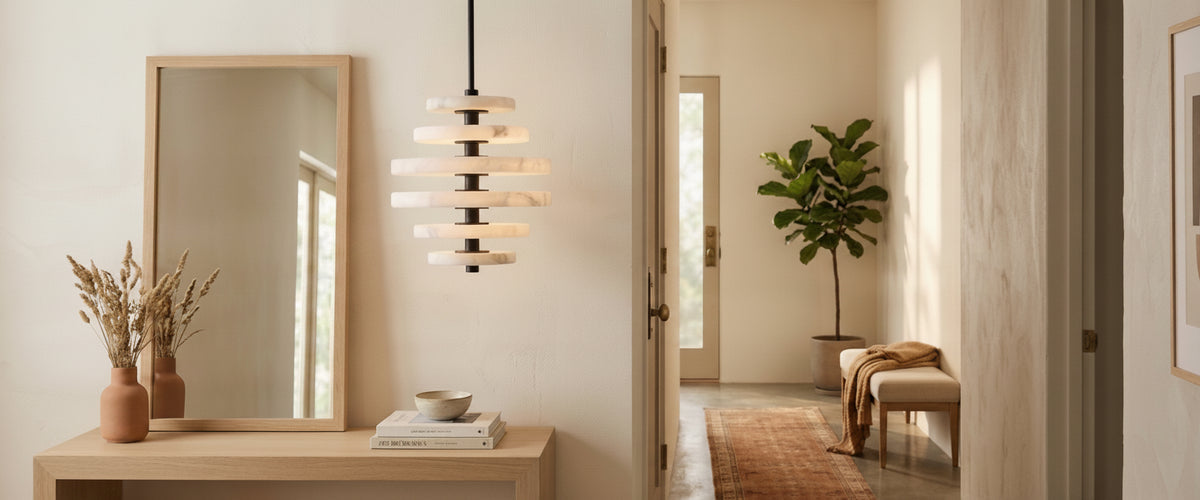

A black entryway chandelier is the most exposed fixture in the house. It hangs in the one room where nobody sits down, where the light gets judged in seconds, and where every visitor looks up whether they mean to or not. Dark metal has no forgiveness built in. A pale fixture blends into a white ceiling and quietly hides a bad drop height; a black entryway chandelier draws a hard silhouette against the plaster and reports every proportion error you made at the specification stage.

At a Glance: What Actually Decides the Purchase
Clearance first. Keep at least 7 feet (2.1 m) between the finished floor and the lowest point of the fixture in any walk-through zone.
Scale second. Add the hall's length and width in feet; that number in inches is a sensible starting diameter.
Finish third. Matte black flattens against modern plaster; satin and gloss hold a highlight and read better against period moldings.
Light output matters more than in any other room. The frame on a black entryway chandelier absorbs light, so the diffuser or shade has to work harder.
Warmth wins. 2700K, CRI 90 or above, on a dimmer specified alongside the driver, not chosen afterward.
Pair black with stone. Alabaster, marble or onyx softens the contrast and stops a black entryway chandelier reading as a dark object floating in space.

Why the Entrance Hall Punishes Poor Lighting Faster Than Any Other Room
Entry halls have no forgiving furniture. There is no sofa throwing a shadow, no rug absorbing glare, no side lamp filling in the corners. Usually there is hard flooring, a mirror, a console, and a lot of vertical wall. Light bounces around, hits polished stone or timber, and shows up every flaw in the beam pattern.
The hall also gets used at more hours than almost anywhere else in the home. Seven in the morning with coats and school bags. Six in the evening with the front door open. Eleven at night when someone comes home and wants enough light to see the stairs without waking the house. One fixture has to cover all of that, which is why a black entryway chandelier lives or dies on its dimming, not on its looks in the product photograph.
Then there is the exterior read. In a double-height entry with a window above the front door, the black entryway chandelier is visible from the driveway, and the height that flatters the interior sightline is rarely the height that centers it in the transom. Check both views before the electrician fixes the drop. A few inches either way decides whether the fixture reads from the street at all.
Ceiling Height and Drop Clearance for a Black Entryway Chandelier
Start with the hard numbers, because a black entryway chandelier that hangs too low reads as an obstruction rather than a feature.
In a double-height void, the visual center of the fixture should sit near the upper floor's eyeline.
Standard-Height Halls (8 to 9 Feet)
Keep the lowest point of the fixture no less than 7 feet (2.1 m) above the finished floor. That leaves very little room, which is why flush and semi-flush forms, or wide-but-shallow ring designs, outperform tiered chandeliers here. If your hall is 8 feet and you want an entryway black chandelier with real presence, go wide rather than deep. A shallow horizontal form such as the Steel Black Linear Pendant Light, 120cm buys presence across the width of the hall while giving back the headroom a tiered fixture would eat.
Double-Height and Stairwell Voids
This is where a black entryway chandelier earns its keep. A useful anchor: hang the fixture so its visual center sits roughly at the level of the upper floor's eyeline, or aligns with the midpoint of the window above the door if there is one. From the ground floor it should feel suspended in the void, not stranded near the ceiling like an afterthought.
Over a Staircase
Measure from the highest tread the fixture passes over, not from the ground floor. Then think about maintenance access. If nobody can reach it without a scaffold tower, choose a design with few, accessible lamps and consider a fixture with a winch point specified at the build stage.
Above a Round Console or Center Table
Leave 30 to 36 inches (76 to 91 cm) between the tabletop and the base of the fixture, and keep the fixture diameter to roughly two-thirds of the table diameter.
Matte, Satin, or Gloss: How Black Finishes Behave in Real Light
Buyers tend to default to matte, and a matte black entryway chandelier is genuinely the safest choice against flat modern plaster, microcement or limewash. It reads as a drawn line. It also absorbs light rather than reflecting it, so the fixture disappears into shadow at night unless the diffusers carry the visual weight.
Satin black is the sleeper option. It holds a soft highlight along curved arms and hoops, which gives a black entryway chandelier dimension in a hall lit largely by a single source. Against white paneling or a painted staircase spindle, satin keeps the chandelier from looking like a cutout.
Gloss black belongs with period plasterwork, ornate cornices and anything lacquered. It picks up bounce from the walls and behaves almost like a dark mirror. Be honest about dust, though. Gloss and near-gloss finishes hold fingerprints from ordinary handling, and a hall near a busy road collects a fine gray film faster than any other room in the house.
One practical note on raw or unpainted render: dark metal against a warm gray render can go muddy under low-CRI light. If the walls are anything other than white, ask for a physical finish sample rather than trusting a screen.
Proportion: Sizing to the Door, the Void, and the Floor Plan
Undersizing is the error we see most, and a black entryway chandelier makes it worse, because a small dark object surrounded by pale ceiling looks even smaller than it is. The length-plus-width rule gives you a floor. A 10 by 12 foot hall suggests a starting diameter around 22 inches; in a double-height space, size up from there, because a fixture read from 18 feet below needs more mass than one read from six.
Stone diffusers on a dark frame keep the silhouette graphic while spreading a warmer, softer light.
Cross-check against the front door. A black entryway chandelier narrower than the door leaf tends to look mean when both are seen together. Cross-check against the stair void too: in a rectangular void, a linear or elongated form often sits better than a round one, which is why slim black linear pendants and bi-emission suspension bars have quietly taken over from traditional tiered chandeliers in narrow entryway schemes. Where the void runs long and narrow and light needs to travel up the wall as well as down onto the floor, a piece like the Sparx Bi-Emission Black Linear Pendant Light 40W 3000K, 181cm is closer to the right design language than a round tiered fitting.
If you want the presence without the visual density, look at globe and bubble forms. Clustered spheres on a black frame give scale while staying transparent; you get volume without a solid black mass overhead. At double-height scale that logic holds best in something like the Global 16 Light Bubble Chandelier, 150cm, where the mass comes from the spread of glass rather than from a heavy frame. Browsing a broad lighting range side by side is the quickest way to feel the difference between a fixture that fills a void and one that merely occupies it.
Bulb Warmth and Dimming: Coaxing Comfort From a Dark Fixture
A black modern entryway chandelier has a lighting problem baked in. Dark surfaces absorb rather than reflect, so the same lamp produces less usable ambient light than it would in a pale fixture. You solve that with the diffuser, not by cranking up wattage.
This is exactly where alabaster earns its place. A black entryway chandelier carrying alabaster discs, cylinders or shades gives you the graphic silhouette people want alongside the soft, honeyed spread that dark metal alone cannot produce. Alabaster is a translucent form of gypsum, and its internal veining scatters light rather than transmitting it in a straight line, which is why the glow reads warm and slightly cloudy instead of glassy. Our alabaster lighting collection is built around that behavior, and the black-and-stone pairing has become one of the most requested combinations for entrance halls.
Specification guidance:
Color temperature: 2700K. Alabaster and onyx already push light toward amber; anything cooler fights the stone.
Color rendering: CRI 90+. Halls contain skin tones, coats, artwork and flowers. Poor rendering shows instantly.
Dimming: confirm driver compatibility before ordering. Trailing-edge dimmers usually suit LED drivers better than leading-edge. Mismatched pairs flicker at low output.
Layering: pair the black entryway chandelier with a stone table lamp on the console and a pair of wall lights beside a mirror. The chandelier then handles atmosphere, not the entire job.
Wiring: always use a qualified electrician for installation, especially for heavy fixtures needing a rated ceiling box or a structural fixing above a stairwell.
The Illuminating Engineering Society publishes useful background on lighting standards and metrics if you want to go deeper on rendering and light levels before you specify.
Six Entryway Chandelier Mistakes That Black Makes Worse
Hanging by ceiling height alone. Sightlines from the door, the stairs and the street all differ. Mock the position with a balloon or cardboard disc on a string before the electrician commits.
Choosing matte to "hide" the fixture. Matte black does not recede against a white ceiling; it advances. If you want quiet, choose a smaller stone-heavy piece, not a darker one.
Skipping the dimmer. A full-output dark fixture at midnight is unpleasant. Any black chandelier for entryway use needs a dimmer from day one.
Ignoring the ceiling plane. Dark canopies show every crack, patch and imperfect skim. Fix the ceiling before the fixture arrives.
Under-scaling for a void. Two-story halls swallow fixtures. When in doubt, size the black entryway chandelier up.
Forgetting access. Lamp changes, dusting and re-tensioning all need a plan. Black shows dust as a gray bloom, faster than brass or alabaster.
Care Checklist for Black Metal and Stone Fixtures
Dust dry with a soft microfiber cloth. Skip feather dusters, which scratch powder-coated finishes.
Never use acidic or ammonia-based cleaners on alabaster, marble or onyx. Acids etch calcium-based stone; the Natural Stone Institute's care guidance is a reliable reference.
Keep water off stone diffusers entirely. Alabaster is porous and will mark.
Check suspension points and fixings annually, particularly on stairwell installations where door slams cause vibration.
Wipe fingerprints from gloss and satin black with a barely damp cloth, then dry immediately to avoid streaking.
Budget: What Actually Drives the Number
On a modern black entryway chandelier, cost comes down to stone selection and yield, fixture scale, metalwork complexity, the driver and dimming engineering, plus installation and finishing on site. Hand-selected alabaster with matched veining across multiple shades costs more than a single-piece diffuser, and a fixture engineered for a 20-foot void carries different structural requirements than one for a standard ceiling. Send us the ceiling height, void dimensions and finish preference and we will quote against the actual space.
Get the clearance, the scale and the warmth right, and a black entryway chandelier stops being a bold gamble. It becomes the piece that sets the tone for everything behind the front door. Start with the room's measurements, then browse the Niori range with those numbers in hand rather than the other way around.