
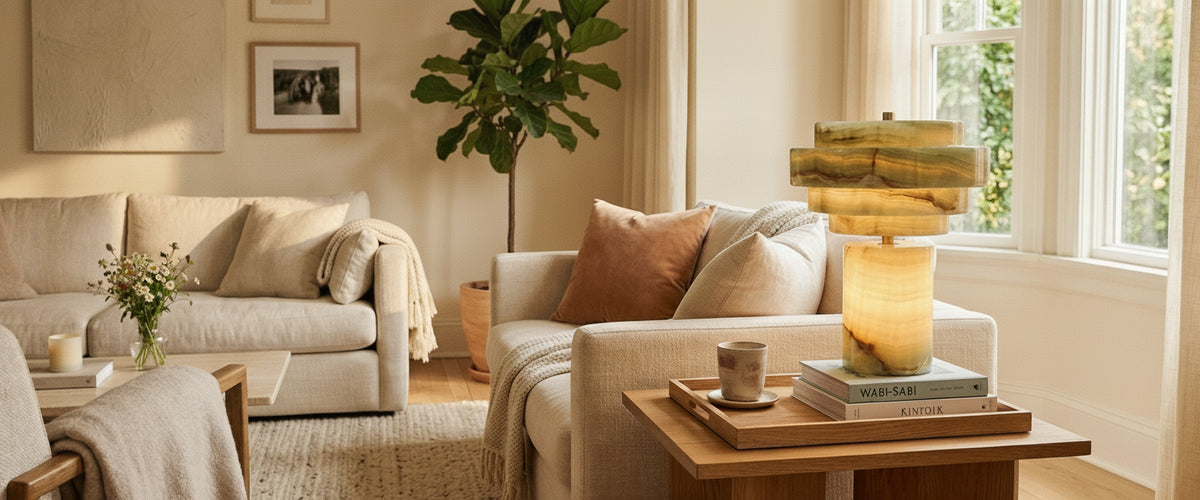

Most people who buy vintage onyx table lamps fall for the stone and forget the socket. That is understandable. A banded green or honey base lit from within has a depth no printed finish gets close to, and the good ones look better at forty than they did new. But a lamp is a piece of electrical equipment wearing a piece of geology, and the second half of that sentence is where the money is either well spent or quietly wasted. At Niori we work with alabaster and natural stone every week, and onyx is the material clients most often bring to us second-hand, hopeful and slightly unsure.

Key Takeaways
- Age shows in the tooling, not the patina. Hand-lapped bases, softened edges and irregular drilling suggest genuine age; laser-flat facets and perfectly concentric bores usually do not.
- Colour is a filter. At the same wattage, honey onyx reads warm and amber, green onyx reads cool and cavernous, white onyx stays closest to the bulb's true colour temperature.
- Assume the wiring needs replacing. Vintage onyx table lamps should be rewired by a qualified electrician before they go anywhere near a socket.
- Shade choice is colour correction. A base that glows amber needs a shade that does not fight it.
- Onyx is calcite, not granite. It scratches, it stains, and acidic cleaners will etch it.

What Separates a Genuine Vintage Onyx Base from a New Cut Sold as Antique
Onyx marble has been quarried and turned into lamp bases for well over a century, with heavy production in Italy, Mexico and Pakistan from the 1950s onwards. That long run is exactly why the market in vintage onyx table lamps is muddy. A newly cut Pakistani onyx stone table lamps, fitted with an aged brass collar and photographed on linen, can pass for 1960s Italian to anyone shopping quickly.
Look at the machining first. Older bases were turned and lapped with human variation: edges are slightly soft, the underside is often roughly finished or shows tool chatter, and the felt pad has usually been replaced at least once. Contemporary CNC work leaves crisp, uniform edges and a base plane so flat it will not rock on a glass table. Then look at the metalwork. Period fittings tend to be solid brass gone unevenly dark where hands touch it, with imperial rather than metric threading on British and American pieces. Spray-lacquered brass with factory-perfect ageing across every surface is a red flag.
The final tell is the stack. Mid-century bases were commonly built from several sawn discs threaded onto a central rod, and after decades those joints show hairline movement, adhesive residue lines or slight misalignment. A single monolithic block is not proof of a fake, but it is more typical of recent production.
Green, Honey, and White Onyx: How Each Colour Transmits Light
Put three bases side by side with identical 4W LED lamps inside and you get three different rooms. Onyx is a banded calcite, formed as mineral-rich water deposits layer after layer, which is why the veining runs in ribbons rather than the scattered clouds of true marble; the Natural History Museum is a good starting point if you want the geology behind it.
Honey and amber onyx is the most forgiving and the most flattering to skin tones. It drags a 2700K bulb visually towards candlelight, which makes it superb beside a bed and slightly muddy in a room where you actually need to read.
Green onyx table lamps behave differently. Green bands absorb more of the warm end of the spectrum, so the glow reads cooler, denser and more dramatic, with the dark veining showing as near-black rivers. Green onyx wants more lumens than honey to look alive, and it sits best against warm woods, olive plaster or deep lacquer rather than cool grey schemes.
White and cream onyx behaves closest to alabaster, transmitting light evenly with the least colour shift. If you want the stone to disappear into a calm scheme rather than announce itself, this is the one. It is also the closest match if you are pairing a vintage find with contemporary pieces from our alabaster lighting collection, where the light quality is deliberately soft and low-contrast.
Reading a Vintage Base Before You Commit
Take a torch. Not a phone light, a proper one. Held against the side of the base, it shows everything the polished surface hides, and it is the single test that sorts sound vintage onyx table lamps from expensive ornaments.
- Structural cracks vs veining. Bands run continuously and follow the layering. A crack cuts across them and reads brighter or duller under backlight. One that circles the drilled bore is the one to walk away from.
- Old repairs. Epoxy usually shows as a flat, glassy patch with no banding. Filled chips on a rim are cosmetic and negotiable; a glued break through the body is not.
- Drilling history. Check whether the central bore is original or has been re-drilled, widened or offset. Chipping at the entry hole and fresh white powder mean recent work.
- Weight and stability. A 35cm base can weigh 3.5 to 5.5kg. Lift it. If it feels light for its size, the stone is thinner than the profile suggests.
- Surface condition. Cloudy rings usually mean somebody stood a glass on it or cleaned it with a bathroom spray.
A client in Harrogate sent us photographs of a pair of 1970s bases last spring, both looking perfect. Under a torch, one had a hairline running from the bore to the outer face, invisible in daylight. She kept the sound one as a lamp and used the other as a bookend. That is the right call more often than people expect. When a pair breaks up like that, a contemporary partner of similar height usually beats a mismatched vintage substitute, and on a bedside where the onyx sits around 20cm tall a compact glass form such as the Estro Globe Glass Table Lamp, 21cm holds the symmetry without pretending to be stone.
Choosing a Shade for a Base That Already Has a Colour Temperature
An onyx marble table lamp is doing two lighting jobs at once if the base is lit, and one very opinionated job if it is not. Either way, shades for vintage onyx table lamps have to work with the stone rather than against it.
For honey and amber bases, avoid optic-white shades: they read blue-ish next to warm stone. Oyster, parchment, mushroom and warm ivory silk all sit comfortably. For green onyx, cream or bone gives contrast without going cold, while black-lined shades throw light down hard and turn a soft base into a spotlight. If you find yourself correcting the base colour at every stage, the room probably wanted a neutral, self-diffusing fixture in the first place, and something like the Dolce 1 Light Glass Table Lamp is closer to the right design language for even light rather than an amber wash.
On bulbs, use a warm LED at 2700K with a high colour rendering index, ideally CRI 90 or above, because veining collapses into mush under poor rendering. Keep any internal base lamp low, around 2W to 4W, so the stone glows rather than glares. Put both circuits on an LED-rated dimmer; older leading-edge dimmers with modern LEDs are the usual cause of flicker and buzz.
Where Vintage Onyx Earns Its Patina, and Where It Quietly Clashes
Vintage onyx table lamps suit rooms with layered, low light and something warm in the palette: a pair flanking a bed, a single base on a hallway console, a study desk where the amber glow does the atmospheric work while a separate task light does the reading. Panelling, deep upholstery and aged brass take onyx effortlessly.
The clashes are predictable. Cool grey minimalist schemes with brushed steel make honey onyx look orange and stranded. Kitchens are hard on the stone because of grease and citrus cleaners, and bathrooms are worse; calcite and standing moisture do not agree, and there are zone regulations besides. A lone stone piece in a room of contemporary glass rarely settles, which is why we suggest committing to two or three stone pieces or letting a coordinated set carry the scheme. Scale matters as much as material: a 35cm base on a console needs a companion with comparable visual mass, which is where a fuller form like the Global Globe Table Lamp, 30cm balances better than a slim, tall silhouette. Browsing a full lighting range as a group rather than piece by piece tends to prevent that.
Electrical Conversion: What a Sound Specification Looks Like
Here is where most vintage onyx table lamps are either saved or ruined. Anything bought at auction, from a dealer or out of a family attic should be treated as unwired until proven otherwise. Rubber-insulated flex from the mid-century era perishes into a crumbly, conductive mess, and old brass lampholders lose their earthing continuity. None of that is visible from the outside.
A sound conversion includes new flex of appropriate rating, a new lampholder with the correct earthing arrangement for a metal-bodied fitting, a properly fitted and fused plug, a grommet or bush where the cable passes through stone or metal, and a fully tested finished assembly. Ask whether the work has been PAT tested and whether the lamp is Class I or Class II as converted. If a seller cannot answer, budget for a rewire and factor it into what you pay. Fixed electrical work in the home falls under building regulations, and the official Approved Document P guidance sets the standard worth knowing before you make assumptions. Always use a qualified electrician; this is not a weekend job with a screwdriver and a video.
Reject outright: twisted-together conductors with insulating tape, two-core flex feeding a metal-bodied lamp with no earth, a cable entering the stone through an unbushed hole, and any lampholder that wobbles in its thread. Also reject any seller who says a lamp is "fine as long as you don't leave it on".
Buying Checklist
Five minutes with this list will tell you more than any listing description.
- Backlight the base with a torch and map every line before you talk about price.
- Confirm whether the base is one block or a stacked assembly, and check the joints.
- Ask directly: has it been rewired, when, and by whom?
- Match the onyx colour to the room's palette, not just to your favourite photograph.
- Plan the shade and the bulb at the same time as the base.
- Check the lamp sits dead flat and that the flex exit does not force it to rock.
- Factor in rewiring, a new shade and possible re-polishing when you set your ceiling, and get a written quote rather than guessing.
Living With Onyx Afterwards
Dust with a dry microfibre cloth. For marks, use a barely damp cloth with a pH-neutral cleaner and dry immediately. No vinegar, no lemon, no bathroom or kitchen sprays, no abrasive pads; calcite etches on contact with acid and the damage is permanent without professional re-polishing. Keep drinks off the stone, and re-check the flex every few years for stiffness or cracking near the entry point.
Bought well, vintage onyx table lamps outlast most of the furniture around them. Bought on the photograph alone, they cost the saving twice over. If you would rather have the same warmth of stone with contemporary engineering behind it, the natural-stone and alabaster pieces we make at Niori give that internal glow without the guesswork about what is inside the base.