
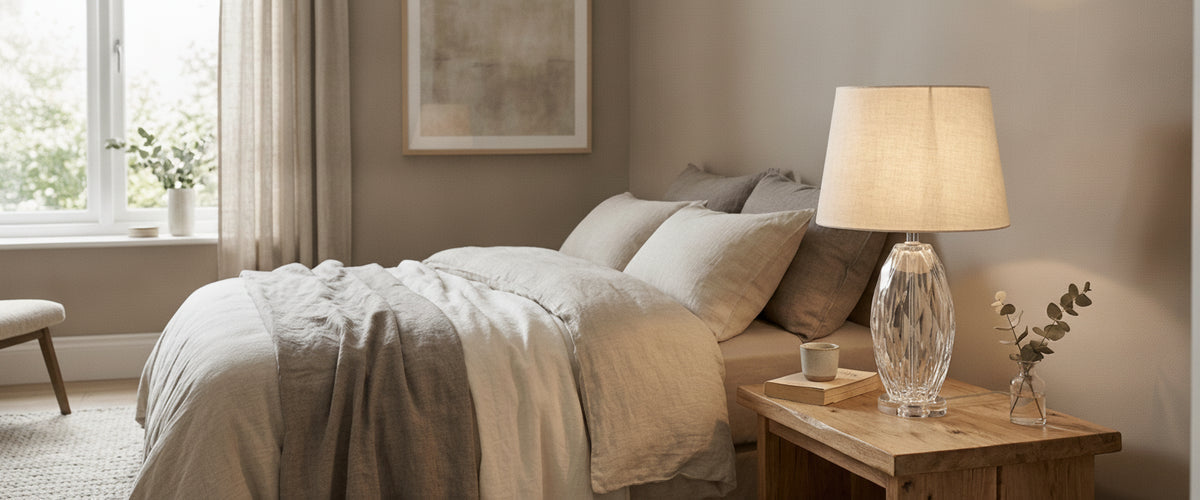

Crystal bedside table lamps are sold under conditions that will never exist in your bedroom. Showrooms run banks of ceiling spots at high output, angled to rake across every facet, so the glass throws sparks in all directions and looks alive. Take the same table lamp home, sit it on a nightstand at 11pm with one 5W bulb inside it, and the fireworks stop. That gap between the shop floor and the bedroom is the single biggest reason people fall out of love with crystal lighting, and it is entirely avoidable if you know what to look at before you pay.

Key Takeaways Before You Shop
Judge crystal bedside table lamps by their own light source, not the room's. Ask to see the lamp switched on with the showroom lighting dimmed, or ask the seller for a video of it lit in a dark room.
Weight, edge sharpness and sound are the fastest tells that separate cut lead crystal from pressed glass and molded acrylic.
Shade height matters more than lamp height. The bottom edge of the shade should sit near eye level when you are propped up reading.
2700K or dim-to-warm, CRI 90+, and a trailing-edge dimmer. A bedroom lamp that only does full brightness is a failed bedroom lamp.
A matched pair of crystal bedside table lamps is the safe answer; a single considered lamp is often the better one when the two sides of your bed do different jobs.
Alabaster gives you the glow crystal cannot, because the stone itself becomes the light source rather than scattering it.

Why Showroom Lighting Flatters Crystal and Your Bedroom Never Will
Crystal does not produce light. It redirects it. Every facet works as a small prism and mirror, which means the drama depends almost entirely on how much external light is hitting the piece and from what angle. A retail display is commonly lit to somewhere around 750 to 1,000 lux, with tight-beam spots positioned to catch decorative glass, while a bedroom at night sits closer to 20 to 50 lux. That is a difference of more than an order of magnitude, and it is why crystal bedside table lamps can look electric in a shop and inert on your nightstand.
Two things fix this. First, look for crystal bedside table lamps where the bulb sits low and inside the crystal body rather than high above it, so the glass is lit from within and refracts its own source. Second, choose crystal with deeper, more varied cutting; shallow decorative etching needs strong external light to register, while genuine hand-cut facets will still catch a bedside glow. The most common complaint we hear follows the same pattern every time: a heavily faceted pair, chosen on the strength of a brightly lit display, looks gray three weeks after it arrives. The lamps are almost always fine. The bedroom has no ceiling spots and no picture lighting, so there is nothing for the crystal to work with.
If your bedroom is deliberately low-lit, and most good ones are, be honest about that before you commit to crystal bedside table lamps, because the material borrows brightness from its surroundings rather than making its own.
Cut Crystal Versus Molded Acrylic: The Visual Tells
Retail listings shuffle the words around, so the same shelf can be labeled bedside table lamps crystal, crystal-effect, or simply glass, and a good share of what is sold as crystal bedside table lamps is pressed soda-lime glass, K9 optical glass or molded acrylic. None of those are dishonest materials at the right price and in the right room, but you should know which one you are holding before you pay a crystal premium. Where the piece is meant to be a small pool of ambient light rather than a display object, a self-lit crystal-effect body such as the Lustris LED Rechargeable Table Lamp is honest about what it is doing, because the light comes from inside the form instead of depending on the ceiling.
Weight
Lead crystal is dense. Traditional full lead crystal, the standard used by houses such as Waterford and Baccarat, carries roughly 24 percent or more lead oxide, which raises both weight and refractive index; the Corning Museum of Glass is a useful reference on how the composition changes optical behavior. Pick the base up. The base of a genuine crystal bedside table lamp should feel surprisingly heavy for its size. Acrylic feels like a prop.
Edges
Run a fingertip along a facet junction. Hand-cut crystal has crisp, slightly irregular arrises where two planes meet, and the polish carries right into the corner. Molded pieces have softened, uniform edges and often a faint seam line running vertically through the pattern. Hold the piece against a window and look for that seam. It is the most reliable single tell.
Optical behavior
Lead crystal disperses light into visible color fringes at the edges of facets, because its refractive index sits near 1.7 against roughly 1.52 for ordinary soda-lime glass and about 1.49 for acrylic. Acrylic scatters white. Put your phone torch against the base of a crystal bedside table lamp in a dark room and watch what lands on the wall: rainbow edges mean crystal, a flat white smear means it is imitating one.
Sound and temperature
Tap the rim gently with a fingernail. Crystal rings and holds the note. Glass gives a shorter click. Acrylic gives nothing. Crystal also feels cool to the touch and stays cool; acrylic warms to your hand within seconds.
Lamp Height and Shade Diameter Relative to the Bed
This is where most bedside buying goes wrong, and crystal bedside table lamps get it wrong as often as any other material. Measure from the floor to the top of your bedside table, then from the floor to your eye level when you are sitting up against the headboard. The bottom edge of the shade wants to land at or just below that seated eye level. Too high and you stare straight into the bulb every time you look up from a book. Too low and the light pools on the table instead of the page.
As general guidance, a bedside table of standard height pairs well with a lamp whose overall height sits somewhere around 55 to 70 cm (roughly 22 to 28 inches), and most crystal bedside table lamps that work well at a bed land in that band, but the seated eye-level test beats any rule of thumb. Taller headboards push the number up. Low platform beds pull it down hard, and a lamp that looked correct in a showroom vignette can tower over a Japanese-style bed frame. Against a low bed, a compact form such as the Arc Small Table Lamp keeps the light below the sightline in a way a tall faceted base cannot.
Shade diameter has its own logic. The shade should not overhang the front edge of the table, or you will catch it with your elbow reaching for a glass of water. On a narrow nightstand, crystal bedside table lamps read better with a smaller shade over a taller base than with a wide drum crammed onto a small surface. Leave room for the things a bedside table actually holds: a book, a glass, a phone, reading glasses. If the lamp footprint takes more than about a third of the table top, size down, or start from a wider surface; a two-drawer piece like the Camvenne 2 Drawer Bedside Table gives a substantial lamp somewhere to sit without crowding everything else off the top.
Color Temperature and Dimming for a Room Built Around Sleep
A bedroom lamp has one non-negotiable job: it has to go quiet. Specify 2700K as the baseline warm white for crystal bedside table lamps, or better, choose a dim-to-warm LED that drops toward 2200K as you lower the output, mimicking the way an incandescent filament used to behave. Push much past 3000K and the room starts to feel like a hallway. Anything at 4000K belongs in a garage. On output, roughly 200 to 400 lumens at the reading side is plenty; the E27 or E14 lamp you drop in matters as much as the base it sits in.
Color rendering matters too. Look for CRI 90 or higher. Crystal bedside table lamps do optical work with the light passing through them, and a poor-quality LED with a spiky spectrum makes the refracted color fringes look muddy and slightly green. With a high-CRI source the dispersion is clean and the base looks like the material it is.
On dimming, most modern LED crystal bedside table lamps want a trailing-edge dimmer; leading-edge is the older technology and tends to buzz or flicker at low levels. Check that the lamp's driver is listed as dimmable before you buy, and if you are dimming from a wall plate rather than an inline switch, match the dimmer to the load. Evidence on light exposure before bed is now well established; the Sleep Foundation summarizes how evening brightness and blue-weighted spectrum suppress melatonin and shift the circadian clock, which is a good argument for a lamp that can run at very low output rather than one that only knows on and off.
One practical note for renovations: if you are moving from plug-in lamps to hardwired bedside wall lights, that is work for a qualified electrician, not a weekend job.
Symmetrical Pairs Versus a Considered Single
Matched pairs of crystal bedside table lamps are the default for good reason. They settle a room, they read as intentional, and they give both occupants equal control. If your bed sits centrally on a wall with equal space either side, buy the pair and stop thinking about it.
Asymmetry earns its place when the two sides of the bed are genuinely different. A bed pushed toward one wall, a window on one side, a tall chest of drawers on the other, a partner who reads and a partner who does not. In those rooms, one substantial crystal bedside table lamp on the reading side plus a small wall-mounted swing arm or a low stone lamp on the other looks considered rather than mismatched. It is the standard fix where one nightstand backs onto a chimney breast and the other has depth to spare: a single sculptural lamp on the deeper side and a slim reading light opposite solves a problem that two identical lamps would have made worse.
The rule that keeps asymmetry from looking accidental: repeat one element across both sides. Same metal finish, same shade color, or same light temperature. Vary the form, not the palette.
Where Alabaster Outperforms Crystal at Bedside
Crystal splits light. Alabaster holds it. That single difference explains why so many designers who like crystal bedside table lamps in principle still reach for stone in a bedroom. Alabaster is a fine-grained gypsum, quarried most famously around Volterra in Tuscany, and it is translucent rather than transparent, so the bulb inside a carved shade turns the whole body of the stone into a soft, honeyed light source, with the mineral veining showing as darker and lighter passages across the surface. At low output it still reads as luminous, which is precisely where faceted glass gives up. Onyx behaves similarly but with stronger banding, if you want the glow with more pattern.
Alabaster also behaves better against a wall. Crystal throws hard sparkle onto adjacent surfaces; stone throws a wide, forgiving wash that flatters plaster, paneling and skin. If you have ever wondered why hotel suites so often use stone or opal shades at the bed and save the glitter for the lobby, that is the reason. You can see the range of forms this material takes across our alabaster lighting collection, from small bedside pieces to larger sculptural bases.
There is a maintenance dimension too. Alabaster is a soft stone, around 2 on the Mohs scale, and it dislikes water, so it wants a dry microfiber cloth and no household sprays. Crystal bedside table lamps need frequent cleaning to keep their optical performance, because dust sitting in the facets kills refraction faster than anything else. Neither is difficult; they simply ask for different habits.
The Bedside Lamp Buying Checklist
See it lit in the dark. Showroom brightness is not a fair test for crystal bedside table lamps.
Check for a mold seam down the base before you accept a crystal claim.
Test seated eye level against the bottom edge of the shade, not the top of the lamp.
Keep the footprint under about a third of the bedside table surface.
Confirm the lamp is dimmable and specify 2700K or dim-to-warm, CRI 90+.
Choose switch position deliberately. Inline cord switches are easier to find half-asleep than a twist knob under a hot shade.
Match metal finishes to door furniture and the bed frame, not to the rest of the house.
Ask about cable color and length. A white flex against a dark wall undoes an expensive lamp.
Plan for both sides before you commit to a single, so you are not hunting for a partner lamp a year later.
Where Crystal Still Wins
None of this is an argument against crystal. In a bedroom with layered light, a picture light over artwork, a dimmed ceiling fitting, curtains that reflect rather than absorb, crystal bedside table lamps look magnificent because there is enough ambient light for them to work with. Crystal also suits period rooms with cornicing and mirrored surfaces, where the sparkle echoes existing detail rather than sitting alone.
Type bedside table lamps crystal into any marketplace and you will get cut lead crystal, K9 glass and acrylic side by side in the same grid. The deciding question is not which listing photographs best but whether your room can feed the facets: crystal is worth pursuing when the room supplies ambient light, and alabaster is worth pursuing when the lamp has to carry the room by itself. Plenty of projects use both, one material at the bed and the other in the pendant overhead. Price varies with material grade, scale, the complexity of the cutting or carving, and the finishing, so ask for a quote on the specific piece rather than working from a headline figure.
Browse the wider lighting range if you are specifying a whole room, and talk to us about pairing and scale before you order, whether you settle on crystal bedside table lamps or carved stone; getting the height right at the outset saves a return.