
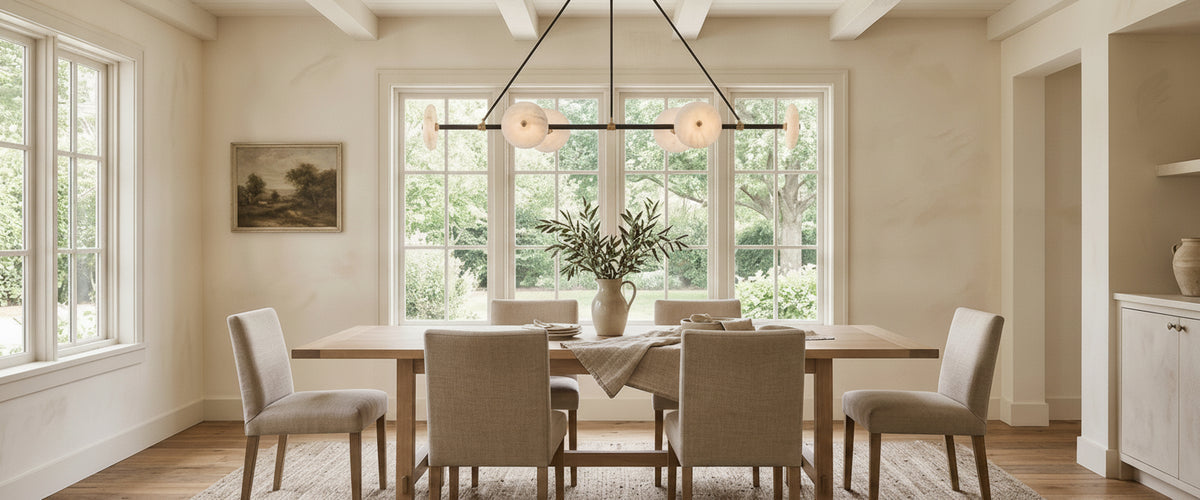

Type farmhouse chandeliers dining room into a search bar and you will get thousands of results, most of which fail in one of two predictable ways. Either the fitting is undersized and floats above the table like a pendant that wandered into the wrong room, or it is so dark and dense that everyone at the table is lit from a hard point source and looks ten years older by dessert. Both problems get decided at the buying stage, not at installation. The farmhouse chandeliers dining room shoppers stay happy with are settled on three arguments before anything ships: scale, finish and light quality.

Key Takeaways
Hang the bottom of the fixture 30 to 36 inches (76 to 91 cm) above the tabletop for an 8 ft ceiling, and add roughly 3 inches for every extra foot of ceiling height.
For diameter, add the room's length and width in feet and use that number in inches. A 12 ft by 14 ft room suggests roughly a 26 inch (66 cm) fixture.
Over a long table, a linear fixture or two matched chandeliers usually beats one oversized round one.
Warm color temperature (2200K to 2700K), high CRI and a properly matched dimmer do more for the mood of farmhouse chandeliers dining room schemes than the metalwork does.
Living finishes such as unlacquered brass and blackened iron improve with age; thin sprayed antique effects rarely survive year two.

What the Farmhouse Chandeliers Dining Room Category Actually Covers
"Farmhouse" is a broad church, and the farmhouse chandeliers dining room buyers actually shortlist fall into four groups. At one end sits forged and blackened iron: candle-style arms, visible rivets, honest weight. Next to it, distressed and reclaimed wood, often a beam or wagon-wheel form with metal strapping. Then antiqued and burnished brass, which reads warmer and slightly more refined, and increasingly a modern-rustic strand that keeps the simple armature but swaps ornament for clean geometry and better materials.
That last strand is where a lot of designers are landing, and it is where farmhouse chandeliers dining room schemes start behaving properly as light sources rather than sculpture. A blackened metal frame carrying alabaster shades gives you the rural silhouette with a diffused, candle-warm glow instead of naked bulbs glaring back off a lacquered table. We ship a lot of that combination into barn conversions and beamed extensions, precisely because the stone softens the hard edges the architecture already supplies.
Ceiling Height and Beams Decide Everything Else
Before you look at a single fixture, look up. A flat 8 ft ceiling and a 16 ft vaulted ridge with exposed trusses are entirely different design problems, and a chandelier that suits one of them will look absurd in the other.
Under a standard ceiling, the farmhouse chandeliers dining room owners choose have to earn their place horizontally, because they have no vertical room to perform. Wide and shallow wins. Tiered chandeliers, candle-style pieces with tall stems and anything with a long chain will crowd the sightline across the table and block the view of whoever is opposite you.
Vaulted or beamed rooms invert that logic. Height gives you permission to go taller and more theatrical, but only if the fixture is hung from a point that relates to the structure. A chandelier dropped from the apex of a vault with 6 ft of chain often reads like an afterthought; one suspended from a cross beam, so the beam frames it, reads deliberate. It is the single biggest fix for farmhouse chandeliers dining room projects under a vault, and we see the same instinct again and again in barn conversions: hang the biggest piece at the ridge. Moving that drop to the tie beam, roughly 2 ft lower and centered on the table rather than the room, transforms the result. Same chandelier, different anchor point.
One practical note: on a sloped ceiling you need a sloped-ceiling adaptor or a canopy rated for the pitch, and the whole assembly must be fixed into structure, not just a plasterboard box. Farmhouse dining room chandeliers are often heavier than they look, so ask us for the fixture weight before your electrician specifies the fixing, and get a qualified electrician to confirm the mounting and the load. Never guess it from photographs.
Farmhouse Chandeliers Dining Room Sizing: Two Measurements
Two measurements matter, and people usually only apply one of them.
Room-based diameter. Add the room's length and width in feet, then treat that figure as inches. A 13 ft by 15 ft dining room points to about a 28 inch (71 cm) fixture. This stops the chandelier from being swallowed by the volume of the room.
Table-based width. The fixture should be roughly half to two-thirds the width of the table, and it should never come closer than 6 inches (15 cm) to the table edge on either side. Get this wrong and guests bump it standing up, or the light spills onto chair backs instead of plates. Most sizing complaints about farmhouse chandeliers dining room purchases trace back to this rule being skipped.
When the two rules disagree, follow the table. A generous room with a narrow table needs the light concentrated where people actually sit, and the room can be balanced with wall lights instead. For tables over 8 ft (2.4 m), stop trying to solve it with one piece. Two matched chandeliers spaced evenly down the length of the table, or a linear suspension, will light the surface far more evenly than a single oversized fixture that leaves both ends dim. Where the table is long but the ceiling will not carry two fixtures gracefully, a wide multi-arm frame that spreads its sources outward, such as the Rendez-vous 10 Light Chandelier, Brass, covers more of the surface than a compact six-arm piece of the same nominal diameter.
Hang Height, Settled
Thirty to thirty-six inches (76 to 91 cm) from tabletop to the lowest point of the fixture is the working range that farmhouse chandeliers dining room installations follow under an 8 ft ceiling. Toward 30 inches for intimacy and low-profile fixtures; toward 36 inches for bulkier pieces or if anyone at the table is notably tall. Add about 3 inches per additional foot of ceiling height. Measure from the table surface, not the floor, and always test the drop with a cardboard mock-up taped to a broom handle before the electrician commits. It takes five minutes and has saved more than one client a second visit.
Finishes That Still Look Right at Year Three
This is where the money either holds or evaporates. Solid brass left unlacquered will darken unevenly around the touch points and settle into a patina that looks better every year. Blackened or oil-rubbed iron does the same, wearing through at the high points to reveal the metal underneath. Both are living finishes, and both are the reason honest farmhouse chandeliers dining room schemes look convincing in old houses.
Sprayed "antique" coatings on plated base metal behave differently. They start out looking aged, which is the trick, and then they stop changing while everything around them keeps developing. By year two the effect looks painted on, because it was. Wood arms need the same scrutiny: solid reclaimed timber checks and moves and gains character; printed-grain veneer over MDF does not tolerate the dry heat above a dining table.
If you want the warmth of aged metal without waiting three years for it, a burnished rather than sprayed finish is the honest shortcut; something like the Corinne 6 Light Orb Chandelier, Burnished Brass starts mellow and keeps deepening instead of stalling at the factory's idea of "antique".
Stone is the outlier here, and it is the one material on farmhouse chandeliers dining room fixtures that does not age at all in a visual sense. Alabaster and marble were formed over geological time; a decade above your table is nothing to them. What they need is protection from moisture and abrasive cleaning, which we will come to.
Where Alabaster Belongs in a Rustic Scheme
Alabaster earns its keep in farmhouse chandeliers dining room schemes because it does the thing candles used to do: it glows rather than glares. The stone is translucent enough to carry light through its body, so the shade itself becomes the light source and the veining reads as a warm map across the surface. Against rough plaster, reclaimed oak and blackened metal, that softness is the counterweight the room needs.
Practically, it also solves the glare problem that plagues exposed-bulb fixtures hung over a polished or glass tabletop. Reflected filament glare is genuinely unpleasant at eye level; a diffusing stone shade eliminates it. If you want to see how the material behaves across different frame styles, our alabaster lighting collection is the clearest place to compare shade forms side by side before you commit to a silhouette.
Onyx is the more dramatic cousin, with stronger banding and warmer color when backlit, though it can overpower a quiet room. Honed marble reads more architectural and blocks more light, so it works better as an opaque shade with the glow directed down. Where the beams and plaster already supply the texture and the light needs to fall cleanly onto the table, an opaque stone shade such as the Marble 6 Light Chandelier, Brass speaks the right language better than a translucent shade that spills light in every direction.
Mixing Non-Farmhouse Furniture Without a Fight
Very few dining rooms are purely one style, and farmhouse chandeliers dining room designs do not demand one. What matters is which element you let dominate.
Works well: a blackened iron and alabaster chandelier over a mid-century walnut table. The metal picks up the leg detail; the stone keeps it from looking severe.
Works well: burnished brass with painted Shaker cabinetry and rush-seat chairs. Warm metal reads as period-appropriate without being literal.
Argues: heavy distressed wood over a high-gloss lacquered or glass table. Two loud textures, no mediator.
Argues: polished chrome or polished nickel with rough-sawn beams. The reflectivity fights the matte surfaces around it.
Bridge trick: repeat the chandelier's metal in one other place in the room, a cabinet pull or a wall light, and the whole scheme locks together.
Bulbs and Dimming: The Part That Makes or Breaks It
The firelit quality this aesthetic depends on comes from the light, not the metalwork. Aim for 2200K to 2700K. Anything at 3000K and above starts reading commercial, and farmhouse chandeliers dining room lighting at 4000K looks like a hardware display.
Specify a color rendering index of 90 or higher. Food, timber and skin all look markedly better under high-CRI light, and the difference on a dining table is obvious rather than technical. Lighting researchers, including the Lighting Research Center, have long documented how much color rendering shapes the perceived quality of a space.
Then dim it properly. Match the dimmer to the LED driver; a leading-edge dimmer paired with the wrong driver produces flicker, buzz and a dead zone at the bottom of the range. Ask your electrician to confirm compatibility rather than assuming. Use identical bulbs across every socket, from the same batch where possible, because mixed color temperatures across the arms of a chandelier are impossible to unsee once noticed.
Pre-Purchase Checklist
Measure ceiling height, table width and table length; calculate both the room-based and table-based diameters.
Decide the anchor point: joist, beam, or sloped ceiling with an adaptor. Confirm structural support with your electrician.
Request the fixture weight and full drop range, including whether the chain or rod can be shortened on site.
Mock up the hang height in cardboard and live with it for a day.
Choose finish by how you want it to look in five years, not five weeks.
Confirm bulb base, maximum wattage, color temperature and dimmer compatibility as one decision.
For stone shades, ask whether pieces are matched for veining and translucency across the fixture.
Get a tailored quote. Budget on natural-stone farmhouse chandeliers dining room pieces depends on material, scale, the complexity of the metalwork, engineering and finishing, so a considered quote beats a guessed range.
Living With It: Care Above a Dining Table
A dining room is a greasy environment, whatever your extraction is like. Airborne cooking oils settle on horizontal surfaces, and the farmhouse chandeliers dining room hosts love most tend to carry stone shades that face upward by design.
Dust with a dry, soft brush or a clean microfiber cloth every few weeks. Alabaster is a gypsum stone, considerably softer than marble and sensitive to water, which is why conservation guidance from bodies such as the Smithsonian's Museum Conservation Institute steers firmly away from wet cleaning on gypsum-based materials. Skip the glass spray entirely. For a stubborn mark, a barely damp cloth followed immediately by a dry one is the limit, and never let moisture sit in a carved recess.
Metal parts want the same restraint. Unlacquered brass should be left alone unless you actively want to reverse the patina you paid for. Iron needs only dusting. Check the suspension and canopy fixings on farmhouse chandeliers dining room installations every couple of years, particularly in rooms with underfloor heating or a wood stove, where seasonal movement is greater.
Get the scale right, buy a finish that improves rather than fades, and light it warm and low. Do those three things and the farmhouse chandeliers dining room schemes you build will hold the space together for decades. If you want a broader look at frame styles, drop options and materials across pendants, chandeliers and wall lights, the full Niori lighting range is a useful place to compare, and our team is happy to talk through sizing for your specific ceiling before you order.