
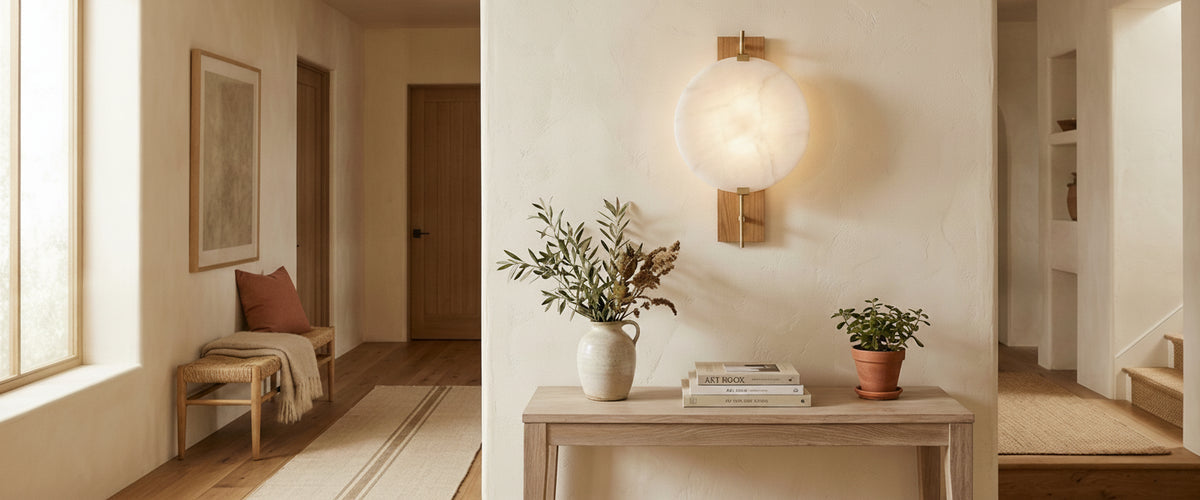

Most wooden wall lights fail for one reason: the timber is doing nothing. It sits on the wall as a veneered rectangle behind a bulb, contributing no structure, no diffusion and no shadow, and within a year it has faded on the side nearest the window. Good timber fittings work differently. The wood carries the fixture, catches the downward wash of light and gives the shade a surface to read against, which is precisely what an alabaster or stone shade needs from a backplate. At Niori we build our range around alabaster and natural stone, so we spend a lot of time looking at what sits behind the shade, and wood is one of the few materials that can hold its own next to it.

Key Takeaways
- Structure beats surface. The wooden wall lights that age well have a solid or thick-laminated timber body rather than a wood-effect film over MDF.
- Species changes the light. Pale oak bounces warmth back into the room, ash stays closer to neutral, and walnut absorbs the spill and tightens the beam visually.
- The shade decides the mood. Alabaster gives a warm, cloudy glow with visible veining; linen is soft and matte; clear glass leaves the bulb exposed.
- Height is not decorative. Around 1.5m to 1.7m (roughly 5ft to 5ft 7in) to the centre works for corridors; bedside sconces sit lower.
- Timber moves. Central heating in winter can dry a room to the point where joints open slightly, so humidity matters more than polish.

Where the Wood Is Structural and Where It Is Just Decoration
Pick up two wooden wall lights and the difference is immediate. In the first, the timber is the chassis: the backplate is machined from solid stock, the fixings anchor into the wood itself, and the arm or channel is cut rather than glued on. In the second, a 0.6mm veneer or a printed foil wraps a board, the electrics sit in a metal housing behind it, and the wood is a colour choice rather than a component.
Neither is automatically wrong. A slim up-and-down bar light with a wood-effect finish, such as the Mayenne Up Down Outdoor Wall Light, can work well outdoors, where real timber would need annual oiling and would silver unevenly under British weather. Indoors, in a hallway you pass four times a day, the gap between the two kinds of wooden wall lights shows. Veneer edges lift where a hand brushes them. Foil finishes scuff at switch height and cannot be sanded back. Solid timber takes a knock and looks older rather than damaged.
Ask three questions before you commit: is the wood solid, laminated or applied; how is the fitting fixed to the wall behind it; and can the driver or lampholder be reached without dismantling the wooden body. That last one catches people out. We have had customers send photographs of a sealed timber sconce with an integrated LED module and no service access, which turns a ten-minute swap into a full replacement.
Oak, Walnut and Ash: How Species Shifts Perceived Warmth
Timber does not simply sit under light; it re-colours it, which is why two otherwise identical wooden wall lights can leave the same room feeling warmer or cooler. A pale European oak backplate has high reflectance and an amber undertone, so a warm 2700K lamp bounces off it and comes back into the room warmer still. Under a soft alabaster shade that can tip genuinely golden. In a north-facing sitting room that is a gift. In a south-facing kitchen with terracotta tiles it can read heavy by mid-afternoon.
Ash is the cooler of the pale timbers. The grain is straighter and more open, the tone closer to neutral, and it holds a crisper edge against white plaster. If you want the wood to read as a quiet frame rather than a warm glow, ash is usually the safer specification.
Walnut behaves like a light absorber. Very little bounces back off a dark chocolate backplate, so the beam looks tighter and more directional even when the fitting has not changed. That is useful behind a bed, where you want the pool of light contained, and it is why walnut pairs so convincingly with white alabaster: the contrast makes the stone look lit from within rather than simply illuminated. One observation from the studio, learned the hard way: unfinished white oak next to a warm-white lamp can pull slightly pink. A hardwax oil with a neutral or white pigment holds the colour steady.
Shade Material Is the Deciding Variable
Change the shade and the same wood wall lights becomes a different object. Most buyers choose wooden wall lights on the timber alone, then wonder why the light in the room is not what they pictured.
Alabaster
Alabaster transmits light rather than blocking it, so the shade itself becomes the light source. You see the veining, the density changes, the faint honey cast at the thin points. Against oak the effect is soft and continuous; against walnut it is graphic. Because each block is different, no two shades match exactly, which is a feature rather than a defect. Our alabaster lighting collection is worth studying if you want to see how much the stone varies before you commit to a pair for a symmetrical wall.
Linen and Fabric
Linen scatters light without any internal drama. The glow is flatter and cooler in character, and the shade reads as textile rather than as a lit object. It suits bedrooms and reading corners, and it is forgiving of a lower-CRI lamp. It also collects dust in a way stone does not.
Clear or Ribbed Glass
Clear glass hands all the visual work back to the bulb, which means the lamp choice becomes critical. Ribbed and fluted glass sits between the two, breaking the filament into repeated highlights. Next to timber, ribbed glass reads more contemporary; alabaster reads more architectural.
On lamps: specify 2700K for domestic rooms and look for CRI 90 or above, because a low-CRI source will flatten both the grain of the wood and the veining of the stone. Choose dimmable throughout, and check that the driver suits a trailing-edge dimmer. Wiring and any new switch drop should be done by a qualified electrician; it is a small cost against getting an unswitched circuit chased into a finished wall.
Mounting Height and Room Placement
Wooden wall lights read intentional when they line up with something. They read accidental when they float.
- Hallways and corridors: centre at around 1.5m to 1.7m (5ft to 5ft 7in) above the finished floor, spaced roughly 2m to 2.5m apart. Any lower and the shade sits in eye line as you walk. Where the corridor wants a controlled wash up and down the plaster rather than a lit shade at head height, a slim linear body such as the Brad LED Up Down Bar Wall Light in Wood keeps the timber reading as a frame instead of an object.
- Bedside: around 500mm to 600mm above the mattress top, offset far enough that the light falls on the page and not on your partner's face. Swing arms give you the adjustment; fixed timber sconces need to be positioned correctly first time.
- Living rooms: flank a fireplace or a run of joinery, not a bare wall. Wood on wood needs contrast, so a walnut fitting against oak panelling usually wants a pale stone shade between them.
- Stairs: follow the pitch line rather than a level datum, keeping the same vertical distance above each nosing. A compact square body like the Brad LED Up Down Square Wall Light in Wood repeats more cleanly down a rising wall than a wide horizontal bar, which starts to fight the diagonal.
- Bathrooms: check the IP rating for the zone and be cautious with untreated timber near a shower. Wood-effect finishes are often the more sensible call here.
Wooden wall lights also work harder in hospitality settings than people expect. Timber takes the hard edge off a room of tile and glass, and a sconce mounted at banquette height cuts the glare a pendant would throw across a table. If you are specifying at scale, the wider lighting range is worth reading in families: one shade material, two body finishes, three fixture types.
What Colour Walls Go with Light Wood Floors
Wooden wall lights and a light wood floor either agree or fight, and the wall colour decides which. Light oak and ash floors carry a yellow-to-pink undertone, so the walls need to either neutralise it or lean into it deliberately.
Warm off-whites with a grey base sit well and stop the room turning custard. Soft greige, clay, muted olive and pale putty all hold up under warm lamps. Cool blue-greys can work but need testing at night, because 2700K lighting will drag them towards mauve. Bright brilliant white tends to make a light wood floor look orange by contrast. If you have light brown wood floors specifically, a mid-tone stone or mushroom on the walls keeps the floor grounded rather than making it the loudest thing in the room.
Where a light wood wall or timber panelling is involved as well, drop the saturation further. Two wood tones plus a strong wall colour is one element too many, and it is usually the wall that has to give way. Paint a large sample board, prop it against the skirting, and look at it at 8pm under the lamps you actually own.
Humidity, Heating and Cleaning Across the Seasons
Timber responds to the air around it all year. British homes swing from damp autumn air to dry, radiator-driven winters, and solid wooden wall lights track that movement. Conservation guidance for wooden objects generally points to keeping relative humidity reasonably stable rather than chasing a single number, and to avoiding rapid swings; the Canadian Conservation Institute's notes on the care of wooden objects set out the principle clearly. In practice: do not mount a solid timber sconce directly above a radiator or a wood burner.
Cleaning is where most damage happens. A dry microfibre cloth, weekly, is the whole routine for the wood. Once or twice a year, a barely damp cloth followed immediately by a dry one. Never use silicone sprays, all-purpose kitchen cleaners or anything containing alcohol, which strips oiled finishes and clouds lacquer.
The stone needs even more restraint. Alabaster is a soft gypsum stone and reacts badly to water and acidic cleaners, which is why conservators handle it dry wherever possible; the Smithsonian's Museum Conservation Institute is a useful starting point if you are looking after older pieces. For a shade on your wall, that translates to a soft dry brush, no sprays, and switching the lamp off first so you are not dusting a hot surface.
A Quick Buying Checklist for Wooden Wall Lights
- Confirm whether the timber is solid, laminated or a wood-effect finish, and match that to the location.
- Check service access to the lampholder or LED driver before you buy.
- Choose the species for the light effect you want, not just the colour you like on screen.
- Decide the shade material second, and view alabaster options in person or ask for photographs of the actual piece.
- Specify 2700K, CRI 90+, dimmable lamps and a compatible dimmer.
- Mark mounting heights on the wall with tape and live with them for a day.
- Book a qualified electrician before plaster goes on, not after.
- Ask for a tailored quote rather than assuming a figure. Budget depends on the species, the stone, the scale, the engineering behind the fitting and the finishing, and bespoke sizing changes all of it.
Get those eight right and wooden wall lights stop looking like a rustic afterthought. They start doing what good wall lighting should: holding the room at eye level, throwing a controlled wash up and down the plaster, and giving the stone above them something warm to sit against. You can see how we approach that balance across the Niori range, where alabaster and natural stone lead and every other material is chosen to support them.