
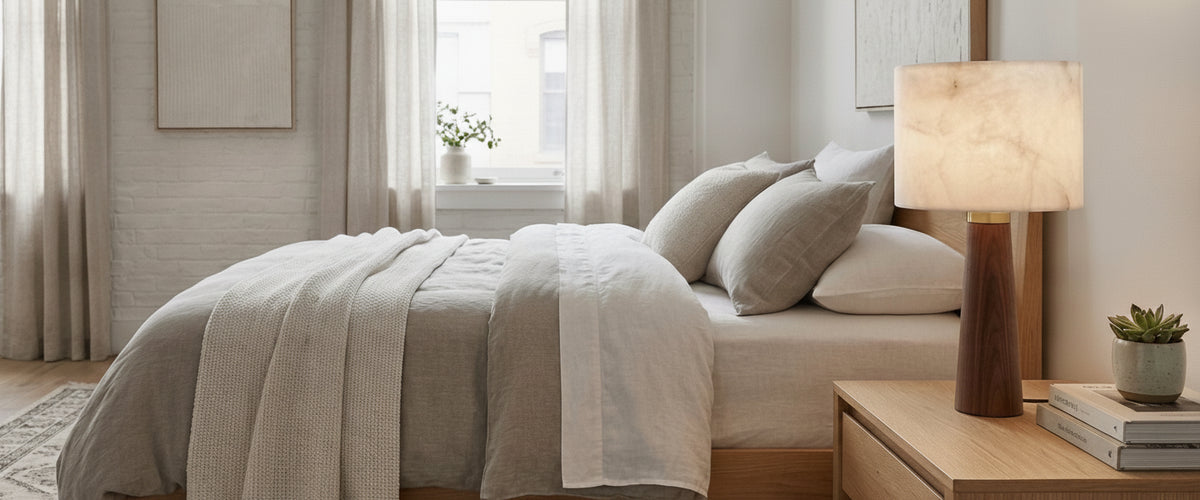

Wooden table lamps bedroom buyers really face five decisions: the species and tone of the timber, the shade material doing the diffusing, the lamp height measured against your seated eye line, how the finish ages under bulb heat, and the bulb spec inside it. The short answer: pale, open-grained woods such as oak and ash hold their character at low light levels, dark dense timbers such as walnut and wenge need a translucent shade to stay legible after dark, total height wants to land around 24 to 28in (60 to 70cm) on a standard bedside table, and the bulb should be dimmable, 2200K to 2700K, with a color rendering index of 90 or above. Everything below explains why each of those five calls matters.
Here is why it matters at all. The oak base that glowed under showroom spotlights can read as a dark stump on your nightstand at 10pm, and buyers almost always blame the timber. The timber is rarely the problem. Wood does not emit light, it reflects it, and the bedroom is the one room where you deliberately keep levels low. Get the light wrong and even good walnut goes flat and gray by evening. What separates a wooden table lamps bedroom pairing that works from one that sulks is those five choices. Get them right and the lamp brings warmth and a quiet sculptural presence to the bedside. Get them wrong and you have bought furniture that happens to hold a bulb.

Key Takeaways
Pale, open-grained woods (oak, ash, sycamore) hold their character at low light levels, which is why they suit wooden table lamps bedroom schemes so well. Dark, dense woods (walnut, wenge, smoked oak) need a brighter or more luminous shade to stay legible after dark.
The shade does the heavy lifting. Beside a timber base, a translucent shade in alabaster, onyx or opal glass keeps the wood visible; an opaque shade throws light down and leaves the base in shadow.
Height beats looks. Aim for the bottom edge of the shade to sit near eye level when you are sitting up in bed, roughly 24 to 28in (60 to 70cm) of total height for wooden bedroom table lamps on a standard bedside table.
Finish affects aging. Oiled timber deepens and needs occasional feeding; lacquer stays stable but can yellow; raw wood is the most honest and the most vulnerable.
Bulb color matters more than wattage. 2200K to 2700K with a high color rendering index makes timber glow on bedroom wooden table lamps. Cooler light drains it.

How Wood Changes Between Daylight and Lamplight
Daylight is broad-spectrum and comes from everywhere at once. It bounces off walls, ceilings and bedding, so it lights a lamp base from several angles and reveals grain as a pattern of tiny shadows. Lamplight does the opposite. It arrives from one point, usually from above and inside the shade, and the tonal range collapses. Figured grain that read as movement at noon can flatten into a smudge by night, which is the single biggest reason wooden table lamps bedroom setups disappoint people once the sun goes down.
Density and tone are the variables most buyers overlook. Open-grained species like oak and ash have visible pore structure that catches raking light and keeps texture alive even when the room is dim. Dark, dense timbers such as walnut, wenge and smoked oak reflect less and absorb more, so they need help. That help comes from either a shade that spills light downward onto the base or a second low-level source in the room. This is exactly why the most successful bedroom wooden table lamps pair a dark turned base with a pale, light-transmitting shade: the contrast does the work that daylight used to do.
One more thing worth knowing. Wood is a photosensitive material. Sustained exposure to light, and particularly to the ultraviolet component in daylight, changes its color over years, with some species darkening and others bleaching. Conservation guidance from the Smithsonian's Museum Conservation Institute covers this well for furniture and wooden objects. Wooden bedroom table lamps sitting in a south-facing bay window will not look the same in five years as ones on a shaded wall.
Why the Shade Matters More Beside Timber Than Any Other Base
Set a fabric drum on a brass base and the metal will still catch light from across the room; brass reflects specularly, so it finds a highlight almost anywhere. Timber reflects diffusely. It only shows well when light actually lands on it. That makes the shade the most consequential decision in any wooden table lamps bedroom purchase.
Four broad options, and they behave very differently:
Translucent stone. Alabaster and thin-cut onyx transmit light through the material itself, so the shade becomes a soft, glowing volume rather than a lid. Light escapes in every direction, including down onto the wood, and the veining gives the pairing an organic logic that timber answers well. Our own alabaster lighting range is built around exactly this quality of diffusion, and on dark-bodied wooden bedroom table lamps it is the easiest way to keep the base readable at low output.
Blown and opal glass. A close relative of stone in behavior: the material itself carries the light rather than capping it. Where the room needs a soft diffused glow rather than a hard downlight, a piece such as the Dolce 1 Light Glass Table Lamp is closer to the right design language, and the same logic applies if you are choosing a glass shade to sit above a walnut or oak base.
Linen and paper. Warm, forgiving, cheap to replace. They diffuse reasonably well but tend to yellow the light slightly and can look tired next to fine joinery within a few years.
Opaque metal or ceramic. Excellent for reading, poor for showing off a base. Choose one and you should accept that bedroom wooden table lamps become silhouettes after dark, so light the base separately with a wall light or a low-wattage floor lamp.
We had a client refitting guest rooms in a converted barn in Suffolk who had already bought four pale oak bases and was unhappy with them. Nothing was wrong with the lamps. The shades were tight black card cylinders, and at night all four rooms read as four dark tubes floating over invisible furniture. Swapping to translucent stone shades turned four disappointing wooden bedroom table lamps into the best thing in each room, and not one base was replaced.
Height and Scale: The Regret That Only Shows Up After You Plug It In
Scale mistakes are the most common returns issue with any bedroom table lamp wooden or otherwise, because people buy to a photograph rather than to their own bedside table.
Work backwards from your seated eye height. Sitting up against the headboard, your eyes typically land somewhere around 43 to 49in (110 to 125cm) from the floor. A bedside table is usually 22 to 26in (55 to 65cm) high. The bottom edge of the shade wants to sit at or just below your eye line so the bulb never glares directly at you while you are reading. That generally puts total lamp height in the 24 to 28in (60 to 70cm) band for a standard bed, taller if you have a high divan or a deep upholstered headboard. It is the one measurement that separates comfortable wooden table lamps bedroom setups from purely ornamental ones.
Then check the footprint. Turned timber bases are heavier than they look, often four to seven pounds (2 to 3kg) once you add a stone shade, and wooden bedroom table lamps need a stable stance on a small surface that also has to hold a book, a glass and a phone. Measure the table, subtract the lamp base diameter, and be honest about what is left. On a narrow bedside table where a wide turned base would swallow the surface, a tighter diameter like the Astro 3 Light Crystal Table Lamp, 20cm shows how much room the smaller footprint gives back, while the 30cm version is the scale that suits a deeper nightstand or a bed with a tall headboard. Two matched lamps flanking a bed also need to clear the headboard visually; if the shades overlap the headboard edge, the composition looks cramped even when the measurements technically work.
Oiled, Lacquered and Raw: How Each Finish Ages Under Bulb Heat
Heat is a slow, quiet force on a lamp base. Even efficient LEDs generate warmth at the driver and lampholder, and that warmth migrates down through the fitting into the timber directly beneath it. Since bedside lamps tend to burn for hours at a stretch, the finish decides how gracefully a wooden table lamps bedroom base ages.
An oiled finish (hardwax oil, Danish oil, tung) sits in the wood rather than on it. It ages beautifully, deepens in tone and can be refreshed at home with a thin wipe of the same oil once a year or so. It is also the most breathable option, which matters if the room swings between a cold night and a warm radiator morning.
Lacquer and polyurethane form a film. They resist spills and fingerprints, which is a genuine advantage on a bedside table, but films can amber over time and are prone to fine crazing where heat and dryness are sustained. If you have a lacquered base, keep the bulb wattage modest and give the fitting some breathing room.
Raw or lightly waxed timber is the most tactile and the least protected. It marks. It also reveals moisture movement more readily, so raw-finished wooden bedroom table lamps in a room that runs dry in winter will show a little seasonal shrinkage around joints. That is normal behavior in solid wood, not a defect.
Bulb Choice: The Combination That Makes Timber Glow
Two numbers decide whether wooden table lamps bedroom bases look alive or dead after dark.
Color temperature. Stay between 2200K and 2700K for a bedroom. Warm light contains more red and amber energy, which is precisely the part of the spectrum that oak, walnut and cherry reflect best. Above 3000K the warmth drains away and timber starts to look gray and dusty.
Color rendering. Look for CRI 90 or above, and ideally an R9 figure that is not near zero, because R9 measures deep red rendering and that is where wood tone lives. The International Commission on Illumination maintains the underlying color-rendering metrics if you want the technical detail. Cheap high-efficiency lamps often achieve their numbers by starving the red end, and timber shows that instantly.
Dimming. Specify a dimmable lamp and a compatible trailing-edge dimmer or an in-line dimmer switch. Bedroom lighting needs to work at three levels: reading, winding down, and finding your way back from the bathroom at 3am. Bedroom wooden table lamps that only do full brightness end up switched off most evenings.
Wooden Table Lamps Bedroom Quality Checks Before You Buy
Before you commit, run this short, unglamorous checklist. It has saved a lot of buyers a return:
Grain continuity. On a turned or stacked base, look at where sections meet. Good makers align grain direction; rushed ones do not.
Solid or veneer. Both are legitimate, but veneer over MDF should be declared. Check end grain at the base; a wrapped edge is a giveaway.
Lampholder seating. The holder should be firmly bedded, square to the base, with no play when you nudge it. A wobbly holder loosens further every time you change a bulb.
Cable exit. The flex should leave through a smooth, chamfered hole or a proper grommet. A raw drilled edge will chafe the cable over years.
Switch position. Rotary switches on the holder force you to reach up past a hot shade. In-line or base-mounted switches are far better beside a bed.
Base weight and felt. Enough mass to resist a tug on the cable, and a felt or cork pad so it does not scar the table.
Shade fitting type. Confirm whether it is a spider, gimbal or duplex fitting before you plan any future shade swap.
Electrical safety. Most wooden bedroom table lamps arrive ready to plug in, but buy from a supplier who can confirm the lamp meets UK requirements, and use a qualified electrician for anything more involved, especially if you are converting a lamp or fitting a new flex.
Choosing a Wooden Bedroom Table Lamp: Decision Criteria
Run through these in order and your wooden table lamps bedroom shortlist tends to write itself.
What is the lamp for? Reading needs directed light and a lower shade edge. Ambience needs diffusion and a shade that glows. Very few lamps do both brilliantly, so decide which one matters.
What else is in the room? If your bed frame, floor and wardrobes are already timber, bedroom wooden table lamps can tip the room into monotony. A stone or alabaster body with a timber or brass detail may sit better, and something as quiet as the Estro Globe Glass Table Lamp, 21cm adds light without adding another wood tone to the scheme. If the room is plaster, linen and painted joinery, wood adds the warmth the scheme is missing.
One lamp or a pair? Pairs demand consistency of grain and tone. Solid timber varies naturally, so ask whether the maker matches pairs from the same board.
How dark is the room at night? Blackout blinds and dark walls raise the case for a translucent shade that puts some light back onto the base.
Budget. Cost tracks material, scale, complexity of turning and quality of finishing rather than any headline figure, so settle on size and shade type first, then compare like for like.
Worth saying plainly: at Niori we work in alabaster and natural stone rather than timber, and much of what we know about wooden bedroom table lamps comes from clients pairing our shades and stone bodies with existing furniture. Stone and wood are close cousins in behavior. Both are natural, both vary piece to piece, and both look better under warm, diffuse light than under anything sharp. If you are weighing a timber base against a stone one, it helps to see the alternatives side by side across our full lighting range before committing to a pair.
Keeping It Right Over the Years
Dust wooden bedroom table lamps with a dry, soft cloth rather than a damp one; water sits in open grain and lifts it. Keep the lamp off a radiator shelf and out of direct afternoon sun where you can. Feed oiled bases roughly once a year, less if the room is stable. If you pair timber with an alabaster or onyx shade, treat the stone gently too: no household sprays, no alcohol wipes, just a dry microfiber cloth and patience. Natural stone is porous, and solvents can leave marks that will not come out.
Buy the shade with as much care as the base, get the height right for how you actually sit in bed, and put a warm, high-CRI, dimmable bulb inside it. Do those three things and wooden table lamps bedroom choices stop being decorative objects that occasionally glow. Well-chosen bedroom wooden table lamps set the whole tone of the room after dark, and that is the job you are really buying them for.