
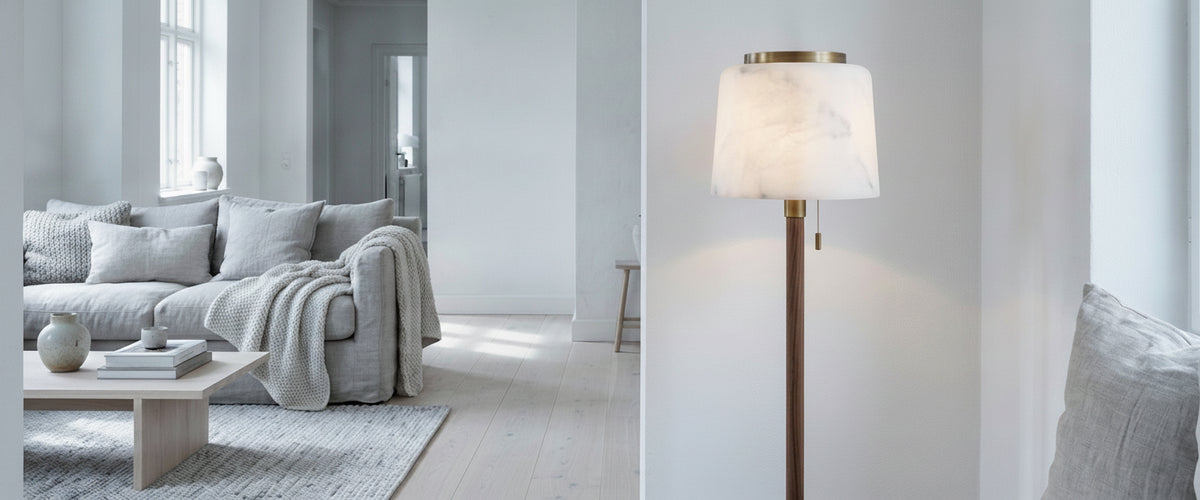

Most wooden floor lamps fail in the same predictable way. They look warm and characterful in a product photograph, then arrive in the room as a pale stick wearing a hat. The wood reads as filler rather than furniture. That outcome has almost nothing to do with budget and almost everything to do with three decisions made before you buy: which timber, which finish, and what sits on top of it. Get those right and a wooden floor lamp holds a corner the way a good armchair does.

Wooden Floor Lamps at a Glance
Dark timbers carry visual weight. Walnut and smoked oak hold their own against strong furniture; pale ash and beech recede and suit tight, busy rooms.
Grain direction is a design choice. Straight quarter-sawn grain reads calm and architectural. Cathedral or figured grain draws the eye and competes with patterned textiles.
Finish changes the light beside it. An oiled finish and waxed timber absorb and soften; lacquered and stained surfaces bounce a harder highlight back at you.
Pair wood with a diffusing shade, not a shiny one. An alabaster diffuser, natural stone, a linen shade or opal glass all soften the source; polished chrome fights the timber.
Joinery and hardware decide lifespan. Look for solid sections, mechanical fixings, a properly weighted base and a switch that feels engineered rather than bolted on.
Dim everything. A wooden floor lamp on a full-brightness bulb is a lamp you will stop switching on.

Why Timber Species and Grain Change Visual Weight
Stand ten feet (about 3 metres) back from any floor lamp and squint. What you are really judging is mass. A walnut floor lamp with a close, straight-grained column looks heavier than a pale ash one of identical dimensions, because darker tone and tighter figure both read as density. This is why so many wooden floor lamps look underweight in large rooms: the timber is pale, the section is slim, and the whole thing evaporates against a light wall.
Same dimensions, different mass: darker tone and tighter figure read as density.
Use that knowledge deliberately. In a room with a deep sofa, a stone fireplace and a large rug, a dark wooden lamp base gives you something to balance against. In a compact flat with painted joinery and a lot of soft furnishing, pale oak or ash keeps the corner quiet. Grain direction matters just as much. Quarter-sawn timber shows straight, even lines and behaves architecturally; flat-sawn stock shows those wide cathedral arches that pull attention. If your room already has a patterned rug or a bold fabric, choose the calmer grain and let the textiles talk.
A veneered base deserves a fairer hearing than it usually gets. A well-laid veneer over a stable core resists movement better than a solid turned column in a centrally heated house, and it allows book-matched figure that would be impossible to cut from one billet. Where the grain is meant to be the ornament, a tall veneered stem such as the Bonham Wood Veneer & Silver Metal Floor Lamp shows what a good lay-up allows at 161cm: continuous figure the full height of the column, with the metalwork restrained to a collar and foot. What matters is the quality of that lay-up and the edge treatment, not the word "solid" on a spec sheet.
Finish Matters: Oiled, Waxed, Stained and Lacquered
The finish on wooden floor lamps is the part your eye reads first, because it controls how light behaves at the surface. A hard-wax oiled finish leaves an open, matte face that swallows highlights; the timber looks like timber. Waxed surfaces sit slightly warmer and pick up a low sheen with handling, which suits older rooms. Stained bases can be superb or flat depending on whether the colour sits in the grain or over it. A cheap stain fills the pores and kills the figure, leaving a base that looks like painted MDF from across the room.
Lacquer is the one to think hardest about. A high-build gloss lacquer throws a specular stripe down the column every time a lamp or window hits it, and that stripe competes with the very glow you bought the lamp for. If you want shine, keep it in the metalwork: an aged brass collar or a bronzed foot ring gives you a controlled sparkle without turning the whole stem into a mirror. Put an oiled walnut sample beside a lacquered one under a 2700K source and the difference is immediate. The oiled face sits quietly next to warm light; the lacquered one keeps announcing itself.
Finish also determines maintenance. Oiled timber can be refreshed at home; two-pack lacquer cannot. The Victoria and Albert Museum's guidance on caring for wooden furniture is a sensible baseline: stable humidity, no direct heat sources, and dusting with a soft dry cloth rather than silicone sprays that build a haze over time.
Shade and Diffuser Pairings That Complement a Wooden Base
Wood is a warm, matte, opaque material. It looks best beside something that glows rather than something that glints. That is why alabaster is such a natural partner. Sliced thin, alabaster transmits light through its own mineral veining, so the shade becomes a source of soft, honeyed illumination instead of a lid on a bulb. Set an alabaster diffuser or a natural-stone shade above an oiled timber stem and the two materials share the same tonal family without matching, which is exactly the relationship you want. If you are pairing across a room rather than within one fixture, our alabaster lighting collection is a useful place to see how stone diffusers behave next to warmer, darker materials.
Stone above timber: two matte, warm materials sharing a tonal family without matching.
A linen shade and heavy cotton work for the same reason: they diffuse and they hold texture. Where the room needs that softer fabric glow, a shade kept to a largely undyed palette, as on the Ashstead LED Ikat Floor Lamp in brass, white and natural, sits closer to timber than a strongly coloured weave would. Opal glass gives a cleaner, more modern read and suits pale timbers particularly well. What rarely works is polished chrome or mirrored metal directly on wood; the two surfaces reflect light on completely different terms and the join looks accidental. Rattan and paper shades can be charming but they tilt the whole piece towards holiday-home informality, which may not be what a formal drawing room wants.
One practical note on scale. A shade that is too small makes a wooden column look like a broom handle. As a rule of thumb, the shade should be visually wider than the widest point of the base, and deep enough that you cannot see the bulb from a standing position at normal distance.
Period Rooms Versus Contemporary Rooms: Silhouette Decides
Timber is not automatically traditional. A turned, beaded, fluted column in oak belongs in a Georgian sitting room or a converted rectory. The same oak cut as a slim tapered tripod belongs in a mid-century scheme, and cut as a single square-section post with a stone or metal foot it looks entirely contemporary. Silhouette does the period work; the material just supplies warmth.
This is where wooden floor lamps go wrong in new-build interiors. Buyers reach for wood to add warmth to a plaster-and-glass room, then choose a heavily turned traditional profile that reads as a piece of reproduction furniture stranded in a modern space. If your architecture is clean, keep the lamp's geometry clean and let the grain be the only ornament. If your architecture is period, a plainer silhouette still works, but you can afford more shape.
Mixed-period rooms are the real test. Take a mill conversion with exposed beams overhead and a polished concrete floor underfoot: turned traditional lamps look apologetic there, because they side with the beams and ignore everything else. A straight-sided timber profile under a pale stone diffuser reads as new work in an old shell, which ties the two surfaces together instead of picking a side.
Where a Wooden Floor Lamp Earns Its Corner
The best position is beside a seat, slightly behind the shoulder line, where the shade edge sits roughly at eye level for someone seated, around 40 to 48 inches (100 to 120 cm) from the floor. That is the whole logic of reading corner lighting: light on the page without light in the eye. A reading corner, the far end of a long sofa and the gap between a wing chair and a bookcase are all places where the lamp does real work.
Wooden floor lamps disappear in three situations. Against a dark timber floor with no rug beneath them, where base and floor merge into one brown mass. In front of a full-height window, where daylight flattens the whole silhouette. And in an open circulation route, where the piece gets knocked, is never switched on, and eventually gets moved to a bedroom. If a corner has no seat and no task, choose a wall light or a table lamp on a console instead. Browsing the wider lighting range by fixture type rather than by material tends to make that decision faster.
There is also the seating layout that no upright column solves: a sofa floating away from the wall, with nowhere behind it to stand a base. A reaching form such as the Arc Floor Lamp in white brings light out over the cushions from a base tucked clear of the walkway, which is a different problem to the one a straight timber stem is built for.
Bedrooms are the quiet win. Wooden floor lamps beside a bedroom chair, dimmed low, give you a second light level that a ceiling fitting cannot, and the timber warms up a room that is often heavy on soft pale textiles. Hallways are the opposite; they need light above head height, not a floor-standing obstacle.
Joinery and Hardware: What Lasts and What Does Not
Pick the lamp up. Weight in the base is the first honest signal, because a stem that tall needs real mass low down to stay stable on a rug. Then look at how the parts meet. Mechanical fixings, threaded inserts and clean shoulder joints outlast glued butt joints under the repeated use a floor lamp receives. Check whether the cable enters the base through a lined grommet or a raw drilled hole; the raw hole will chafe the flex eventually.
Switch quality tells you plenty about the rest. A rocker switch pinned into the flex is the cheap route; an inline dimmer, a foot switch integrated into the base, or a properly mounted rotary at the lampholder all suggest a manufacturer who thought about daily use. If you are hard-wiring or fitting a wall-controlled circuit, use a qualified electrician; UK guidance from Electrical Safety First is clear that fixed wiring work is not a DIY task.
Bulbs and Dimming
Warm-white LED at around 2700K is the right default for timber and stone alike. Look for a colour rendering index of 90 or above, otherwise walnut turns muddy and alabaster loses its warm depth. A dimmable floor lamp is only as good as its driver, so check the fixture and the driver are both dimmable and compatible with your dimmer type before you buy; mismatched trailing-edge dimmers are the most common cause of flicker. Warm-dim LEDs, which drop towards 2200K as they lower, suit evening rooms particularly well.
A Buying Checklist for Wooden Floor Lamps
Have you chosen the timber tone against your wall colour and floor, not in isolation?
Does the grain calm the room or compete with it?
Is the finish matte or low-sheen rather than high-gloss?
Does the shade diffuse light, and is it visually wider than the base?
Does the silhouette match the architecture, period or contemporary?
Is there a seat and a task within reach of where it will stand?
Is the base weighted enough for a rug, and the cable routed cleanly?
Is the fixture dimmable, with a 90+ CRI warm-white lamp?
Can the finish be maintained or refreshed in five years?
Care Over the Long Term
Wood moves with humidity, so keep wooden floor lamps away from radiators and log burners; a base that dries unevenly can show hairline checking at the end grain. Dust with a dry microfibre cloth and refresh oiled surfaces sparingly with the maker's recommended product. If your lamp pairs timber with a stone or alabaster diffuser, treat the stone differently: no household chemicals, no ammonia, just a dry or barely damp soft cloth, since alabaster is a soft mineral that etches easily. Check the flex and plug annually for wear, especially if the lamp gets moved.
Price tracks three things: timber grade, whether the shade is fabric, glass or hand-cut stone, and how much of the finishing is done by hand. A veneered stem under a linen shade sits at one end of that range; a solid walnut column under hand-cut alabaster sits at the other, and the difference shows most in the light rather than the spec sheet. You can see how we approach material pairing across the collections on the Niori site, where alabaster and natural stone sit alongside timber, glass and brass detailing in pendants, wall lights, table lamps and floor lamps.