
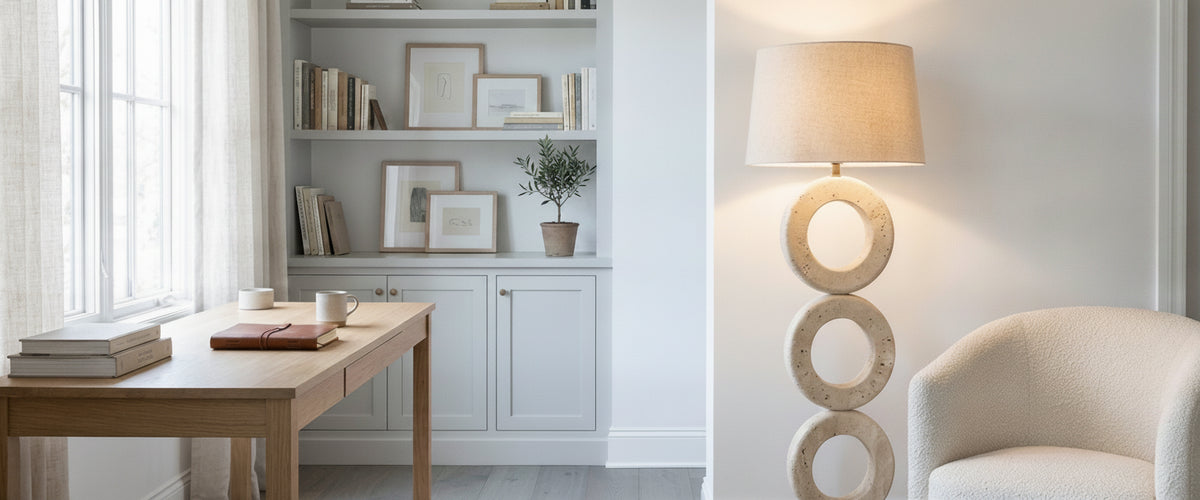

Most floor lamps quietly disappear into the furniture around them. A contemporary travertine floor lamps does the opposite. The base has real mass, an open grain and a faintly fossilised surface that pulls your eye down to the floor, and then the shade throws light back up over it. That tension between heavy stone and soft glow is the entire point of the piece. It is also where buyers come unstuck: pick the wrong shade, or park it in the wrong corner, and a beautiful block of stone reads as an expensive doorstop.

Key Takeaways
- Travertine is mostly opaque. Unlike alabaster or onyx, it does not glow from within. On a contemporary travertine floor lamp the stone is the anchor and the shade does the lighting.
- The shade decides the mood. Linen and cotton give warm, diffuse light with a soft ceiling wash. Frosted glass gives a crisper, more contained pool.
- Silhouette matters at standing height. Column, disc and stacked bases each carry weight differently across a room.
- Give it room. Stone needs clear floor around it to register as sculpture rather than an obstacle.
- Travertine is porous. Filled or unfilled, it wants a pH-neutral clean and an impregnating sealer, not a household spray.
- Budget varies widely with stone selection, block size, machining, finishing and the metalwork, so ask for a tailored quote rather than assuming a figure.

How Travertine Handles Light Compared With Alabaster and Onyx
At Niori we spend most of our time with translucent stone, so the contrast is stark. Alabaster is a gypsum stone that transmits light through its body; switch on a lamp behind it and the whole panel warms to honey and cream, with the veining drawn in like ink under water. Onyx does something more theatrical, throwing bands of amber and caramel across a wall. Travertine refuses to play that game. It is a freshwater limestone laid down around springs and calcareous seeps, riddled with the voids left by trapped gas and decayed plant matter, which the British Geological Survey describes among the sedimentary carbonate deposits. Those pores scatter light rather than pass it along.
The practical result: a travertine base reflects and textures light instead of emitting it. Rake a low beam across the surface and the stone comes alive with shadow in every pore. Light it flatly from above and it flattens to a pale biscuit tone. This is why a contemporary travertine floor lamp behaves so differently from an alabaster one in the same room. The alabaster piece is a light source with a stone body. The travertine piece is a stone body carrying a light source, and it needs a second light in the room, a wall light or a low table lamp, to model the base properly after dark.
Column, Disc and Stacked Bases: How Each Silhouette Reads at Standing Height
Search around and you will see the same handful of names cycling through listings: Maestro, Polo, Grande. Strip away the naming and every contemporary travertine floor lamp comes down to three structural ideas, each of which behaves differently once it is standing at roughly shoulder height in a real room.
The Column
A single travertine cylinder or square shaft running from floor to shade. The maestro travertine floor lamps silhouette usually sits here: tall, quiet, architectural. Columns read as vertical punctuation, so they work beautifully flanking a chimney breast or bracketing a wide sofa. They also demand a straight run of wall or a clean corner; slot one behind a curved armchair and the geometry fights.
The Disc or Puck
A thick travertine round supporting a slim metal stem. A Polo travertine floor lamp typically follows this logic, with the stone doing its work low to the floor and the eye reading mostly stem and shade above. This is the most forgiving option in a busy room because the visual mass stays below knee height. It is also the most likely to be scuffed by a hoover head, so consider a felt underlay.
The Stacked Base
Two or three blocks of stone set one on the other, sometimes with a brass collar between them. A grande travertine floor lamp is often built this way to justify its scale. Stacks are the most sculptural and the most opinionated. They need generous, plain surroundings; put a stacked travertine base floor lamp next to a patterned rug and a carved console and the whole corner turns to noise. Where the corner cannot absorb that much density but you still want a warm, natural material at floor level, a splayed timber frame such as the Blues Wood Tripod Floor Lamp spreads its weight visually instead of concentrating it in one solid block.
The Shade Decides More Than the Stone
Buyers shopping for a contemporary travertine floor lamp agonise over veining and then choose the shade in thirty seconds. It should be the other way round. A natural linen or cotton drum softens the beam, warms the colour slightly and lets a good proportion of the output escape upward, which lifts the ceiling and keeps the room feeling generous. That upward wash is what saves a stone base from looking gloomy after sunset.
Frosted or opal glass does something almost opposite. It contains the light, gives a defined luminous form at the top of the lamp and casts a tighter pool below. Wonderful for reading, less generous to the room. Pair frosted glass with travertine and you get a hard, graphic object; pair it with translucent stone instead and you get the layered, internal glow we build much of our alabaster lighting around. Both are valid. They are simply different rooms.
One more pairing worth knowing: unbleached linen against travertine is a warm-on-warm combination that flatters the stone's cream and rust tones. Bright white cotton, by contrast, makes travertine look dusty. Take a shade sample and hold it against the stone in daylight before you commit.
Scale and Breathing Room
Stone reads heavier than it measures. The base of a contemporary travertine floor lamp that looks modest on a product page can dominate a small sitting room, because the eye responds to density as much as to volume. As a rule of thumb, allow at least 40 to 50 cm (16 to 20 in) of clear floor on the open sides of the base so it stands as an object rather than an obstruction. If the floor plan simply cannot spare that clearance, a narrow-footprint design like the Twine Wood Floor Lamp in Black holds the same corner without claiming a square metre of floor around it.
Height is the other trap. Most floor lamps land somewhere between 1.5 and 1.8 m (5 to 6 ft), and the shade bottom should sit just above eye level when you are seated, so you never see the bulb from the sofa. If you are placing a grande travertine floor lamp beside a low, deep sofa, check the seated sightline rather than the standing one. Designers get this wrong more often than homeowners do, usually because they are specifying from elevations.
Contemporary Rooms Versus Warmer Traditional Settings
A contemporary travertine floor lamp has an obvious home in pared-back interiors: microcement floors, plaster walls, oak joinery, a bit of blackened steel. The stone supplies the warmth that minimal palettes usually lack. In a new-build kitchen extension in Surrey, a single column lamp in a reading corner did more for the room than three additional downlights would have.
The stone also earns its place in older, softer houses, which surprises people. Travertine sits happily against lime plaster, worn flagstones and faded rugs because it is a masonry material with a long architectural history behind it, and it never looks self-consciously new. Where it struggles is in high-gloss, jewel-toned interiors; against lacquer and brass, the matte porosity can look unfinished. In those rooms a metal silhouette speaks the same language as the surrounding finishes, and something like the Otvenna Arc Floor Lamp in Brass and Black reaches over a seating group in a way a fixed stone column never will. It is also the moment to look at polished marble or an alabaster and natural stone lighting option with more sheen.
Bulbs, Dimming and Colour Temperature
Specify the electrics as carefully as you chose the block, because a contemporary travertine floor lamp depends on light quality far more than on raw output.
- Colour temperature: 2700K for living rooms and bedrooms. Anything cooler pushes travertine grey and kills the rust tones.
- Colour rendering: look for CRI 90 or above so the stone's veining and the shade fabric both stay honest.
- Dimming: specify a dimmable LED and a compatible trailing-edge dimmer or an in-line dimmer on the cable. Stone lighting lives or dies on the bottom third of the dimming curve.
- Output: around 400 to 700 lumens is usually plenty for an ambient corner; go higher only if it is a genuine reading position.
- Warm dim: if the budget allows, a warm-dim lamp that drifts towards 2200K at low levels flatters travertine enormously in the evening.
- Wiring: plug-in lamps are straightforward, but any hard-wired or floor-outlet installation should go to a qualified electrician.
Buyer's Checklist Before You Commit
Before you order a contemporary travertine floor lamp, work through this list with whoever is making it.
- Ask whether the travertine is filled or unfilled. Filled stone has the natural voids resined and honed flat; unfilled keeps the open pitting and the shadow play, but collects dust.
- Confirm the finish: honed, brushed or polished. Honed is the safest for a lamp base you will touch daily.
- Ask for photographs of the actual block or batch. Natural stone varies, and vein-run matters more on a large base.
- Check the weight and your access route. Stone bases are genuinely heavy, and a second pair of hands is not optional on a staircase.
- Check the base underside for felt or cork protection, especially on engineered wood and natural stone floors.
- Confirm cable exit and length, and whether the flex colour can be specified to suit the wall.
- Ask about sealing at the factory and which product was used, so you can match it later.
- Request a tailored quote that sets out stone selection, machining, metalwork and delivery, rather than working from a headline figure.
Living With a Travertine Base: Cleaning, Sealing and Patina
Travertine is calcium carbonate, which means acid is its enemy. A client in a Bath townhouse set a lamp beside a drinks tray and lost the argument with a spilled negroni; the citrus etched a dull ring into the honed surface within days, and it took professional re-honing to lift. Wine, vinegar, lemon, cola and most limescale removers will all do the same. Keep them away from the base, and never reach for a general-purpose bathroom spray.
For routine care, dust with a dry microfibre cloth and wipe occasionally with a barely damp cloth and a pH-neutral stone cleaner. Blot spills immediately rather than wiping, which spreads liquid into the pores. Reapply an impregnating sealer periodically; frequency depends on the finish and how much handling the piece gets, and the guidance published by Stone Federation Great Britain is a sensible reference point for natural stone maintenance in the home.
Expect the stone to change slightly. Unfilled travertine gathers a fine grey film in the pores, particularly near an open fire, and a soft brush every few months keeps it clean. Handled edges gradually take on a faint sheen. Most owners come to like it. If you want a stone that stays visually identical for decades, translucent alabaster under a sealed finish is the steadier choice, and you can compare how the two behave across the pieces on the Niori range.
Buy a contemporary travertine floor lamp because you want mass and texture in the room, not because you want the stone itself to glow. Get the shade, the scale and the dimming right, and the base will do exactly what good sculpture does: hold a corner without asking for attention.