
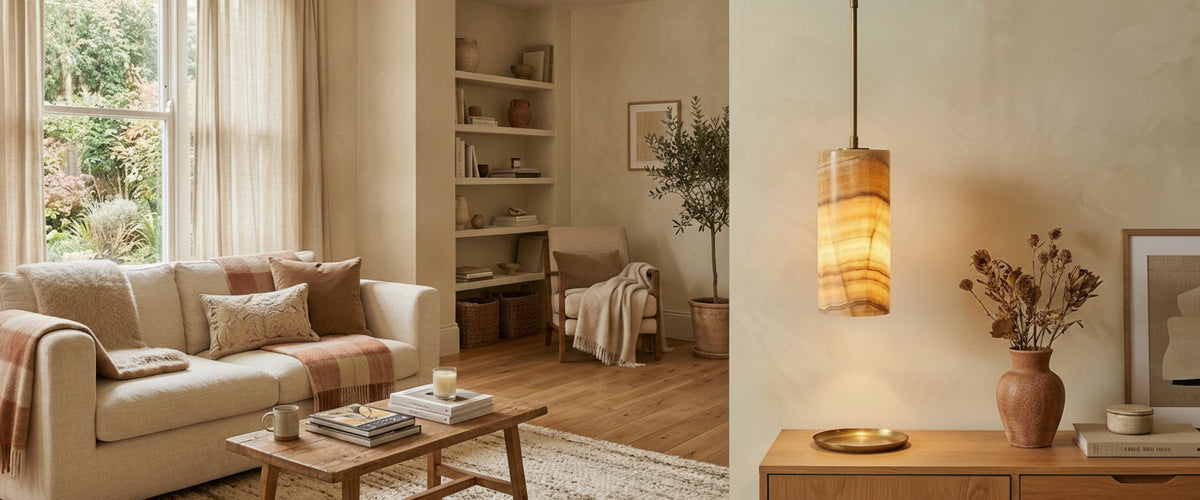

Backlight a slab of onyx and it will either look like poured honey or like a bruise. There is very little middle ground, and the deciding factor is usually not the stone at all: it is the bulb temperature and the wall thickness behind it. An onyx cylinder pendant light is one of the most theatrical fixtures you can hang over a kitchen island or a dining table, and one of the least forgiving if you specify it casually. Get the calibration right and the whole room warms by a shade. Get an onyx cylinder pendant light wrong and you have an expensive tube of stone glowing orange at head height.

Key Takeaways
Onyx is more dramatic than alabaster because its banding is directional; light travels through the layers unevenly, which is what produces that fire-lit look.
Base color changes the temperature of the glow. Honey onyx pushes amber. Blue and green onyx cool it and can go murky under very warm bulbs.
The cylinder profile throws light down a column rather than spreading it sideways like a dome, which is why an onyx cylinder pendant light suits islands, tables, and stairwells.
Aim for 2700K to 3000K, CRI 90+, and modest lumen output. Overpowered bulbs bleach the veining out of the stone.
Confirm weight, dimming protocol, and fixing method with the supplier before you commit to an onyx cylinder pendant light. Stone pendants are heavier than the glass fixtures they visually resemble.

Why Onyx Transmits Light Differently From Alabaster
Both stones are calcite-based and both are translucent, but they are built differently. Alabaster (in the lighting trade, usually gypsum or a fine calcite marble) tends to be cloudy and even, with a milky diffusion that scatters light in every direction. Onyx is a banded stone, formed in layers by mineral-rich water depositing calcite over long periods, which is why the Natural Stone Institute classifies commercial onyx separately from true chalcedony onyx used in jewelry. Those parallel bands act like a series of filters. Light passes freely through the clearer layers and stalls in the denser ones, which is the whole reason an onyx cylinder pendant light behaves the way it does.
The practical result: alabaster glows softly and forgivingly, while onyx glows in stripes, flames, and rivers. A slab that looked quietly handsome in daylight can turn into something close to stained glass once it is lit from within. That is the appeal. It also means you cannot judge an onyx cylinder pendant light from an unlit photograph, which is why we send illuminated sample images to designers before a build. One project for a Napa wine room went through three slabs; the first two had bands that read beautifully in reflected light and dissolved into muddy gray once backlit.
Wall thickness matters as much as the stone itself, and on an onyx cylinder pendant light it is the spec buyers forget to ask about. Cut too thick and the fixture reads as a dark tube with a bright rim. Cut too thin and the piece becomes fragile and the veining loses depth. Well-made hanging onyx pendant lights sit in a narrow band where the stone is thin enough to transmit and thick enough to hold structural integrity, usually with an internal frame or a resin backing on more brittle slabs.
Blue, Honey, and Green Onyx Compared
Base color is the single biggest driver of mood on an onyx cylinder pendant light, and it interacts with your bulb choice rather than sitting independently of it.
Honey onyx at 2700K: caramel glow, banding still legible rather than bleached.
Honey Onyx
The default for a reason. A honey onyx pendant light lit at 2700K produces a caramel glow that flatters skin tones and warm woods, and it looks especially good over walnut or oiled oak dining tables. The risk is oversaturation. Pair honey onyx with a 2200K filament bulb and the fixture goes tangerine, which can make a white kitchen look jaundiced after dark. Honey is still the safest starting point for a first onyx cylinder pendant light.
Blue Onyx
A blue onyx pendant light is the harder specification and the more striking one. Blue and gray-blue onyx has a cool cast that fights very warm light; under 2200K the blue turns green-gray and looks dirty. Push to 2700K or even 3000K and the stone holds its color while the veining stays legible. Blue onyx pairs well with brushed brass and with pale plaster walls, and it works particularly hard in bathrooms and powder rooms where a warmer stone would feel heavy.
Blue onyx holds its color at 3000K; go warmer and the banding drifts toward green-gray.
Green Onyx
Green sits between the two. It reads jade in daylight and moss when lit, and it deepens rather than brightens, so give it more lumens than you would give honey onyx of the same size. A green onyx cylinder pendant light is excellent above a bar or in a study where you want light with weight to it.
If you are comparing base colors side by side, it helps to look at how the same forms behave in different stones across our alabaster and natural stone lighting range, because the shift between a milky alabaster cylinder and a banded onyx cylinder pendant light is larger than most renders suggest.
Why the Cylinder Profile Concentrates Light Downward
Geometry does real work here. A dome or bowl shade presents a wide curved surface to the eye and throws light outward and upward, filling a ceiling with reflected wash. A cylinder does something else: it forms a vertical tube, so most of the direct output exits through the open base in a fairly tight column, while the walls glow as a secondary, softer light source. On an onyx cylinder pendant light, those walls are the whole point.
That gives you two useful behaviors at once. You get a defined pool of task light on the surface below, which is exactly what you want above a prep counter or a dining table. And you get the ambient glow of lit stone at eye level, which does the atmospheric job that recessed downlights never manage. The cylinder also flatters onyx banding, because horizontal veining wraps the tube like a contour line and vertical veining runs the full height of the piece. Ask the supplier which way the slab has been oriented; it changes the character completely.
Scale is the other half of the equation. A narrow onyx cylinder pendant light around 6 to 8 inches (15 to 20 cm) in diameter works in multiples, hung in a run of three above an island, and something in the proportions of the Nest Cylinder Glass Pendant Light, 19cm is the scale to hold in mind when you are testing spacing on paper. A single generous cylinder of 16 inches (40 cm) or more becomes the focal object in the room, closer to the presence of the Turbo Cylinder Pendant Light, 40cm, and at that diameter it should not compete with a second statement fixture in the same sightline.
Bulb Temperature and Wattage: The Calibration That Makes Onyx Sing
Onyx punishes lazy lamping. Three rules from the studio for lamping an onyx cylinder pendant light:
Stay between 2700K and 3000K for most stones, dropping to 2500K only for pale, near-white onyx where you want extra warmth.
Insist on CRI 90 or higher. Low-CRI LEDs flatten mineral color, and veining is mineral color. This is the change clients notice most when we swap a lamp out.
Use opal or frosted lamps, not clear filament bulbs. A visible filament casts a hard shadow line on the inside of the stone and creates a hot spot that bleaches the banding directly behind it.
Lumens should be lower than instinct suggests. Stone already absorbs a share of the output, but a heavily overdriven source does not make onyx glow more; it washes the pattern out and leaves a glaring base aperture. For a small to medium onyx cylinder pendant light, a modest output source dimmed to taste will read richer than a bright one at full power. Where a fixture is intended to carry real task duty over an island, layer it: let the pendant do mood and stone character, and add discreet under-cabinet or track light for chopping.
Hanging Height and Placement for a Stone Pendant
Standard practice still applies, with one adjustment for weight and opacity.
Kitchen island: 30 to 36 inches (76 to 91 cm) from countertop to the base of the fixture. With an onyx cylinder pendant light, sit toward the lower end so the glowing walls fall within sightline rather than above it.
Dining table: 30 to 34 inches (76 to 86 cm) above the tabletop. A single large cylinder centered over a round table works well; over a long rectangular table, a run of two or three narrow cylinders spaced evenly reads better than one undersized piece.
Hallways and circulation: keep at least 7 feet (2.1 m) of clear headroom. Heavy stone at head height in a corridor is a hazard, not a feature.
Stairwells and double-height voids: the cylinder's downward throw is an advantage here. Hang so the fixture is visible from both floors and lands roughly at the level of the upper landing. Where the void is tall enough to swallow a compact shade, an elongated form such as the Index Cylinder Pendant Light, 127cm holds the vertical space in a way a single short cylinder cannot.
Bathrooms: check the fixture's suitability for the zone and humidity in question, and have it installed by a qualified electrician.
A client in Austin hung a run of three onyx cylinder pendant lights over a 10 foot (3 m) island and initially spaced them like glass pendants, tight and even. We moved them 4 inches (10 cm) further apart. Lit stone has visual mass that clear glass does not, and crowding it makes an island feel low.
Dimmability, Load, and What to Verify Before You Buy
Dimming is not optional on an onyx cylinder pendant light. Dimmable onyx pendant lighting lets you run the fixture bright for cooking and drop it to 20 percent for dinner, and stone reveals different veining at different levels; the darker bands surface as you dim. Compatibility is where projects go wrong. LED drivers and dimmers must be matched, and research from the Lighting Research Center has long documented flicker and drop-out problems in mismatched combinations. Trailing-edge dimmers generally behave better with LED drivers than older leading-edge units.
Buyer Checklist
Fixture weight, stated in writing. Stone is heavier than it looks and heavier than the glass version of the same silhouette. You need the number before choosing a mount.
Fixing method. Confirm whether the ceiling rose must land on a joist or requires a brace or backing plate. Plasterboard alone is rarely enough.
Dimming protocol. Ask whether the fixture is mains dimmable, 0-10V, DALI, or supplied with an integrated driver, and specify the dimmer to suit.
Lamp type and access. Is the source replaceable, and can it be reached without dismantling the stone?
Slab matching. On multi-pendant runs, ask whether the cylinders are cut from the same block. Onyx varies enormously between blocks.
Cable and rod adjustment. Confirm the suspension can be shortened on site, and by whom.
Lit sample or illuminated photography of the actual stone, not a stock render.
Repair and replacement route if a panel is chipped in transit or during install.
Budget for an onyx cylinder pendant light depends on slab quality, diameter, wall thickness, metalwork finish, driver specification, and how much hand-finishing the stone needs. Rather than guess from a range, ask for a tailored quote against your ceiling height and dimming setup; you can browse forms and scales across the wider lighting collection first to narrow the brief.
Living With Onyx: Care That Actually Matters
Onyx is calcite, which means acid is the enemy. Vinegar, lemon, descaler, and most bathroom sprays will etch the surface and dull the polish permanently. Dust an onyx cylinder pendant light with a dry or barely damp microfiber cloth, and use a pH-neutral stone cleaner if something needs lifting. Skip ammonia glass cleaner even on the metal parts, because overspray finds the stone.
Heat is the quieter risk. Keep sources cool and well ventilated inside the fixture; sustained heat against a thin calcite panel is not kind to it over years. Check suspension fixings once a year, and if the stone has been sealed, ask the maker how often the seal should be refreshed. Niori specializes in alabaster and natural-stone lighting, and the onyx cylinder pendant light we most often see still in service after a decade is the one that was simply dusted properly and never sprayed with anything.
Specify the stone for its bands rather than despite them, light it at 2700K with a high-CRI opal source, hang it low enough to see the glow, and an onyx cylinder pendant light will carry a room on its own. That is a lot of work for one fixture. Onyx is one of the few materials that can do it.