
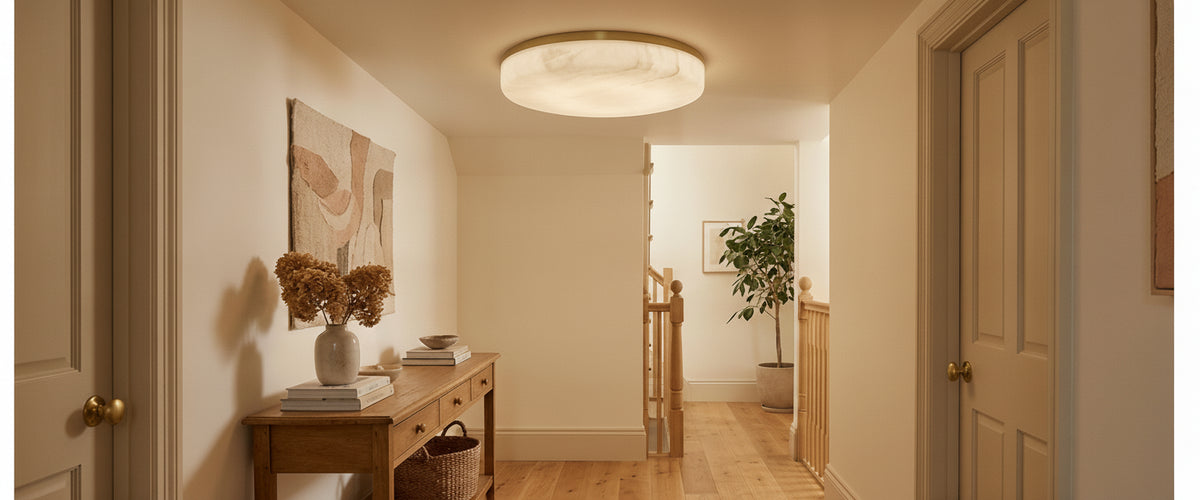

Hang a pendant in a room with 2.3-metre ceilings and you will spend the next decade ducking around it. That is the everyday reality in Victorian terraces, converted lofts, tenement box rooms and most new-build first floors, and it is why the brass flush mount keeps quietly outselling flashier fixtures. Done badly, it is a builder's afterthought screwed to a rose. Done well, with a warm metal tone and a diffuser that actually softens the light, it reads as a deliberate design decision rather than a compromise forced by a low ceiling.
At Niori we work mostly in alabaster and natural stone, so we have a particular view on what separates a good brass flush ceiling lights from a mediocre one. It is almost never the metal. It is what the metal is holding.

Quick Answer: What to Get Right
- Finish first. Polished brass is loud and formal, satin or brushed brass is quiet and forgiving, antique or heritage brass reads warm and lived-in. Same shape, three different objects.
- Under 2.4 metres (about 7 ft 10 in), go true flush. Semi-flush fittings drop 100 to 200mm and that gap changes how the room feels.
- The diffuser sets the mood. Alabaster gives warm, uneven, faintly golden light; opal glass gives even white diffusion; an open frame gives sparkle and glare in equal measure.
- Measure the canopy, not just the fixture. The plate needs to cover the existing back box or rose cleanly.
- Confirm dimming before you buy. Integrated LED, retrofit lamp and driver type all decide which dimmer will work.

Polished, Satin and Antique: Why the Same Brass Flush Mount Reads Like Three Different Objects
Brass is not one colour. Polished brass is close to yellow gold, throws hard specular highlights and shows every fingerprint on a low brass flush mount that people reach up to. It suits formal rooms with cornicing, dark paint and a bit of ceremony. Satin or brushed brass diffuses those highlights into a soft sheen; it is the safest choice in a family hallway or a kitchen where the light sits within arm's reach of a cupboard door. Where the metal is going to be seen close up and lit from within, a frosted satin treatment like the one on Gorsewell Ribbed Semi-flush 4 Light Flush Ceiling Light, Frosted Satin Brass keeps the highlights soft instead of mirror-bright.
Antique and heritage brass finishes are darkened deliberately, usually with a lacquered patina, so the metal reads bronze-warm rather than gold-bright. In a period property that tone often disappears into the ceiling in the best way. Worth knowing: unlacquered brass will keep changing. Museum metalwork guidance is clear that tarnish is a surface reaction rather than damage, and that over-polishing removes material each time, which is why conservators recommend gentle, infrequent cleaning of decorative brass (the V&A's guidance on caring for metalwork is worth reading). If you want the fitting to look identical in ten years, buy lacquered. If you want it to soften, buy unlacquered and leave it alone.
Ceilings Under 2.4 Metres: The Case for a True Flush
The difference between flush and semi-flush sounds trivial and is not. A semi-flush sits on a short stem and floats the shade below the ceiling plane, which looks generous at 2.7 metres and cramped at 2.3. Once the underside of a fitting drops below roughly 2.1 metres (about 6 ft 11 in) in a circulation space, tall guests start noticing it, and in a hallway with a door swing or a loft hatch nearby it becomes a genuine clearance problem.
A true brass flush mount keeps the ceiling reading as one plane. That matters more in small rooms than large ones, because the eye reads uninterrupted ceiling as height. In a low corridor where every centimetre of headroom counts, a tight-to-the-plane fitting such as Collier 3 Light Flush Ceiling Light, Heritage Brass does the job a stemmed fixture cannot. We had a client in an Edinburgh tenement with a beautiful cornice and a 2.25-metre bedroom ceiling under a later partition; three flush alabaster discs in brass collars along the corridor made the whole floor feel taller than the single dropped pendant it replaced. Nothing structural changed. Only the sight line.
Semi-flush still earns its place. Above a stair half-landing, in a room with a 2.6-metre-plus ceiling, or where you want the light to wash upward as well as down, that small drop gives the fitting presence and lets some light bounce off the ceiling.
Period Homes vs New Builds: Which Brass Tone Sits Naturally
Older houses tend to be full of warm, slightly irregular surfaces: lime plaster, softwood floors, painted timber. Antique and heritage brass belongs there without effort. Polished brass in the same room can look brand new in a way that fights the fabric, unless the scheme is intentionally glamorous and the rest of the metalwork agrees with it.
New builds run the other way. Flat plasterboard ceilings, crisp skirtings and cooler paint colours give a brushed or satin brass flush mount something to push against, and the warmth reads as a deliberate correction to an otherwise cool box. Polished brass also works well here precisely because it announces itself. What rarely works is mixing three brass tones in one sight line. Pick a tone, then keep door furniture, switch plates and light fittings within one step of it.
One more period-property caution: joist positions and old back boxes seldom line up with modern fixing centres. Check what is above the ceiling before you fall in love with a slim canopy.
Opal Glass, Alabaster and Open Frames: How the Diffuser Rewrites the Downward Glow
This is where a brass flush ceiling light either becomes something you enjoy living under or something you switch off in favour of lamps.
Opal glass is the reliable workhorse. It diffuses evenly, hides the lamp, cleans easily and gives a neutral white light with no character of its own. Good in bathrooms and utility spaces where you want function. Where a larger room needs that even coverage from several lamps rather than one bright centre, a multi-shade arrangement like Hollis 5 Light Semi-Flush Ceiling Light, Heritage Brass with Opal Glass spreads the output without raising glare.
Alabaster behaves differently because it is a translucent mineral, not a manufactured screen. Light passes through the calcite structure and picks up the stone's own veining, so the disc glows unevenly, warm in the thin sections and honeyed where the mineral is denser. On a flush fitting that unevenness is the whole point: it stops the ceiling looking like it has a single flat bulb glued to it. Brass collars and alabaster are also a genuinely old pairing, which is why the combination rarely dates. You can see the range of stone diffusers we work with across our alabaster lighting collection.
Open frames and exposed lamps give sparkle and, at ceiling height in a small room, glare. If you love the look, pair it with a low-output decorative lamp and a dimmer, and avoid using it as the only light source in a room where people sit and look upward.
The Rooms Where a Brass Flush Mount Looks Considered
Hallways and landings. The strongest case of all. Two or three matched flush fittings spaced evenly beat one central light, and the repetition itself looks intentional.
Bedrooms. A single warm brass flush mount overhead, dimmed low, plus bedside lamps. Alabaster is especially good here because the glow is soft enough to leave on while someone reads.
Kitchens with beams or bulkheads. Where a pendant would sit awkwardly against a low soffit, a flush fitting keeps the ceiling clean and lets task lighting under the cabinets do the work.
Bathrooms and en suites. Only with the correct IP rating for the zone, and always installed by a qualified electrician; bathroom wiring is notifiable work in UK homes and Electrical Safety First is worth reading before you plan anything.
Dressing rooms, boot rooms, box rooms. Small spaces where a hanging fixture would simply be in the way.
Where it looks like a shortcut: a double-height hall, a formal dining room over a table, or any space where the ceiling is high enough that a chandelier or pendant would fill the volume properly. If you have the height, use it. Our broader lighting range covers pendants, chandeliers and wall lights for exactly those rooms.
Spec Checks Worth Making Before You Commit
Before you order a brass flush mount, run through the eight points below with the product spec sheet open.
- Canopy diameter vs existing fixing. Measure the ceiling rose or back box you are replacing. A slim canopy that leaves a ring of old paint or a filled hole showing will annoy you forever.
- Overall drop. For flush fittings, check the projection below the ceiling and subtract it from your ceiling height. Keep 2.1 metres of clearance in walkways where you can.
- Lamp type and cap. Integrated LED means no lamp changes but no upgrades either. Replaceable lamps (E14, E27, G9) give you control over colour temperature later.
- Colour temperature. Choose 2700K for living spaces. Alabaster and brass both pull warm, so anything above 3000K starts to fight the materials.
- Dimmer compatibility. Leading edge, trailing edge and driver specifics decide whether the fitting dims smoothly or flickers at the bottom of the range. Confirm the driver spec before ordering the dimmer.
- Weight and fixing. Stone diffusers are heavier than glass. Ask about weight and check the ceiling can take it, especially in lath and plaster.
- Finish consistency. If you are buying several fittings for one hallway, order them together so the brass batch matches.
- Access for cleaning. A dust-collecting open frame at 2.3 metres over a stairwell is a chore. Plan for it.
Living With It: Care and Patina
Brass wants very little. A dry microfibre cloth, occasionally a barely damp one, then dry immediately. Skip proprietary metal polish on lacquered finishes; it will cloud or strip the lacquer. Alabaster and marble diffusers should never meet vinegar, bleach or bathroom spray, because acidic cleaners etch calcite. Dust them dry and, if a mark persists, use a slightly damp cloth with plain water and dry it off.
Budget for a brass flush mount depends on scale, the diffuser material, whether the stone is hand-selected for veining, the engineering behind the fixing and the finishing on the metal. Multiples for a long corridor also change the picture. If you are specifying for a house, a hotel corridor or a set of guest rooms, send us the ceiling heights and a plan and we will quote for the actual job rather than a generic list price.
A low ceiling is not a limitation on good lighting. It is just a brief with a constraint in it, and a well-chosen brass flush mount answers that brief better than almost anything else you can hang.