
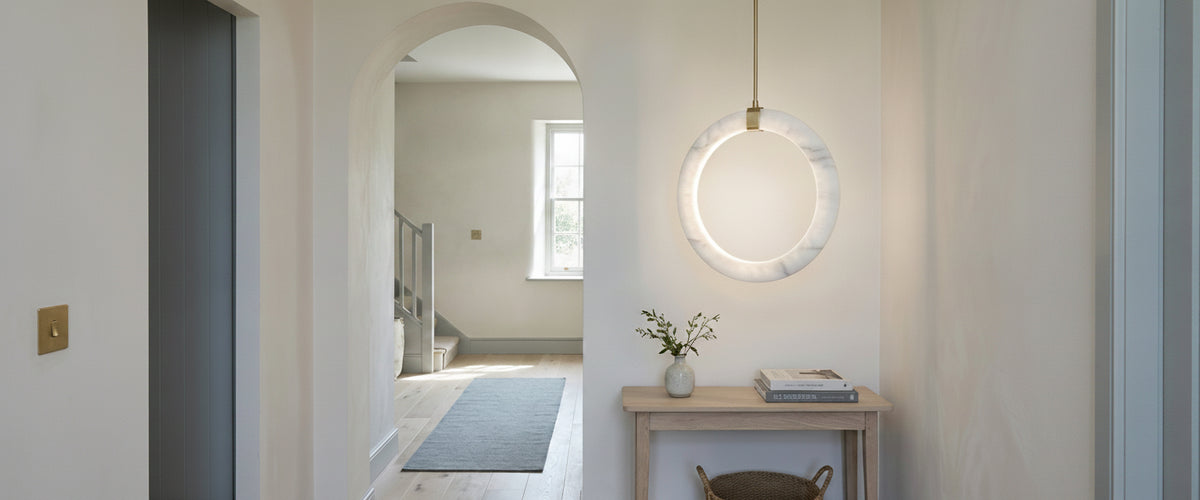

Nobody has ever walked into a room and said, "lovely switch plate." They just feel that everything has been thought about. That is the quiet power of screwless brass light switches: a solid metal faceplate with clipped-on edges, no visible fixings, sitting flat against the plaster like it grew there. Get it right and the wall reads as one surface. Get it wrong and you have a slightly crooked bit of hardware next to a beautifully lit alabaster pendant, dragging the eye down at exactly the wrong moment.
At Niori we spend most of our time on alabaster and natural-stone lighting, but the questions that follow a big pendant order are almost always about the small metalwork: which brass, which finish, what happens where the plaster meets the plate. Screwless brass light switches come up in nearly every one of those conversations. Here is the working knowledge, from the studio floor.

Key Takeaways Before You Specify
Screwless means a two-part plate. Screwless brass light switches use a base grid plate fixed to the back box, then a decorative front that clips over it, hiding every fixing.
Finish matters more than form. Polished, satin and antique brass each behave differently against paint, plaster and tile.
Depth catches people out. Metal plates and dimmer modules need room, so check back-box depth before ordering.
Dimmers must match the fixture. Low-wattage LED sources in alabaster fittings need a compatible trailing-edge dimmer and a sensible minimum load.
Lacquered or unlacquered is a lifestyle decision. Unlacquered brass patinates around fingerprints. Some clients love it; some are horrified by month three.
Always use a qualified electrician. Faceplates are decorative; the wiring behind them is not a weekend project.

Why the Faceplate Is the Detail Designers Notice First
Walk a project with an interior designer and watch where their eyes go. Ceiling line, skirting, door furniture, switch plates. These elements repeat dozens of times across a house, and repetition is what makes a scheme feel deliberate or accidental. A hallway with four white plastic rockers and one brass plate by the front door does not read as eclectic. It reads as unfinished. A switch is also one of the few parts of a lighting scheme you actually touch, several times a day, often in the dark, and metal has a weight and a cool, slowly warming feel that molded plastic never manages. Screwless brass light switches trade on exactly that.
There is a practical argument for screwless brass light switches too: fewer visible fixings means fewer things to line up. Slotted screw heads are meant to sit horizontally, and on a run of five plates in a corridor, one screw rotated fifteen degrees is genuinely visible in raking light. Remove the screws and the alignment problem goes with them.
Polished, Satin or Antique: How Each Finish Sits Against Your Walls
Polished brass is bright, reflective and unapologetic. It sings against saturated colors (inky blues, oxblood, forest greens) and dark timber paneling. On pale limewash it can look jewelry-like, which may be exactly right in a dressing room and exactly wrong in a calm bedroom. Polished screwless brass light switches also show fingerprints fastest, particularly unlacquered ones.
Satin or brushed brass is the workhorse. The fine directional grain scatters reflections, so the plate holds its color rather than mirroring the room back at you. It sits comfortably against white plaster, warm neutrals, tadelakt and honed stone, and where a fixture already carries brass detailing it usually makes the more restful match, because the stone does the glowing and the metal does not compete. Satin is the safest whole-house default for screwless brass light switches.
Antique or aged brass is chemically darkened, starting life somewhere between bronze and old gold. It works beautifully in period properties, against lime plaster, reclaimed brick and encaustic tile. Be aware that "antique" is not standardized between manufacturers; one supplier's antique is another's dark bronze. The easiest way to judge the tone is against a lit fitting in the same family, such as the Felix Antique Brass LED Picture Light 46cm. Order a sample screwless brass light switch too, and hold it against your wall color at night as well as in daylight.
On a marble splashback or a run of large-format porcelain the plate competes with a highly reflective surface, and satin nearly always wins. Polished metal against polished marble creates two hotspots fighting each other.
Satin plates hold their color against pale plaster; polished versions read brighter and show every fingerprint.
What a Clean, Screwless Edge Signals
A traditional slotted plate says heritage. It is honest about how it is fixed, and in a Georgian rectory with brass rim locks that honesty is part of the charm. A clip-on plate says something different: precision, modernity, a builder who cared about the plaster tolerance behind it. That is why screwless brass light switches suit crisp new work so well.
Here is the catch nobody mentions at specification stage. Screwless brass light switches are less forgiving than screwed plates. Because the front clips onto a base, any bow in the wall or proud edge of plasterboard shows as a shadow gap on one side, and you cannot nip a screw to pull the plate flush. On a farmhouse project we supplied, the electrician packed the back boxes and the plasterer feathered each surround; the result was faultless. On a hurried site, the same product would have looked worse than a standard plate. Flat, square-cornered profiles read most contemporary, while a slight bevel softens the look for transitional interiors.
Where Screwless Brass Disappears Beautifully, and Where It Is Wasted
Worth every penny: entrance halls, principal bedrooms, dining rooms, stairwell landings, snugs, and any wall you see from a seated position. Anywhere a guest stands still, screwless brass light switches earn their keep, which is why boutique hotels spend the money on corridor switching.
Consider carefully: kitchens with heavy grease exposure, utility rooms, and anywhere small children press the plate with sticky hands daily. Unlacquered brass will mottle fast there; lacquered satin copes far better.
Genuinely wasted: plant rooms, garages, loft hatches and walls behind permanently open doors. We routinely advise running screwless brass light switches through the front-of-house spaces and a good-quality neutral plate everywhere else. Nobody has ever noticed. If you are coordinating metalwork with your fittings, browsing the alabaster lighting collection alongside a physical sample is the fastest way to decide whether the metal should match closely or sit a shade warmer.
Back-Box Depth, Dimmers and Multi-Gang Runs
Most problems with screwless brass light switches start long before the plates arrive, so treat this as a pre-order checklist and hand it to your electrician.
Back-box depth. UK boxes are commonly around 25mm (1 in) or 35mm (1.4 in). Rotary and smart dimmer modules usually need the deeper box; plain switches often fit the shallower one. Confirm per position, not per house.
Box condition. Clip-on plates need the box set flush and square. Chipped plaster edges will show.
Gang count. Decide two-gang versus two separate plates early; narrow plates side by side rarely look as good as one wider plate.
Way count. Two-way and intermediate switching for corridors and stairs changes module counts, so plan it before ordering.
Dimmer type. Most LED sources in decorative fittings want trailing-edge. Check the driver specification.
Load range. A single low-wattage alabaster wall light can fall below a dimmer's minimum load and flicker.
Multi-gang derating. Three or four modules in one plate reduces the permitted load per module because of heat. Read the manufacturer's table.
Finish batch and certification. Order the whole house of screwless brass light switches in one go, since brass varies subtly between runs, and use a registered electrician; standards guidance is published by the IET.
Rotary dimmer modules usually need the deeper back box, so confirm clearance position by position.
Pairing Switch Metalwork With Alabaster and Stone Fittings
Alabaster gives a warm, diffused light with veining that shifts as the stone thickness changes. It is a cloudy glow rather than a sharp beam, and it flatters warm metals, which is why brass turns up so often on the collars, stems and canopies of our pendants and table lamps, and why screwless brass light switches sit so easily beneath them.
Decide whether you are matching or harmonizing. Matching means the same finish family and works best in smaller rooms where plate and fitting are read together. Harmonizing means letting the switch sit slightly darker or quieter, which suits open-plan spaces where an exact match looks showroom-like. One client ran antique plates against pale plaster under a polished-brass-and-alabaster pendant; the contrast worked because the pendant was clearly the object and the switches the background.
Scale shifts that balance. In a corridor or modest bedroom, something restrained like the Essence Brass Round Wall Light 75cm lets the metalwork match without crowding the wall; in a double-height hall, the 115cm version becomes the focal object and the plates are better dropped a shade quieter. Color temperature matters too: screwless brass light switches look their best under warm light, roughly 2700K, which is also where alabaster reads richest, while cool white pushes brass towards a greenish cast. The full lighting range shows how warm sources and brass detailing behave together.
Care, Patina and the Long View
Lacquered brass needs almost nothing: a dry microfiber cloth, occasionally slightly damp, never an abrasive cream. Polish cuts straight through the lacquer and leaves a patchy mess that cannot be undone without refinishing, so treat lacquered screwless brass light switches gently from day one.
Unlacquered brass is a different proposition. It oxidizes, darkens around fingertips and develops a living surface over years. Conservation advice favors the gentlest possible cleaning and warns against aggressive polishing, which removes material each time; the V&A's guidance on caring for metalwork is a sensible primer. Alabaster asks for the same restraint: a soft dry brush, no household cleaners, no water. Two natural materials, one principle.
The Short Version
Screwless brass light switches are a small-ticket detail with a disproportionate effect on how finished a room looks. Choose the finish against your actual wall in your actual light. Check back-box depth and dimmer compatibility before you order a single plate. Spend the money in the rooms people occupy and be ruthless everywhere else. Then let the alabaster do the glowing while the brass quietly holds it together. If you are planning a whole-house scheme, start from the Niori range and work outwards from the pieces that matter most.