
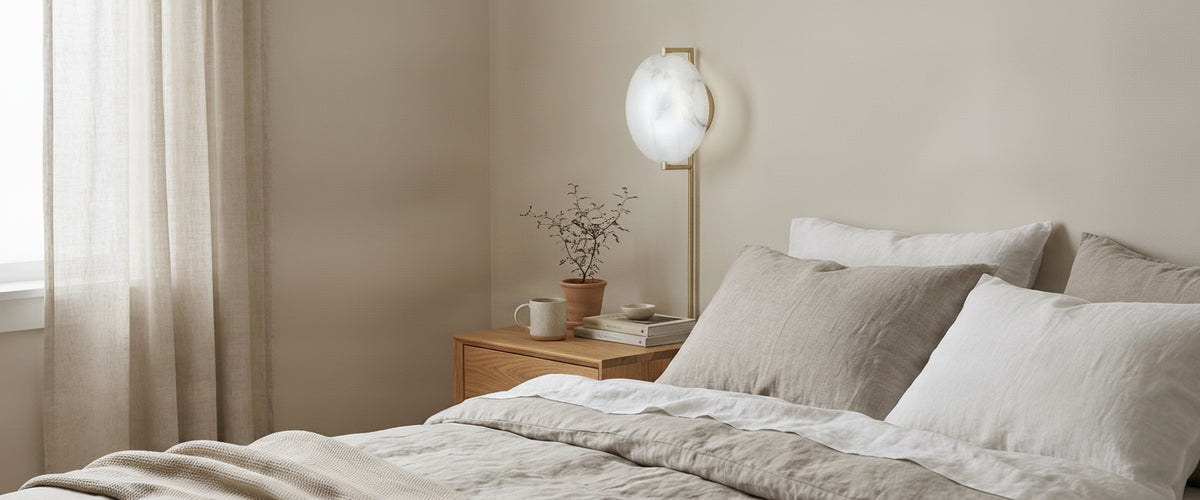

Gold looks effortless in a showroom at three in the afternoon. At eleven at night, with the dimmer at twenty percent and a cheap lamp behind it, the same finish can go hard, yellow and faintly hotel-corridor. That gap between daylight promise and evening reality is the whole problem with gold bedroom wall lights, and it has very little to do with the fixture being good or bad. It comes down to finish, height, shade material and the bulb you screw into it.

Key Takeaways
Satin and brushed gold bedroom wall lights hold up far better under low dimming than bright polished gold, which throws sharp specular highlights at eye level.
Bedside wall lights usually land between 1.1m and 1.4m (roughly 3ft 7in to 4ft 7in) from the floor, but the height should be set from the mattress and pillow, not from a rule.
Shade material decides whether the metal is flattered or exposed. Alabaster and opal glass diffuse; bare bulbs and open cones do not.
Warm plaster, clay, olive and inky blue-greens make gold look intentional. Cool gray and stark white can push it towards brass-yellow.
Run gold bedroom wall lights on 2400K to 2700K lamps with a compatible dimmer. Above 3000K the warmth drains out and the metal starts to read gray-yellow.
Any hard-wired wall light should be installed by a qualified electrician.

Why Gold at the Bedside Behaves Differently From Gold Anywhere Else
A hallway sconce is seen in passing, usually standing up, usually at full brightness, usually for a few seconds at a time. Gold bedroom wall lights are seen lying down, at close range, for long stretches, at the lowest setting in the house. Those are completely different jobs, and gold responds differently to each.
Two things change at the bedside. First, viewing angle: from a pillow you look up at the underside and the back plate of the fitting, which is exactly where budget pieces hide their weakest finishing and where reflected light pools. Second, brightness: gold is a warm-toned reflector, so as you dim, the metal keeps bouncing amber into the surrounding wall while the light source itself fades. Get it wrong and the wall around the fitting glows the color of weak tea.
This is also why the same product can be right in a snug and wrong in a bedroom. In our experience, buyers who report that their gold bedroom wall lights looked "cheap" almost always installed a polished finish with a clear bulb and no diffusion. Change one of those three variables and the complaint disappears.
Satin, Brushed and Antiqued Gold: How Each Reads After 9pm
Gold is not one finish, and on gold bedroom wall lights the differences matter most in the last hour before sleep.
Satin and Matte Gold
Satin gold scatters light across a soft, even surface. It holds tonal warmth without producing hot spots, which is why it is the safest choice for gold bedroom wall lights sitting directly beside a bed. On a dimmer it fades gracefully; the metal darkens with the room instead of clinging on as a bright object in your peripheral vision. Where the fitting sits within arm's reach of a pillow, a low-sheen body such as the Dynamics Up & Down Wall Light in Matte Gold is the safer specification than a mirror-bright equivalent.
Brushed Gold
Brushed finishes carry a fine directional grain. That grain catches raking light, which gives the fitting texture and stops it looking flat in daylight. Worth noting: the direction of the brushing matters when the light is mounted vertically, because a vertical grain reads longer and slimmer than a horizontal one on the same body.
Antiqued and Aged Gold
Antiqued gold has been deliberately darkened in the recesses, so shadow is already built into the surface. It suits older houses, paneled walls and deeper color schemes, and it is forgiving of fingerprints. The trade-off is that it can look muddy against pale plaster in a north-facing room where there is little warm daylight to lift it.
Polished and Mirror Gold
Reserve mirror-finish gold bedroom wall lights for larger rooms and higher mounting positions. Mirror-bright metal at eye level, 60cm (24in) from a pillow, is a specular highlight you cannot dim away. It works far better on a chandelier at ceiling height than on a bedside sconce.
One practical note on longevity: most decorative gold finishes are lacquered plated brass, and that lacquer is the layer doing the protecting. Conservation guidance on metals from the Smithsonian's Museum Conservation Institute is consistent on the point that abrasives and acidic cleaners strip protective coatings and accelerate tarnish, which is exactly why a dry microfiber cloth beats any proprietary metal polish on a modern lacquered fitting.
Mounting Height and Arm Projection: Measure the Bed, Not the Wall
Search gold wall lights bedroom and you will get pages of pretty fittings, most of them photographed on an empty wall. Placement is where the scheme goes wrong. The common installation mistake is treating a sconce as wall decoration and centering it on the wall rather than on the sleeper.
Start from the mattress, not the floor. A useful working range is 55cm to 70cm (about 22in to 28in) above the top of the mattress for a reading light. Measure with the mattress and topper in place, because a deep sprung base plus a thick topper can shift everything by 15cm (6in).
Account for headboard depth. An upholstered headboard 12cm (5in) proud of the wall pushes the light source backwards relative to the book. If projection is short, the beam clips the headboard instead of landing on the page.
Match the pair to the sleepers. There is no rule that says both sides must be identical in height. If one person reads bolt upright and the other lies almost flat, setting the two sconces a few centimeters apart is invisible in the room and far more comfortable in use.
Check the swing arc. Adjustable arms need clearance from curtains, blinds and the corner of the headboard. Open the arm fully before the electrician drills.
Keep the switch reachable from lying down. A rocker or pull cord on the fitting itself beats a wall plate you have to sit up to reach.
Cable position is worth settling early too. If you are running new circuits for gold bedroom wall lights, ask for the outlet centre to be set behind the back plate, and confirm the wall type. Plasterboard, brick and lath all need different fixings, and the fitting's weight distribution changes what is safe.
Shade Material: Fabric, Glass or Alabaster
On gold bedroom wall lights, the shade decides how much scrutiny the metal has to survive.
Fabric gives the warmest, softest downward pool and hides the lamp entirely. It also absorbs light, so you may need a slightly brighter source than you expect, and pale linen will yellow gradually near a warm lamp.
Opal and ribbed glass give a cleaner, more contemporary read and light up as an object in their own right. Ribbed and fluted glass adds sparkle that flatters brushed gold, though it puts more brightness into the room than fabric does.
Alabaster is the one that changes the character of the whole fitting. Because the stone is genuinely translucent, light travels through the material and comes out carrying the veining with it, so the shade glows rather than simply blocking glare. That soft, slightly amber diffusion is naturally sympathetic to gold: the warm stone and the warm metal share a tonal family, and neither one has to shout. This is the pairing we see most often in bedrooms across our alabaster lighting range, usually a slim gold or brass arm with a stone shade or backplate detail.
One thing to check with any natural stone: no two shades are identical. Veining varies piece to piece, which is part of the appeal but means a matched pair of gold bedroom wall lights either side of a bed will be siblings, not twins. Ask about pairing at the point of order if symmetry matters to you.
Wall Colors That Make Gold Look Convincing
Backdrop does half the work for gold bedroom wall lights. Gold sits inside the yellow-orange part of the spectrum, so what surrounds it either supports that or fights it.
Warm plaster, clay, oatmeal and mushroom: the most reliable partners. The metal reads as a tonal step up rather than a color clash, and dimmed light pools beautifully.
Deep greens, ink blues and aubergine: excellent for drama. Dark walls absorb spill light, so the gold becomes the brightest object in the room and needs a diffused shade to stop it dominating.
Pale limewash and lime plaster: the finish texture catches the wash from an up-down fitting and shows every gradient. A narrow twin-beam body like the Imaria Up Down Wall Light in Gold throws two soft cones across that texture instead of one flat pool, which is one of the more convincing combinations in a modern bedroom.
Cool gray and blue-white: the hardest backdrop. Gold bedroom wall lights can look isolated and slightly brassy here. If the room is already cool, choose antiqued gold, bring in a stone shade to bridge the temperature gap, or use a two-tone body such as the Alani Up Down Wall Light in Black & Gold, where the darker casing anchors the metal rather than leaving it stranded against the wall.
Timber matters too. Walnut and oak headboards pull gold towards the red end and make it look richer; high-gloss white lacquer does the opposite.
Bulbs and Dimming: The Pairing That Keeps Gold Warm
You can undo good gold bedroom wall lights with the wrong lamp in about four seconds.
Color temperature: 2400K to 2700K for bedrooms. 3000K is acceptable in a dressing area. Anything at 4000K or above turns warm metal gray-yellow and kills the effect entirely.
Color rendering: look for CRI 90 or higher. Low-CRI LEDs flatten the subtle tonal shifts in both brushed metal and stone veining. The Illuminating Engineering Society is a solid reference point on how color rendering and source quality affect the way finishes are perceived.
Dim-to-warm: the single best upgrade for gold bedroom wall lights. These lamps drop towards 2200K as they dim, mimicking incandescent behavior, so the metal stays amber instead of going pale.
Dimmer compatibility: confirm trailing edge versus leading edge with your electrician, and check the minimum load. LED loads are small, and an old dimmer designed for halogen will often flicker or buzz.
Beam and glare: for reading, aim for a controlled downward beam rather than a wide flood. Frosted or opal lamps behind a clear or ribbed shade cut glare when you are lying down.
If you are specifying gold wall lights for the bedroom of a hotel or a guest suite, put both bedside fittings on the same dimmed circuit and keep the ceiling fitting separate. The wall lights should be able to run the room on their own at night. That is also the moment when the rest of the scheme needs to agree with them, so it is worth reviewing the wider lighting collection as a set rather than buying sconces in isolation.
Buyer's Checklist for Gold Wall Lights in the Bedroom
Measure from the top of the mattress, with topper, before choosing height.
Check headboard depth against the fitting's projection.
Choose satin, brushed or antiqued gold bedroom wall lights over mirror-polish at bedside height.
Decide whether the shade should diffuse (alabaster, opal glass, fabric) or direct.
Test the gold sample against your actual wall color, at night, under a dimmed lamp.
Specify 2400K to 2700K, CRI 90+, ideally dim-to-warm.
Confirm dimmer type and minimum load with a qualified electrician.
Confirm switching is reachable from lying down.
For natural stone, ask how pairs are matched for veining and tone.
Plan care: dry microfiber only, no abrasives, no solvent sprays near lacquer or stone.
Living With Gold and Stone Over Time
Lacquered gold bedroom wall lights are low maintenance but not no maintenance. Dust weekly with a dry cloth, and keep hand cream and perfume away from the arm you touch most, since oils and alcohol both attack lacquer over months rather than days. Alabaster and marble shades want the same restraint: dry dusting, no water sitting on the surface, no household sprays. Stone is porous, and a spray cleaner that evaporates off a metal arm can leave a shadow on a shade that never fully lifts.
Done properly, a pair of gold bedroom wall lights becomes the most-used lighting in the house. They handle reading, they handle the last twenty minutes before sleep, and they let the ceiling fitting stay off for most of the evening. Niori builds around alabaster and natural stone precisely because those materials behave well in that low, close, late-night range, and gold detailing is the metal that most often keeps them company. Choose the finish for the hour you will actually use it, not for the showroom.