
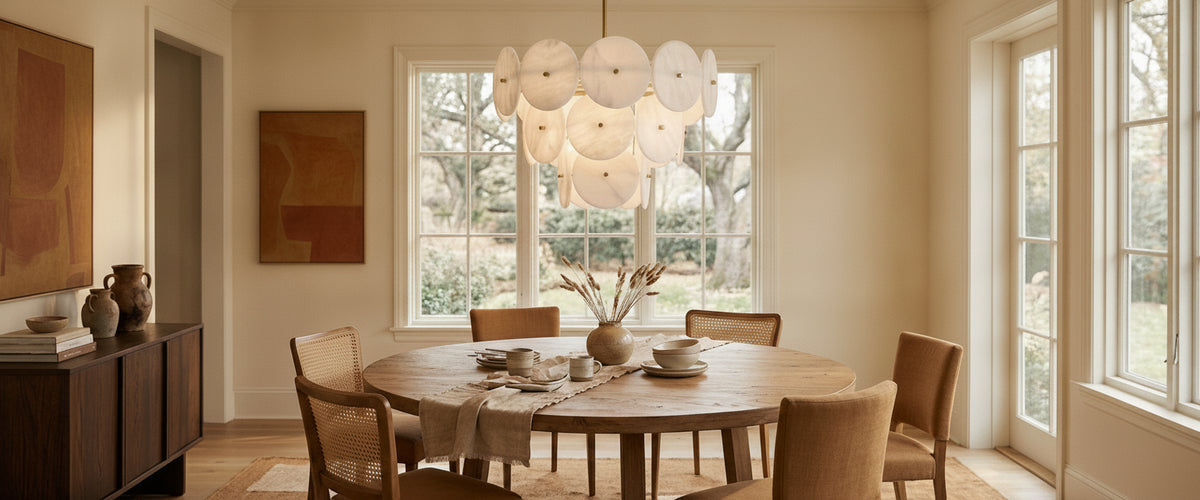

Brass photographs beautifully and behaves unpredictably. The finish that looks crisp under showroom spots can, two winters later, read as a quietly aged heirloom or as a tarnished afterthought hanging over the Sunday roast. Planning a brass chandelier dining room scheme is really three decisions stacked on top of each other: which brass, at what size, under which bulb. Get those right and the fitting carries the room for a decade. Get one wrong and you will feel it every time you sit down to eat. What follows takes those decisions in the order a brass chandelier dining room actually needs them.

Key Takeaways Before You Buy
Six things worth settling before you commit to a brass chandelier dining room purchase:
Finish sets the ageing curve. Unlacquered brass darkens and mottles, antique brass barely moves, satin and lacquered brass hold their colour but lose the depth.
Diameter should sit between half and two thirds of your table width, not your room width.
Hang the lowest point roughly 75 to 90cm (30 to 35in) above the tabletop for a standard 2.4m (8ft) ceiling, adding height for taller rooms.
2700K flatters brass; 3000K merely lights it. Warmer light pulls the gold out of the metal and the honey out of alabaster.
Alabaster shades soften brass and stop a bright metal frame reading as hard or showy over a dining table.
Budget depends on scale, material grade, engineering and installation, so ask for a tailored quote rather than working from a headline figure.

Unlacquered, Antique and Satin Brass Tell Three Different Stories
Most buyers assume brass is brass. It is not a single material choice; it is a family of finishes, and the three you will meet in almost any brass chandelier dining room search behave very differently once cooking steam, candle smoke and fingertips get involved.
Unlacquered (living) brass has no protective coating, so the surface oxidises. Over a dining table it darkens fastest around the arms people brush past and slowest on the upper surfaces nobody touches. The result after two years of dinner parties is uneven, warm and genuinely attractive if you like that sort of thing. If you want it bright again, a light polish brings it back, though conservators generally advise minimal, gentle cleaning of metal surfaces rather than aggressive abrasive work, as repeated polishing removes material permanently. The Canadian Conservation Institute sets out the principle clearly in its guidance on caring for metal objects.
Antique or aged brass has been chemically darkened and then sealed, so it arrives with the patina already applied and stays roughly where it started. It suits period rooms, panelled dining rooms and anywhere you want the fitting to look as though it has always been there. The trade-off is that it will never develop character of its own.
Satin and brushed brass sit in the middle: a fine directional grain, a lacquer or PVD coating, and a muted glow rather than a mirror. This is the safest choice for busy households because fingerprints disappear into the grain. Polished, lacquered brass is the brightest of the group and the most demanding, since every smear shows and the lacquer eventually wears where hands touch it.
One thing we have learned from shipping fittings out of the studio: unlacquered brass shows handling marks the moment it leaves the packing crate. We tell clients to unwrap with clean cotton gloves, because a thumbprint pressed into raw brass on day one can still be faintly visible eighteen months later, sitting a shade darker than everything around it.
How the Finish Reads Against Warm and Cool Dining Palettes
Brass is a warm metal with a green-gold bias, and it reacts to whatever surrounds it. In a warm brass chandelier dining room scheme (clay plaster, oak, burnt orange, terracotta, olive) the metal almost disappears into the palette as an accent rather than a statement. That can be lovely, or it can be flat. If your dining room already leans warm, a brighter satin or polished brass gives the fitting enough separation to be seen.
Cool rooms behave differently. Against grey-blue walls, pale limestone floors or a cool white ceiling, brass reads much stronger. It becomes the warm punctuation in an otherwise restrained space, which is exactly why designers reach for brass dining room chandeliers in monochrome schemes. In that setting, antique brass often works better than polished, because a cool room makes bright metal look more assertive than it did on screen. Where a cool scheme needs the brass to behave as sculpture rather than trim, a coiled form such as the Glistis Brass Dimmable LED Spiral Pendant Light 80cm holds the eye without the fussiness of a multi-arm frame.
A useful test before committing: hold a brass sample against your wall colour at night, under the light you actually use, not daylight. Brass shifts more between daylight and lamplight than almost any other metal in a home.
Scale Over the Table: Diameter and Drop for a Brass Chandelier Dining Room Scheme
The most common mistake we see is a fitting chosen for the room rather than the table. Dining rooms are lit from the table outwards, so in a brass chandelier dining room the table, not the floor plan, is the governing dimension.
Round tables: aim for a chandelier diameter of roughly half to two thirds of the table diameter. A 140cm (55in) round table takes something in the region of 70 to 90cm (28 to 35in) across.
Rectangular tables: either a single fitting no wider than two thirds of the table width, or a linear chandelier that runs along the table's length while staying comfortably inside its footprint.
Drop height: the lowest point of the fitting should sit around 75 to 90cm (30 to 35in) above the tabletop. Below that and guests duck; above that and the light pools too widely to feel intimate.
Tall ceilings: add roughly 7 to 8cm (about 3in) of drop for every additional 30cm (12in) of ceiling height above 2.4m (8ft).
Sightlines: sit down at your table and check what you can see across it. A bulky brass frame at eye level ruins conversation more effectively than any centrepiece.
Those numbers are easier to picture against a real fitting. On that 140cm round table, a slim brass disc such as the Oracle Brass Slim Round Pendant Light 90cm sits at the upper end of the ratio and reads as a defined pool of light rather than a fitting straining to cover the room, while a 60 to 70cm disc suits a 110 to 120cm table without crowding the sightline across it.
Weight matters too. Larger brass and stone fittings can be substantially heavier than a glass equivalent, which affects the ceiling fixing and sometimes the joists above it. Any hard-wired installation should be carried out by a qualified electrician, and in England certain electrical work in the home falls under Building Regulations, set out in the government's Approved Document P. Ask about weight and fixing requirements before you order, not after the crate arrives.
Bulb Temperature and the Brass Effect: Why 2700K Flatters
Brass has a colour of its own, and the lamp you put behind it either supports that colour or fights it. For a brass chandelier dining room, the safe specification is 2700K: the light carries enough red and amber to make brass look like gold rather than yellow metal. Skin tones improve, wine looks better in the glass, and any alabaster or onyx in the fitting glows honey rather than grey-white.
At 3000K the room is competently lit and slightly colder. Brass turns a little brassier in the pejorative sense: more zinc, less gold. Push to 4000K and you have a kitchen showroom over your dining table. For dining specifically, we would take 2700K almost every time, with 2200K to 2400K as an option if the chandelier is one of several layers and you have wall lights doing the practical work.
Dimming deserves the same attention. Choose lamps rated for dimming, pair them with a compatible trailing-edge dimmer, and check whether the driver in an integrated LED fitting is dimmable at all. Warm-dim lamps that shift towards amber as they lower are worth the extra outlay over a dining table, because they mimic the way candlelight drops in colour temperature as the evening goes on. Browse the wider niori lighting range with dimming in mind from the start; retrofitting a compatible control is far more disruptive than specifying it up front.
When Brass Anchors the Scheme and When It Fights Every Other Metal
Mixed metals work when there is a clear hierarchy, and a brass chandelier dining room is no exception. Brass overhead, brass or bronze on the cabinet handles, and one contrasting metal elsewhere reads deliberate. Brass overhead, chrome on the radiator valves, nickel on the door furniture and black steel on the window frames reads like four separate decisions taken on four separate days.
A brass dining room chandelier anchors a scheme best when it is the warmest and most reflective thing in the room, and when at least one other element echoes it quietly. A brass picture light, a linear brass shelf bracket, the pull on a sideboard. It fights the room when it is competing with a large expanse of cool metal, particularly stainless steel in an open-plan kitchen diner. In those spaces, an alabaster-shaded fitting with restrained brass detailing usually resolves the tension better than a fully exposed brass frame, because the stone does the visual heavy lifting and the metal reads as trim. Where the steel simply dominates and brass would always be the odd one out, it is often more honest to change metal altogether and let a chrome and crystal linear fitting such as the Alvera 8 Light Crystal Island Chandelier run with the room rather than against it.
This is where natural stone earns its place. Alabaster diffuses light from within rather than throwing it, so a brass and alabaster chandelier gives you a soft, low-glare pool over the table with none of the hard highlights that bare bulbs and polished metal produce together. Our alabaster lighting collection is built around exactly that combination: translucent stone doing the diffusion, brass doing the structure and the jewellery.
What Five Years of Patina Actually Looks Like
Ask for honesty here, because photographs of aged brass are almost always shot at year one. On unlacquered brass in a real brass chandelier dining room, five years produces a range rather than a single tone: mid-brown where hands and cloths touch, a warmer bronze on vertical faces, and darker, almost chocolate shading in crevices and behind arms. Rooms near the coast age faster. Rooms with open fires or gas hobs age faster still.
Whether that suits you depends on the room you have. In a Georgian dining room in Bath with panelling and old oak, five-year patina looks correct. In a crisp, pale extension with polished plaster and pale stone flooring, the same fitting can start to look neglected rather than aged, and clients often ask us for antique or satin brass instead once they see it in situ.
Care is straightforward either way. Dust with a dry microfibre cloth, keep water and household sprays off both brass and stone, and never let a proprietary metal polish touch an alabaster or marble element, since acidic and abrasive cleaners etch soft stone permanently. If you want to slow oxidation on unlacquered brass, a thin coat of microcrystalline wax applied once a year is gentler than repeated polishing.
The Buyer's Checklist
Work through this list before you sign off a brass chandelier dining room order:
Measure the table, not the room, and set the diameter at half to two thirds of the table width.
Confirm the drop from the ceiling to the lowest point of the fitting, allowing for ceiling height and any table extension leaves.
Decide your ageing tolerance: living brass, aged brass or coated brass.
Test the finish against your wall colour under evening light.
Specify 2700K lamps, dimmable, with a compatible trailing-edge dimmer.
Audit the other metals in the room and pick one supporting echo.
Check fixture weight, ceiling fixing and whether a qualified electrician is needed for the circuit work.
Ask what the stone and metal elements need in terms of long-term care before you buy, not after.
Request a tailored quote; scale, stone grade, engineering and installation all shift the figure considerably.
Brass rewards a decision made with your eyes open. Every successful brass chandelier dining room comes down to the same three moves: choose the finish for the way you want it to look in year five, size it against the table, and light it warm. Do that and dining room brass chandeliers stop being a risk and start being the thing guests comment on before they have taken their coats off. If you want help matching a finish to a specific room, the team at Niori works with alabaster and natural-stone fittings every day and can talk you through how a given brass will sit against your scheme.