
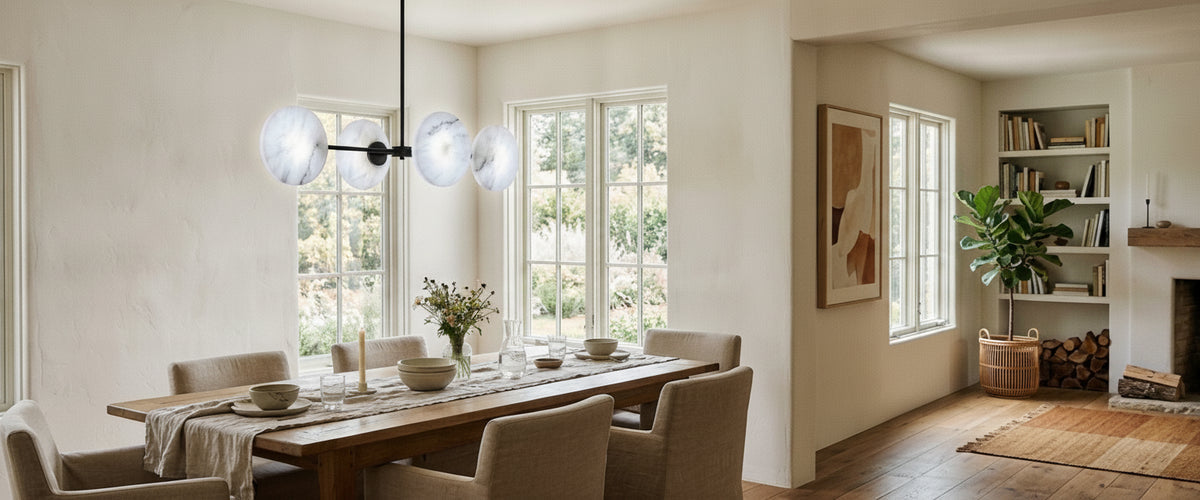

Most black chandeliers fail the same way. They look sharp in a showroom photograph, then turn into a dark smudge above the table by seven o'clock on a January evening. The fixture reads as a hole punched in the ceiling rather than the thing holding the room together. Getting a black dining room chandeliers right is less about the silhouette you fall for online and more about finish, drop height, diameter and what sits behind it. At Niori we build most of our fixtures around alabaster and natural stone, and black metal is the frame we use most often to give that warm, milky light something to push against.

Key Takeaways Before You Shop
- Black works as an anchor when it has a job. Over a table it frames a defined zone. Floating in an open-plan corner with nothing to relate to, it reads as a void.
- Matt absorbs, satin holds shape, gloss reflects. Matt under warm LED can go flat; satin and lightly textured finishes keep the form legible.
- Diameter: roughly half to two-thirds the width of the table. Drop: bottom of the fixture around 75 to 90cm (30 to 36in) above the tabletop.
- Powder-coated steel and patinated brass hold their colour for years. Sprayed or lacquered finishes on thin substrates are the ones that mottle.
- Dark metal needs a light source inside it, not just around it. Alabaster or onyx diffusers stop the piece reading as a dark object with bulbs attached.
- Never hang a black dining room chandelier as the only light. Wall lights, a sideboard lamp and dimming keep it warm rather than harsh.

Why Black Reads as an Anchor Over a Dining Table
A dining table is one of the few places in a home with a fixed, obvious centre, and that is exactly what a dark fixture needs. Black draws the eye down and inwards, and because the table already defines a footprint, the ceiling piece reinforces something the room has agreed on. Put the same design over an open landing or in the middle of a wide, pale living room and it has nothing to relate to. It stops being architecture and starts being a shadow.
That is why a black chandeliers dining room scheme often succeeds where the same designer's piece fails elsewhere in the house. The table gives it scale, the chairs give it rhythm, and the sightline from the doorway gives it a job. Long refectory tables in barn conversions and Victorian knock-throughs are where a black dining room chandelier earns its keep most reliably, because both have length that wants a horizontal fixture rather than a single central blob.
The failure mode worth naming: an all-dark fixture in a room with no other dark notes. If there is no black in the joinery, the chair legs, the window frames or the art, it looks imported from another scheme. One repeated dark element anywhere in the room is usually enough to make the ceiling piece feel deliberate.
Matt, Satin and Gloss: How Each Finish Treats Warm Light
Finish changes the character of a black dining room chandelier more than form does. Matt absorbs almost everything that hits it, so the piece reads as pure silhouette. That is superb against a pale ceiling and unforgiving against a dark one, where the whole thing disappears into gloom. Under candlelight, matt gives you nothing back; the candles do the work and the frame recedes.
Satin and lightly textured finishes are the safer choice for most rooms. They catch just enough of a warm LED to describe the edges of the frame, so arms, curves and joins stay readable from the far end of the table. Fine-textured architectural powder coatings do this particularly well because the surface breaks up reflection instead of bouncing it back in one hard highlight. Quality here is not cosmetic; coating standards bodies such as Qualicoat exist because pre-treatment and cure quality determine whether a coating stays even for a decade.
Gloss is the specialist option. It behaves almost like a mirror, picking up candle flames, the glow of alabaster shades and the reflection of the table below. In a room with plenty of natural light and a strong scheme, it looks properly theatrical. In a small, low-lit space it multiplies every hotspot. If you are choosing blind, satin flatters the widest range of interiors.
Drop and Diameter Numbers That Stop a Black Dining Room Chandelier Eating the Table
Dark fixtures read as visually heavier than pale ones of identical size, so the usual sizing conventions need a slight trim rather than a stretch.
Diameter and length
For a round table, aim for roughly half to two-thirds the table's diameter. For a rectangular table, a linear suspension of about half to two-thirds the table length is the classic proportion; a long table under a single round fixture almost always looks undersized at one end. On a six-seater of around 1.8 to 2m, that puts you near the Steel Black Linear Pendant Light, 120cm, while a three-metre refectory table needs something closer to the Sparx Black Linear Pendant Light 27W 3000K, 181cm. Leave at least 15cm (6in) of clear table either side so the piece never appears to overhang the plates.
Height above the table
The bottom of a black dining room chandelier should sit around 75 to 90cm (30 to 36in) above the tabletop on a standard 2.4m (8ft) ceiling. Go higher and it loses its grip on the table; lower and you block sightlines across dinner. For every additional 30cm (1ft) of ceiling height, add roughly 7 to 8cm (3in) to the drop, and specify the longer stem or chain at the point of order rather than improvising on installation day.
Visual weight
A solid shade blocks light and reads as mass. An open cage or a frame with translucent stone diffusers reads as lighter at the same dimensions. Where a room wants presence without bulk, a sparse open-armed form such as the Global 16 Light Bubble Chandelier, 150cm spans the same width while letting the ceiling read through it. If you love a heavy silhouette but the room is tight, go a size down.
Which Materials Hold the Colour, and Which Start to Mottle
Black is unforgiving. Any unevenness in the coating shows within a couple of years, particularly above a table where warm air, cooking vapour and candle soot rise straight into the fixture.
- Powder-coated steel: the durable workhorse. Properly pre-treated and cured, it stays even and takes cleaning without marking.
- Blackened or patinated brass: ages rather than degrades. The finish softens at handled edges, which most buyers grow to like.
- Darkened metals with a lacquer: fine, but the lacquer is the wear layer. Abrasive cleaning cuts through it and creates a patchy look.
- Painted resin or thin composite arms: the usual culprits behind mottling and chalking. Lamp heat and repeated wiping do the damage.
- Dark natural stone: Nero Marquina marble, soapstone and dark onyx bring depth no paint can imitate, and stone cannot flake.
Pairing dark metal with backlit stone is where a black dining room chandelier stops being a trend piece. Alabaster is a fine-grained gypsum stone, quarried in Britain for centuries in the Trent Valley and long used for carving precisely because it transmits light so kindly; the British Geological Survey documents those deposits and their history. Set a lit alabaster panel inside a dark frame and the stone glows warmer by comparison while the frame gains purpose. Our alabaster lighting collection is the clearest place to see the two behave together.
Wall Colour and Backdrop: Contrast That Makes Black Sing
The backdrop decides whether the fixture is a sculpture or a stain. Chalky off-whites, warm plaster tones and pale limewash give the crispest silhouette, and light bouncing off those walls keeps the room from feeling closed in. Deep greens, inky blues and oxblood work beautifully too, but only when the fitting emits visible warm light; against a dark wall, a matt frame with concealed sources vanishes.
Mid-tone greys are the trap. Grey has too little contrast to sharpen the outline and too little warmth to flatter the glow, so the piece looks vaguely grubby rather than graphic. Timber panelling is more forgiving, especially oak and walnut, because the grain gives the eye something to read behind the frame.
A hard-won detail from the studio: we shipped a black-framed linear suspension with alabaster diffusers to a converted farmhouse in Suffolk with exposed dark beams. On paper it should have failed. It worked because the plaster between the beams was a warm white, giving the fixture a bright field to sit against while the beams echoed its colour. Backdrop beats blueprint every time.
Bulbs, Dimming and the Layers Around It
A black dining room chandelier reflects almost nothing back into the room, so the lamps inside it are doing all the work. Choose warm output in the 2400K to 2700K range; anything cooler turns dark metal cold and blue-tinged. High colour rendering matters more here than in most rooms because you are lighting faces, wine and food.
Dimming is not optional. Full brightness on an exposed-lamp fixture creates glare against a dark frame, which is the single most common complaint we hear. Specify dimmable drivers and a compatible dimmer at the point of order, and have a qualified electrician confirm the load and control type before installation.
Then layer. A pair of alabaster wall lights lifts the vertical planes so the ceiling piece is not working alone. A stone table lamp on a sideboard gives a low, warm pool for the end of the evening. Browse the broader lighting range if you are building a scheme rather than buying a single piece; matching material families across pendant, wall and table light is what makes a dining room feel designed rather than assembled.
Buyer's Checklist for a Black Dining Room Chandelier
- Measure the table, then set fixture size at half to two-thirds of the longest dimension.
- Measure floor to ceiling and calculate the drop before you order stems or chain.
- Confirm ceiling structure, fixing points and weight with your electrician.
- Decide matt, satin or gloss based on wall colour and natural light.
- Ask what the finish actually is: powder coat, patinated metal, lacquer or paint on composite.
- Confirm dimmability, driver type and lamp colour temperature in writing.
- Identify one other dark element in the room so the fixture reads as part of the scheme.
- Plan two supplementary light sources at different heights.
- Ask about lead time and access requirements for a heavier stone fixture.
On budget, resist fixed expectations from a category page. Cost on a dining room chandelier, black or brass, is driven by scale, hand-finishing, whether stone is involved and how it is cut, the engineering behind the suspension, and installation complexity. A tailored quote based on your table size, ceiling height and finish preference will tell you far more than a price band ever could.
Keeping It Looking New
Dust the frame with a dry microfibre cloth every few weeks; grease and dust build faster above a table than anywhere else in the house. Avoid solvents, abrasive creams and anything alkaline, all of which attack coatings and lacquers. Alabaster and stone components want a barely damp cloth and nothing more, since gypsum stone is water-sensitive. Turn the power off before touching any fitting, and let a qualified electrician handle re-lamping.
Done properly, a black dining room chandelier is the most reliable way to give a table its own room, even when there are no walls to define one. Pair it with warm stone diffusers, get the drop honest and the dimming right, and it will read as the anchor it should be. To see how dark metalwork behaves alongside alabaster and marble across pendants, chandeliers and wall lights, start at the Niori homepage and work through by fixture type.