

Black metal reads as a shape. Gold reads as a highlight. Get the ratio between the two wrong and a black and gold chandeliers stops looking like a fixture and starts looking like a scribble drawn on the ceiling. Get it right and the piece does something few other fixtures manage: it holds the center of a room in daylight, when it is switched off, as confidently as it does at night.
That is the real buying decision here, and it has almost nothing to do with the word "chandelier" on the product page.

Key Takeaways Before You Shop
- Black and gold is a high-contrast pairing. Polished or bright gold against matte black is graphic and loud. Aged brass against black is quieter and warmer, and forgives a busier room.
- Black frames need light behind them. Against a dark ceiling or a walnut coffer, black arms vanish. Against pale plaster, they draw perfectly.
- Crystal on a black frame behaves differently. The dark structure disappears and the drops appear to float, which is either the effect you want or a confusing mess.
- Arm count matters more than diameter. Eight generous arms read better at scale than sixteen thin ones.
- Cleaning a black and gold chandelier depends on the finish. Powder-coated black, blackened brass and lacquered gold each demand a different cloth and a different chemical, or no chemical at all.

Black and Gold Versus Black and Brass: A Distinction With Real Consequences
Retailers use "gold" and "brass" almost interchangeably. They should not. Bright gold, whether plated or lacquered, is cool-leaning and reflective; it flashes back at you from across the room and reads as jewelry. Brass, especially brushed or antique brass, absorbs some of the light it receives and returns a softer amber. Both work with black. They do not work in the same rooms.
If your interior is disciplined and fairly monochrome, with pale walls, dark joinery, stone or large-format tile underfoot, a black and gold chandelier with a bright gold accent is the sharper choice. It gives the room a punctuation mark. If your interior already has warmth in it, with oak floors, linen upholstery, terracotta or clay tones, brushed brass against matte black keeps the piece from shouting over everything else in the room.
One more practical note from the studio: matte black powder coat shows dust and fingerprints faster than any other popular finish, satin black included. On a fixture hung 10 feet (about 3 m) up, nobody notices. On a low-slung black and gold chandelier over a dining table, where guests reach past it, they do. Ask about the sheen level before you commit, not just the color name.
Wall Color, Ceiling Height and Floor Tone That Make the Contrast Work
A black and gold chandelier is a silhouette, so it needs a backdrop. The most reliable setting is a pale ceiling with a warm white or off-white wall, where the arms describe a clean outline and the gold picks up glancing light from the lamps. Chalky greens, deep blues and clay pinks all take black well too, because the frame reads as a graphic line rather than a competing color.
Where it fails: a dark ceiling. We shipped a large black and brass linear chandelier to a Napa client with a stained cedar ceiling, and the first photograph back showed the arms almost completely lost. The fix was a pair of narrow-beam recessed downlights aimed to graze the fixture, which brought the brass forward and gave the black just enough edge definition. Worth planning before installation, not after.
Ceiling height sets the rest. Over a dining table, the general rule is 30 to 36 inches (76 to 91 cm) from tabletop to the lowest point of the fixture, adding a little for ceilings above 9 feet (2.7 m). In an entry or stairwell, the bottom of the piece should clear head height with room to spare, and it should be visible from the floor above if there is one. Floor tone matters less than people assume, though a very dark floor plus dark walls plus a dark fixture will flatten the whole room. Something in the middle of the room needs to be light.
What Crystal Does on a Black Frame
A black crystal chandeliers works on an optical trick. The dark frame recedes, especially in evening light, and the drops appear to hang in mid-air. Cut crystal on a gold or chrome frame reads as one connected object; the same crystal on black reads as scattered points of light with a shadow behind them. It is a colder, more theatrical effect, and it suits contemporary rooms far better than traditional ones.
The material behind the sparkle is worth understanding. Lead crystal refracts more sharply than ordinary glass because of its higher refractive index, which is why historic chandeliers were prized for the way they broke candlelight into color. The Metropolitan Museum of Art holds good examples of how cut glass was used to multiply a small number of flames into a room full of light. Modern crystal-and-black pieces borrow that logic but usually dial the drop count down.
Where crystal gets you into trouble is glare. Exposed clear lamps behind crystal on a black frame create hard, bright points against a dark background, and the eye finds that tiring at a dining table. Frosted lamps, or diffusing glass shades, solve it without killing the sparkle.
Where Alabaster Changes the Equation
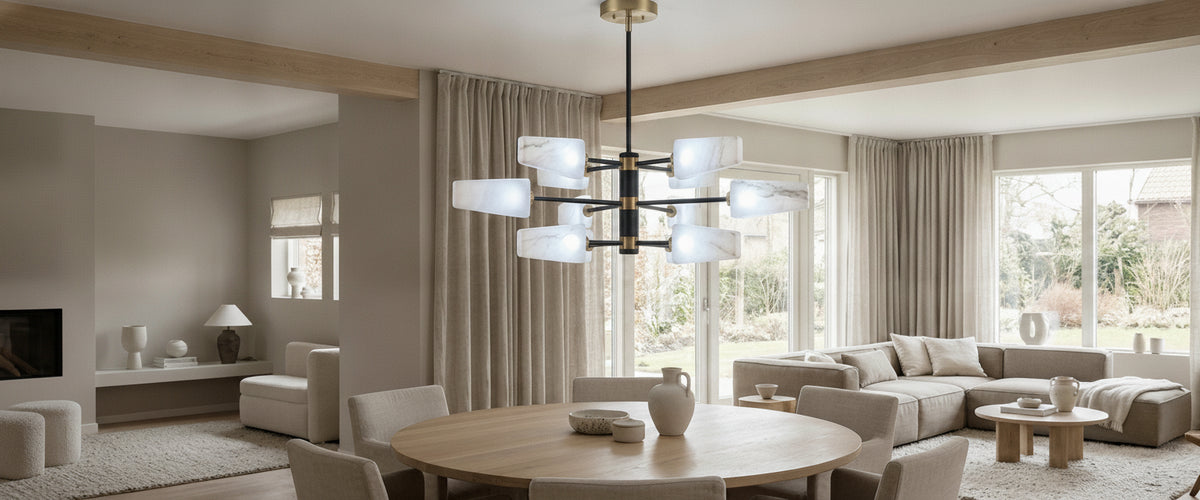
There is a third route, and it is the one we return to most often at Niori. Instead of crystal, use stone. Alabaster and marble diffusers on a matte black or black-and-brass frame produce a warm, low-glare glow that crystal cannot replicate, because the light passes through the material rather than bouncing off it. Every slab has its own veining, so the lit surface has depth and movement instead of uniform brightness.
Practically, this makes a black contemporary chandelier far easier to live with over a dining table or an island. You get the graphic frame and the metal accent you were shopping for, plus a light source you can look at directly without squinting. Where the room needs a soft diffused glow rather than hard points of light, something like the Aurelian LED Layered Arms Alabaster Chandelier in Matt Black is closer to the right design language than a crystal equivalent of the same diameter. Our alabaster lighting range covers layered-arm chandeliers, linear pieces for long tables, and matching wall lights when you need the ceiling fixture echoed at eye level.
Alabaster is a soft stone, gypsum-based, and it does not like water or acidic cleaners. That is a maintenance trade rather than a flaw. It also means colored or veined stone should never be painted or sealed with a general-purpose product; leave finishing to the maker.
Arm Configurations That Stay Legible at Scale
The mistake buyers make with a modern black chandelier is choosing by diameter alone. A 40-inch (100 cm) fixture with twenty-four thin arms turns into a dark cloud when viewed against a bright window. The same diameter with eight to twelve well-spaced arms stays readable from across the room. Scale a black and gold chandelier by arm count first and diameter second.
Silhouettes that hold up at scale:
- Layered or tiered arms with clear vertical separation between levels, so the eye can count the tiers.
- Branching forms with asymmetric spacing, which suit double-height stairwells where the piece is seen from two floors.
- Linear bars over long tables and islands, where the run of the fixture matches the run of the surface below.
Branching forms are the most forgiving of the three, because the gaps between the arms do as much visual work as the arms themselves. A piece such as the Galaxy 12 Light Branching Chandelier in Black & Brass stays readable in a stairwell precisely because the globes are spaced far enough apart to be counted from below. Over a long dining table the logic reverses and you want a single continuous run, which is where a linear piece like the Aurevia 14 Light LED Linear Alabaster Chandelier earns its length instead of crowding the table.
Silhouettes that overcrowd: dense globe clusters in black, tight concentric rings, and anything where the arms cross visually from the primary viewing angle. If you cannot describe the shape in one sentence, the room will not be able to either.
Budget on any of these depends on the material, the diameter, the number of light points, the metalwork and the finishing, so it is worth requesting a tailored quote rather than assuming a black-frame piece costs the same as its brass twin.
The Rooms Where a Black and Gold Chandelier Is the Obvious Choice
Dining rooms. The strongest case. One table, one focal point, and a black and gold chandelier gives the room structure that a pale fixture cannot.
Entry halls and stairwells. Height gives a black chandelier modern drama, and the gold catches light from windows during the day. Check the piece looks right from below and from the landing.
Formal living rooms with pale walls. Works when the room has other dark anchors, such as a black steel fireplace surround or dark window frames, so the fixture is not the only dark object floating in a light space.
Hospitality. Bars, private dining rooms and hotel lobbies where the fixture needs presence on camera as well as in person.
And where it dominates badly: small bedrooms, low-ceilinged cottages, and any room already carrying heavy pattern. A black contemporary chandelier in a 9-foot (2.7 m) bedroom with a patterned wallpaper competes with everything and wins nothing. In those spaces, wall lights and a table lamp do more. Browse the wider lighting collection if you need a softer solution for a compact room.
Bulbs, Dimming and Installation Checklist
Once you have chosen a black and gold chandelier, the specification decides whether it flatters the room or fights it:
- Color temperature: 2700K for living and dining spaces. Anything above 3000K makes gold look green and black look flat.
- Color rendering: CRI 90 or higher, particularly with stone diffusers, where poor rendering kills the warmth of the veining.
- Dimming: confirm the driver and dimmer are compatible as a pair. Flicker and dropout are almost always a mismatch, not a faulty lamp. The Illuminating Engineering Society publishes useful background on dimming performance if you want the technical detail.
- Lamp appearance: frosted or opal in exposed sockets; clear only where the fixture is above eye level.
- Ceiling support: confirm the fixing point can carry the weight, including any crystal or stone. Heavy pieces may need a brace or a structural fixing, checked by the installer.
- Wiring: use a qualified electrician for any hardwired installation. Isolate the circuit first, always.
- Layering: a chandelier should not be the only light in the room. Pair it with wall lights or a floor lamp so the space still works at low levels.
Care: Cleaning a Black and Gold Chandelier Without Ruining the Finish
- Powder-coated matte black: dry microfiber first to lift dust, then a barely damp cloth with a drop of mild dish soap. No solvents, no abrasive pads, no all-purpose sprays.
- Blackened or antiqued brass: dust only. Brass polish strips the patina and leaves bright streaks you cannot undo.
- Lacquered gold: dry or barely damp cloth. Polish will cut through the lacquer.
- Crystal drops: wear cotton gloves, support each drop as you wipe, and use distilled water with a little isopropyl alcohol rather than glass cleaner, which can seep into pin fittings.
- Alabaster and marble: soft dry brush, then a dry cloth. Keep water off it and never use acidic or citrus cleaners.
- Frequency: dust twice a year in a normal home, quarterly above a dining table or near an open kitchen where cooking film builds up.
Switch the circuit off before you touch anything, let lamps cool, and photograph the crystal arrangement before removing drops. Reassembly is the part everyone underestimates.
Niori works in alabaster, marble and natural stone, with brass and blackened metalwork detailing, which means most of what we ship in black is a black and gold chandelier in spirit and a stone light source in practice. If you are weighing crystal against stone, ask for both options on the same frame and compare them lit at the same dim level. The difference is immediate.