
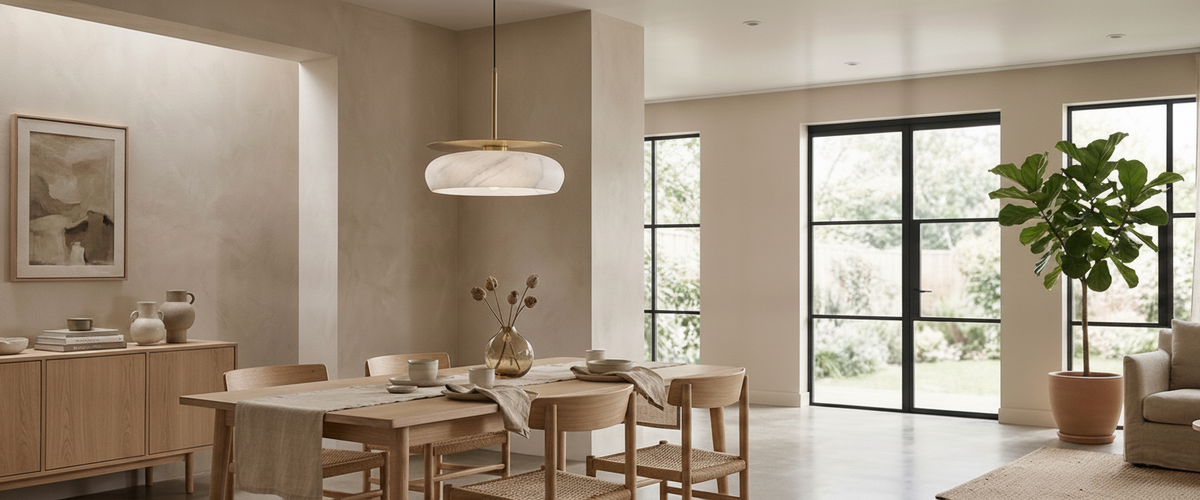

Spend real money on a carved alabaster pendant, screw in the first E26 LED you find in a kitchen drawer, and you can flatten the whole thing in a second. The stone that looked honey-warm in daylight goes flat and slightly grey after dark. Nine times out of ten the fixture is fine; the bulb is the problem. E26 LED light bulbs vary far more than the box suggests, and inside a translucent stone shade those differences show up mercilessly.
Alabaster and onyx are picky about what you put behind them. They filter light through mineral veining, so the character of the bulb reaches your eye changed but not hidden. Get the bulb right and the fixture reads warm, layered and alive. Get it wrong and you have paid for a lamp that looks like a night light.

Quick Answer: Choosing E26 LEDs for Stone Fixtures
Colour temperature: stay in the 2200K to 2700K range for alabaster and onyx. Warm, not clinical.
CRI: aim for 90 or higher so the stone's veining and colour read true.
Lumens: think in lumens, not watts. A diffusing stone shade eats output, so err slightly brighter than a bare fitting would need.
Shape: match the bulb form to the fixture. Compact globes and candles suit shades; long filament tubes can cast shadows through thin stone.
Dimming: only buy bulbs marked dimmable, and pair them with a compatible LED dimmer to avoid flicker and buzz.
One note before we go further. E26 is the US medium screw base; the UK and most of Europe use E27, which is nearly identical in size but wired to a different standard. If you are buying for a home outside North America, check the base your fixture takes before ordering. The advice on E26 LED light bulbs below applies to both.

Why the Wrong Bulb Turns a Warm Stone Fixture Cold and Grey
Alabaster has a faint natural warmth in its base colour. Feed it a cool or neutral white bulb and you are fighting that warmth instead of working with it. The stone starts to look blue-grey where it should look candlelit. This is the single most common mistake we see when clients send us photos of a fixture that "doesn't look like the website". The fix is almost always a matter of picking the right E26 LED light bulbs for the job.
Colour temperature is measured in kelvin. Lower numbers are warmer and more amber; higher numbers are cooler and bluer. For natural stone we push people firmly toward the warm end, around 2700K, and often lower for bedrooms and dining rooms. Once you get past 3000K into so-called neutral white, alabaster loses the glow that made you want it in the first place.
Colour Temperature and CRI: What Actually Reaches Your Eye
Colour temperature sets the mood; CRI (Colour Rendering Index) sets the honesty. CRI measures how faithfully a light source shows colour compared with natural daylight, on a scale up to 100. A cheap medium-screw LED at CRI 80 can render the stone's veining as muddy and washed out. At CRI 90 and above, the ochre, grey and amber threads in the stone read clearly. This is why the CRI on your E26 LED light bulbs matters as much as their warmth.
This matters more with stone than with a fabric shade because you are looking through the material, not just at a pool of light beneath it. The bulb's rendering quality gets baked into every part of the fixture's surface. When we photograph pieces in the studio, the difference between an 80 CRI and a 95 CRI bulb behind the same alabaster panel is not subtle; the low-CRI version looks dead.
If you want the technical grounding, the ENERGY STAR guidance on light bulbs is a sensible reference for reading bulb specs honestly. Look for the printed CRI figure on your E26 LED light bulbs, not marketing words like "true colour".
Lumens Versus Filament Shape: How the Bulb Behaves Inside a Diffusing Fixture
Watts tell you energy use, not brightness. Lumens tell you brightness. A diffusing stone shade absorbs and scatters a meaningful share of the output, so E26 LED light bulbs that look ample in a bare socket can feel dim once they are behind alabaster. As a rough guide, plan for a slightly higher lumen figure than you would choose for a clear glass fixture, then dial it back with a dimmer if needed.
Shape is the other half of the equation. Inside a rounded shade or a globe pendant, a compact bulb that throws light evenly in all directions gives the smoothest wash across the stone. Long decorative filament tubes look beautiful in a clear fitting, but tucked inside thin alabaster they can print a visible hot line or shadow through the material. If the bulb will be seen, choose form for looks; if it hides inside stone, choose form for even spread.
The same logic applies across the range on our lighting collection, from table lamps to wall lights. A small table lamp with a tight stone shade wants a modest, compact E26 LED light bulb; a large pendant over a dining table can take more output and still stay soft.
Dimmable LEDs and the Flicker Problem No One Warns You About
Dimming is where budget LEDs fall apart. An E26 LED light bulb marked dimmable is not automatically compatible with the dimmer already on your wall. Old trailing-edge and leading-edge dimmers were built for incandescent loads, and pairing them with cheap LED drivers gives you the classic symptoms: flicker at low levels, a narrow dimming range that jumps from bright to off, and an audible buzz from the fitting.
Two rules save most of this grief. First, buy bulbs specifically listed as dimmable, and note whether the maker recommends a trailing-edge dimmer. Second, if you are changing dimmers or circuits, have a qualified electrician confirm the switch is rated for LED loads. Flicker is not just annoying; some people are genuinely sensitive to it, and a stone fixture over a reading chair or dining table is exactly where you will notice.
In practice, we tell clients to test the exact bulb and dimmer pairing on one fitting before committing to a whole room. A chandelier with several E26 LED light bulbs in its sockets multiplies any flicker problem, so proving the combination first is cheap insurance.
Matching Bulb to Fitting: Pendants, Table Lamps and Where E26 Quietly Fails
Not every alabaster fixture uses an E26 or E27 base. Many smaller pieces, wall lights and slim table lamps run on smaller bases such as E14 or use compact capsule bulbs, and forcing a large medium-screw bulb where it was never meant to go leads to bulbs that foul the shade or sit proud of the fitting. Always check the socket the fixture actually takes before you buy led bulb light fixtures or replacement bulbs. Where a shade calls for a warm, candle-shaped bulb rather than a globe, something like the E14 Candle LED Bulb in Warm White sits closer to the right design language for a slim stone fitting, while a very compact base such as a G4 Capsule LED is what small integrated fittings actually take.
Room by room, the choices shift:
Dining pendant or chandelier: warm 2700K, high CRI, dimmable E26 LED light bulbs, enough combined lumens to light the table without glare through the stone.
Bedside table lamp: lower output, 2200K to 2700K, dimmable for a soft late-night level. Alabaster's diffusion is ideal here.
Wall lights in a hallway: even, compact bulbs so the stone glows uniformly rather than showing a bright spot. For a small sconce that needs an even, rounded glow rather than a directional beam, a warm globe bulb such as the E14 Golf Ball in Warm White spreads light more gently through thin stone.
Floor lamp in a living room: a single higher-output bulb behind a large shade, dimmed to taste.
You can see how base and shade size vary across our alabaster lighting pieces, which is exactly why we list the required bulb type per fixture rather than assuming one size of E26 LED light bulbs fits all.
Red Flags on the Box: Fake CRI Claims and Buzzing Drivers
A few things on the packaging tell you whether a set of E26 LED light bulbs is worth your fixture. No printed CRI figure, or a vague "high colour rendering" claim with no number, usually means it is 80 or below. A colour temperature listed only as "warm white" without a kelvin value is another dodge; warm white can mean anything from 2400K to 3000K depending on the maker.
Watch for missing dimming information, no mention of a compatible dimmer type, and a suspiciously high lumen-per-watt figure with no CRI to back it up. Efficiency and colour quality trade off against each other, so E26 LED light bulbs boasting huge output and perfect colour for very little power are often overstating one of them. When a driver is cheap, you hear it: a faint buzz that a stone fixture will amplify in a quiet room.
On the practical side, LEDs run far cooler than the incandescent and halogen bulbs they replace, but the base and driver still warm up in use. That is normal and, for stone fixtures, welcome; it means far less heat soaking into a natural material that you want to last for decades. When an E26 LED light bulb finally fails, don't put it in general waste. LEDs contain electronics that should go to a recycling point that accepts electrical items, and many hardware retailers and local recycling centres take them back.
Get your E26 LED light bulbs right and the fixture does its job quietly for years. If you are unsure which E26 LED light bulbs a particular piece needs, start from the Niori homepage and check the specification listed with each fixture before you order.