
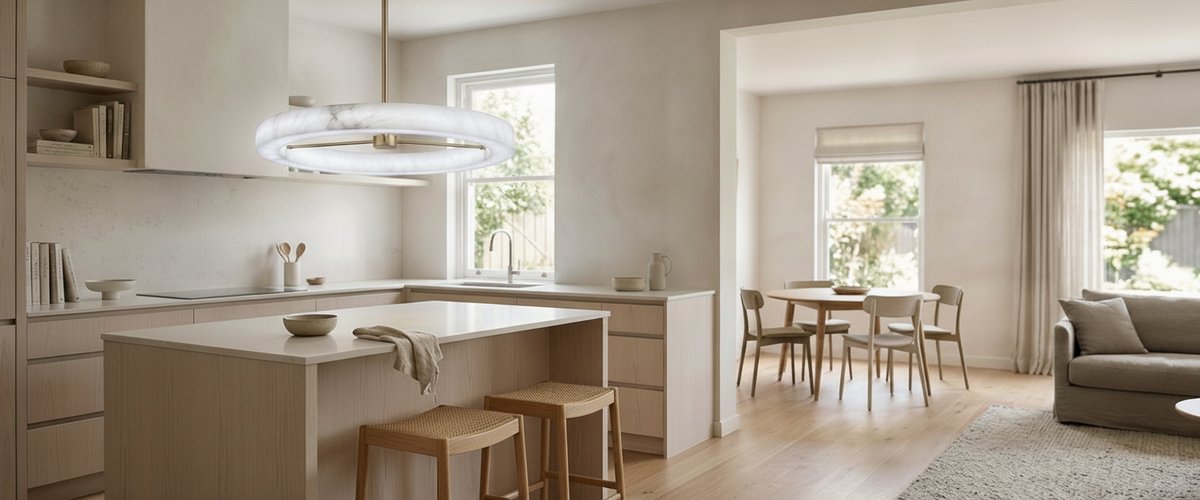

Getting dimmer switches led lights to work together is mostly about matching the dimmer type to the load, respecting the minimum load, and zoning each room for the job it does. Get it right and a room falls into step; get it wrong and the same alabaster pendant that softened your evenings starts buzzing at you while you chop onions. The fix is rarely the fancy control. Most modern LED fixtures want a trailing-edge control rather than an older leading-edge unit, need a load that sits inside the dimmer's range, and behave best when lamps sharing a circuit use the same driver and color temperature. This matters even more with alabaster and natural stone, where the whole appeal is a warm, even glow that a poorly matched control can turn patchy or cold.
We ship a lot of alabaster pendants, wall lights and table lamps into homes where the wiring was set up years before anyone thought about LED sources. When people ask us about dimmer switches led lights, the lesson repeats: the fixture is rarely the problem. The dimmer, and how it was paired, usually is.

Quick Answer: Getting Dimmer Switches Led Lights Right
Match the dimmer type to the load. Most modern LED fixtures want a trailing-edge dimmer, not the older leading-edge units built for filament bulbs.
Check the minimum load. A single low-wattage LED lamp can fall below what a dimmer needs to run smoothly, causing flicker or dropout at the low end.
Zone your rooms. Kitchens and task areas need clean full brightness; bedrooms and living rooms need a deep, stable low glow.
Don't ask one control to run mismatched lamps. Different LED drivers on one circuit rarely dim in step, and that is where dimmer switches led lights fall out of sync.
Use a qualified electrician for any switch wiring. The steps below explain the principle, not a licence to DIY mains work.

Why a Dimmer That Flatters the Living Room Feels Wrong in the Kitchen
Rooms don't want the same light, so they rarely want the same dimming behavior. In the living room you are chasing atmosphere, a slow drop from bright to intimate that makes an alabaster pendant read like a warm lantern. In the kitchen you are chasing function first. You need honest, near-daylight brightness over the hob and the board, and the dim setting is a secondary, evening-only trick. This is one room where dimmer switches led lights have to earn their pairing.
The mistake is treating both spaces as one lighting problem. A control tuned for a lounge, with a low minimum and a gentle curve, can make kitchen task light feel weak and yellow when you actually need to see. Set the kitchen up for full output and clean color first, then add a modest fade for when the cooking is done and the room becomes somewhere to sit.
Bedroom Dimming: The Low-End Glow Most Switches Can't Hold
Bedrooms are where cheap dimming shows itself. What you want at night is a very low, steady glow, the kind that lets you read a page or cross the room without a jolt of brightness. That is exactly the setting most poorly matched combinations struggle to hold. This is where dimmer switches led lights are often mismatched from the start. Push the dial down and the light either drops out entirely or hangs on with a faint shimmer.
Two things fix this. First, choose a control rated to dim down to a genuinely low percentage rather than clicking off at 20 percent. Second, check that your LED lamp is listed as dimmable and that its minimum load sits comfortably inside the dimmer's range. A single small alabaster table lamp on a bedside circuit is often the trickiest case, because one low-wattage source can fall below the dimmer's floor. Where you need a warm source to hold that deep evening glow reliably, a driver-based module such as the 12W LED Module Light Engine Warm White gives the control something more stable to work with than a bare retrofit bulb. Warm light also helps the wind-down; research on light and sleep from the Sleep Foundation points to dimmer, warmer evening light supporting the body's natural rhythm, which is part of why a deep low-end glow matters more here than anywhere else in the house.
Living Room Layers: How Dimming Lets One Fixture Do Three Jobs
Dimming is what lets a single fixture earn its keep after dark. A carved alabaster pendant at full output can carry an early evening with guests. Bring it down a third and it becomes a companion to lamplight for reading or television. Take it lower still and it turns into a quiet marker of the room, more object than light source, its veining glowing softly from within.
That range only works if the dimming is smooth and the low end is stable, which comes back to how you pair dimmer switches led lights on the same circuit. Alabaster and onyx reward this because the stone diffuses whatever passes through it; a steady, well-matched dimmer lets the material show its depth instead of flattening it. If you are building a layered scheme, look at how pendants, wall lights and table lamps in the alabaster lighting range can share a warm color temperature so that dimming them together reads as one considered mood rather than a set of mismatched glows.
Kitchen and Task Zones: Where Full-Bright Matters More Than the Fade
Task areas flip the priority. Over an island or a prep run, the number that matters is peak brightness and the honesty of the color, not how low you can take it. Set these circuits up so full output is genuinely full and the color rendering shows food and surfaces truthfully. Your dimmer switches led lights should never make you second-guess what you are cooking.
You can still add a fade for the evening, but keep it as a secondary layer. A common setup is bright, clean task light on one control and a softer alabaster wall light or pendant on a separate dimmer, so the room can shift from working kitchen to somewhere you linger without compromising either. Trying to run both moods off one switch is where people end up disappointed with the pairing.
Trailing Edge Versus Leading Edge, and Why LEDs Punish the Wrong Pick
This is the single most useful thing to understand about pairing dimmer switches led lights. Older units are leading edge, designed for the heavy, forgiving load of filament bulbs. LEDs draw far less power and behave differently, so pairing them with a leading-edge control often gives flicker, buzz, a narrow usable range, or lamps that refuse to dim at all.
Most modern LED fixtures want a trailing-edge dimmer, which suits the low load and electronic drivers of these sources and gives a smoother, quieter fade. Where the fixture takes a mains-voltage driver rather than a low-voltage feed, a control like the Wi-Fi Bluetooth LED Smart Controller 78mm Mains Dimmer is closer to the right design language for the load. When you buy a control, check it is rated for LED and note its minimum and maximum load. Then check your fixtures against that window. A pendant with a driver-based module has different needs from a lamp taking a retrofit bulb, and the guidance from bodies such as Electrical Safety First is worth reading before you or your electrician commit to a control. Get the edge type wrong and even a well-made stone fixture will flicker in a way that has nothing to do with the alabaster and everything to do with how the pairing was matched.
Placement Mistakes: One Dimmer Chasing Lamps It Was Never Wired For
The most frequent fault we hear about with dimmer switches led lights is one control trying to run lamps it was never suited to. Somebody adds two alabaster wall lights and a pendant to a single old dimmer, mixes drivers and wattages on that circuit, and then wonders why the low end is jumpy and one lamp glows while another sits dark.
A few habits prevent it:
Keep like with like. Group fixtures with the same driver type and color temperature on one dimmer so they fade in step.
Respect the load window. Add up the wattage on the circuit and confirm it sits inside the dimmer's minimum and maximum.
Separate task from mood. Give kitchens and desks their own control, distinct from ambient stone fixtures.
Plan before you plaster. If you are renovating, decide which fixtures share a circuit before the walls close up.
If you are still choosing pieces, it helps to view the fixtures and their sources together across the wider lighting collection so that the dimming plan and the fittings are decided as one, rather than bolted together later. That way your fittings and controls are matched from the outset.
Wiring and Fitting a Dimmer, in Principle
People search for how to wire, fit and install a dimmer switch constantly, so here is the honest version. Replacing a switch means isolating the circuit at the consumer unit, confirming it is dead, removing the old faceplate, and transferring the existing conductors to the matching terminals on the new control, usually a common and a switched-live, with earth managed correctly. The dimmer then screws back to the wall box and the module clips into the faceplate.
Straightforward as that sounds, mains wiring is not a casual DIY job. Loose terminals, the wrong load rating, or a missed earth cause flicker at best and a hazard at worst. Use a qualified electrician, especially where a project involves several stone fixtures on shared circuits. It costs little against the price of the fittings and it protects the light quality you paid for. Getting dimmer switches led lights fitted properly is cheap insurance.
How to Dim LED Lights Without a Dimmer Switch
Sometimes rewiring is not on the table, in a rental or a finished room, and you still want control over your LED lights. The cleanest route is a smart LED source or an inline controller wired at the fixture. Something like the 74mm Wi-Fi Bluetooth Smart LED Controller Dimmer sets brightness by app or remote with no change to the wall switch, and its scene control means an alabaster lamp can hold a fixed low glow every evening without anyone touching a dial. Plug-in dimmers on a lead work for a table or floor lamp where even that is more than the room needs. It is a fair stand-in when full dimmer switches led lights wiring is off the table.
Caring for the Light After the Dimming Is Sorted
Once the electrics behave and your dimmer switches led lights are running in step, the stone does the rest, and it asks for very little. Dust alabaster and onyx with a dry, soft cloth. Skip household sprays and anything acidic; natural stone is porous and does not want harsh cleaners near it. Let LED modules and drivers run cool with a little air around them, and if a lamp ever flickers again after months of good behavior, suspect the driver or a loose connection before you blame the beautiful piece hanging from the ceiling.