
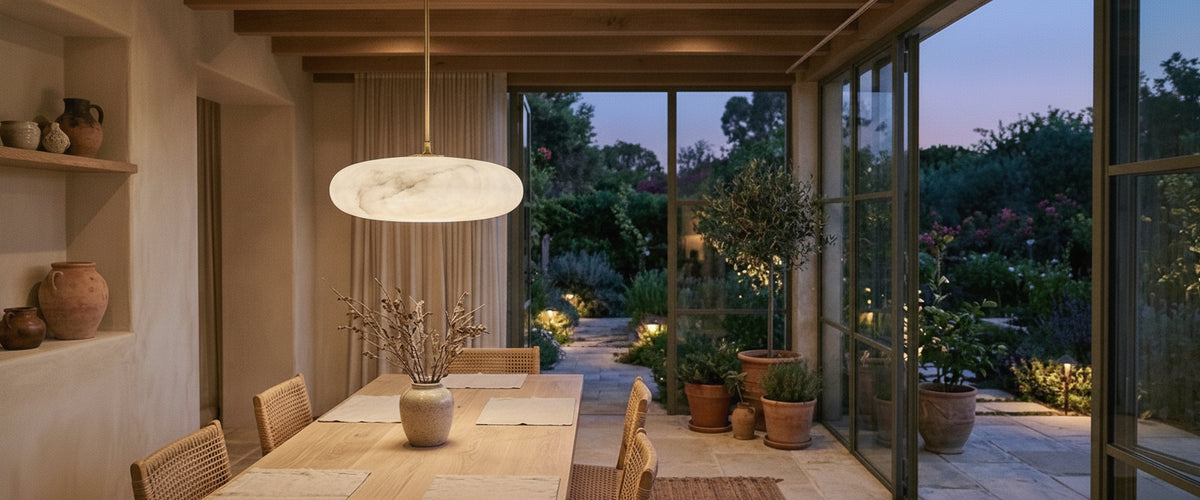

Most gardens are over-lit and under-designed. Drive through any well-heeled village after dark and you will see the same mistake repeated: four floodlights bleaching a lawn, a security lamp glaring at head height, and not one shadow left to give the space depth. Good outdoor and garden lighting works the other way round. You start with the dark and add small, deliberate pools of warmth until the garden reads as a series of layers rather than a car park with shrubs.

Quick Answer: What Separates a Considered Scheme from a Bright One
Light objects, not areas. A tree canopy, a stone wall, a level change, a specimen pot. Never the whole plot at once.
Stay at 2700K or warmer. Cooler light makes foliage look gray and skin look ill.
Use three fitting families for three jobs: low-level path lights for safe movement, wall lights for architecture, discreet spikes and buried spots for drama.
Buy on ingress protection and materials. IP65 for exposed positions, IP54 for sheltered ones, marine-grade fixings near the coast.
Alabaster is an indoor material. It belongs in the room you see the garden from, or under a genuinely dry loggia, never in the rain.
Budget is driven by scale, fitting count, cable runs, groundworks and finishing. Outdoor and garden lighting costs move with the site, so ask for a tailored quote rather than working from a headline figure.

Darkness Is the Composition, Light Is Only the Punctuation
Interior lighting fills a volume. Outdoor and garden lighting carves one out. Once the sun goes, the garden has no walls or ceiling, so every beam you add becomes the edge of the room you are building. That is why restraint reads as expense: three well-aimed fittings on a multi-stem birch will do more for a terrace than a dozen spots peppered across the borders.
A useful discipline is to walk the garden at night with a torch before you buy any outdoor and garden lighting at all. Shine it up through the planting, across the brickwork, down a set of steps. Note the two or three moments that make you stop. Those are your fittings. Everything else is optional, and most of it is noise.
Path, Wall and Overhead Fittings Do Three Separate Jobs
Trouble starts when one fitting is asked to cover for another. A bright wall lantern by the back door does not make a dark path safe; it just gives you glare and a black hole beyond it. Sort the roles first and the rest of the outdoor and garden lighting plan falls into place.
Low-Level and Path Lights
These exist for feet, not for atmosphere. They are the plumbing of outdoor and garden lighting: necessary, and best left unnoticed. Keep them low, keep the source shielded, and space them loosely so the effect is a rhythm of soft patches rather than an airport runway. Two or three per path is usually plenty; the eye fills in the rest.
Wall Lights
This is where architecture gets its shape. Up and down wall lights give you a clean double wash on rendered or brick elevations and are the workhorse of most outdoor and garden lighting schemes. Fit them at a height where the source sits above eye level, roughly 1.8 to 2m (6 to 6.5ft), and check the beam angle against the wall material. Smooth render shows every hotspot; textured stone forgives more. Niori's outdoor wall fittings sit in graphite, matt black and white finishes for exactly this reason: the housing should disappear and only the wash should register. On an exposed elevation that takes driving rain and hose-down cleaning, a sealed fitting such as the Asker Outdoor Up/Down Wall Light in Graphite is the sensible starting point, whereas a courtyard wall sitting under a deep overhang can be specified more lightly with something like the IP54 Up & Down Outdoor Wall Light in Matt Black. You can browse the wider range across our lighting collection when you are pairing exterior fittings with what is happening indoors.
Spikes, Buried Uplights and Overhead Fittings
Spike spots are the flexible ones; move them seasonally as planting grows. Buried uplights look neater but demand drainage and a plan for leaf litter. Overhead fittings under a pergola or porch soffit give you the softest layer in any outdoor and garden lighting plan, a downward wash that feels like moonlight, and because they are sheltered you get more choice of material and finish.
Uplighting a Tree versus Grazing a Wall
Same output, entirely different garden. Uplighting sends a narrow beam up into a canopy so the branch structure becomes a lit silhouette and the leaves scatter the light back down. It creates height and mystery, and it is the single best return on investment in most outdoor and garden lighting budgets. Aim from two positions rather than one so the trunk is not flattened, and keep the fitting far enough out that the beam catches the crown, not just the bark.
Grazing works in the opposite direction. Set a fitting close to a wall, within around 150 to 300mm (6 to 12in), and let the beam skim across the surface so texture throws its own shadows. On dry-stone, flint, split-face slate or an old brick garden wall the effect is superb. On flat render it is merciless, so pull the fitting further out and widen the beam to a general wash instead. Where a smooth elevation needs soft, even coverage rather than a hard scraped beam, outdoor and garden lighting with a diffused wide beam, such as the Eclipseax White Outdoor LED Wall Light, is closer to the right design language.
Color Temperature: 2700K Reads Like a Candle, 4000K Reads Like a Supermarket Car Park
If you change one thing about your garden and outdoor lights, change the color temperature. Warm white at 2700K keeps green foliage looking green, brings out the ochres in stone, and makes a terrace feel occupied. Push to 4000K and the same garden turns clinical: leaves go blue-gray, brickwork goes flat, and the whole scheme announces itself as equipment rather than atmosphere.
For dining terraces and seating areas, 2700K is the default and 2200K is worth considering where you want a genuinely candlelit feel. Keep every fitting on the same temperature; mixed Kelvin values are the fastest way to make expensive outdoor and garden lighting look accidental. Dimming matters too. Outdoor LED fittings vary in how well they dim, so confirm the driver is compatible with your chosen control before wiring anything in, and dim in scenes rather than one master level so the tree uplights can sit lower than the steps.
Where Alabaster and Natural Stone Actually Belong
Here is the part most guides skip. Gypsum alabaster is soft and slightly soluble in water; leave it in British rain and the surface will bloom, dull and eventually erode. So it never goes out into the weather, and we say so plainly to every client who asks. What it does do brilliantly is handle the threshold. A pair of alabaster wall lights inside a fully covered loggia, or a stone pendant hung under a deep porch, gives you that honeyed, diffused glow at the point where house meets garden, without asking a soft stone to do the job engineered outdoor and garden lighting is built for.
Two years ago we shipped alabaster wall lights to a client in Hampshire who had originally wanted them flanking an exposed garden gate. We talked them into a sheltered outdoor kitchen instead, with IP-rated outdoor and garden lighting doing the exposed work. They still look as they did the day they left the studio. That is the trade: put the stone where it is protected and let engineered exterior fittings take the punishment. If you are working out which pieces suit a covered terrace, the alabaster lighting collection is the place to start.
Other stones behave differently. Granite, slate and basalt cope well in exposed outdoor and garden lighting positions. Polished marble is a poor choice for exposed spots because acidic rain etches the surface and the polish goes patchy; honed marble in a dry, covered position is a different conversation. Onyx, like alabaster, wants shelter. Brass detailing outdoors will patinate unless it is lacquered, and many clients grow to like it, but decide that on purpose rather than by accident.
What British Weather Ruins First
Failures in outdoor and garden lighting are rarely about the light source. They are about water finding a route in.
Seals and gaskets. Cheap rubber hardens and cracks after a couple of winters. Check whether replacement gaskets are available before you commit to a fitting.
Plated finishes. Thin chrome or plated coatings blister and lift, especially within a few miles of the coast. Powder-coated aluminium, 316 stainless and solid brass age far better.
Buried joints. The most common fault we hear about. Push-fit connectors dropped into a shallow trench with a bit of tape around them will fill with water. Use proper resin-filled or gel-filled IP-rated joints in accessible positions.
Fixings. Mild steel screws into a coastal wall will bleed rust stains down the render inside one season.
Drainage around buried uplights. A gravel bed underneath, and a plan for clearing leaves each autumn, or you will be replacing units.
Light Spill, Neighbors and Wildlife
Restraint is not only aesthetic. Poorly aimed outdoor and garden lighting throws light over boundaries, washes out the night sky and disrupts nocturnal wildlife. Shielded fittings, narrow beams and warmer color temperatures all reduce the damage, and guidance from DarkSky International on shielding and warm-toned sources is worth reading before you finalize a layout. Bats are particularly sensitive to lit flight paths, and the Bat Conservation Trust publishes practical advice on keeping hedgerows and roof lines dark.
Practically, that means: never aim into a neighbor's window, keep hedge lines and water features unlit or barely lit, and put the whole scheme on timers or scenes so the garden goes properly dark late at night. Garden and outdoor lighting that switches off at midnight looks better and costs less to run.
Circuits, RCDs and When a Qualified Electrician Stops Being Optional
Low-voltage plug-in sets on a decked terrace are within reach of a confident homeowner. Anything mains-voltage outdoors is not, and most outdoor and garden lighting beyond a plug-in set is mains work. New exterior circuits, buried armoured cable, garden feeds and outdoor sockets fall under the BS 7671 wiring regulations and, in England and Wales, Building Regulations Part P; they need RCD protection and must be tested and certified. Use a qualified electrician registered with a recognised competent person scheme, and get the certificate; it matters when you sell the house.
Plan circuits generously while the trenches are open. Separate the terrace fittings from the far-garden fittings so you can run one without the other, allow spare capacity for outdoor and garden lighting you may add as planting matures, and agree switching locations early. Retro-fitting a second circuit through an established border is a miserable job.
Your Outdoor and Garden Lighting Checklist
Walk the garden at night with a torch and pick your two or three hero moments.
Assign fittings by job: movement, architecture, drama.
Fix on one color temperature, 2700K or warmer, across every fitting.
Match IP rating to exposure: IP65 where rain hits, IP54 under cover.
Choose finishes for your location, with marine-grade materials near the coast.
Keep alabaster, onyx and polished marble in covered or interior positions only.
Specify IP-rated, accessible cable joints; no buried tape-and-hope connectors.
Confirm dimming and driver compatibility before installation.
Set scenes and timers so the garden goes dark late.
Book a qualified electrician for any mains work and keep the certification.
Getting Costs and Scope Right
What you spend on outdoor and garden lighting depends on the number of fittings, materials and finish quality, cable routes and groundworks, control gear, and the labour to install and commission it. A small courtyard with four sheltered wall fittings sits in a different world from a half-acre plot with tree uplights, buried spots and a scene controller. Rather than working from a guessed figure, send us a plan or a few photographs and we will quote against the actual scheme. Niori works in alabaster and natural-stone lighting for interiors and covered thresholds, alongside engineered exterior fittings, and it is usually the interplay between the two that makes garden and outdoor lighting look designed. Start on the Niori homepage if you want to see how the ranges sit together.