
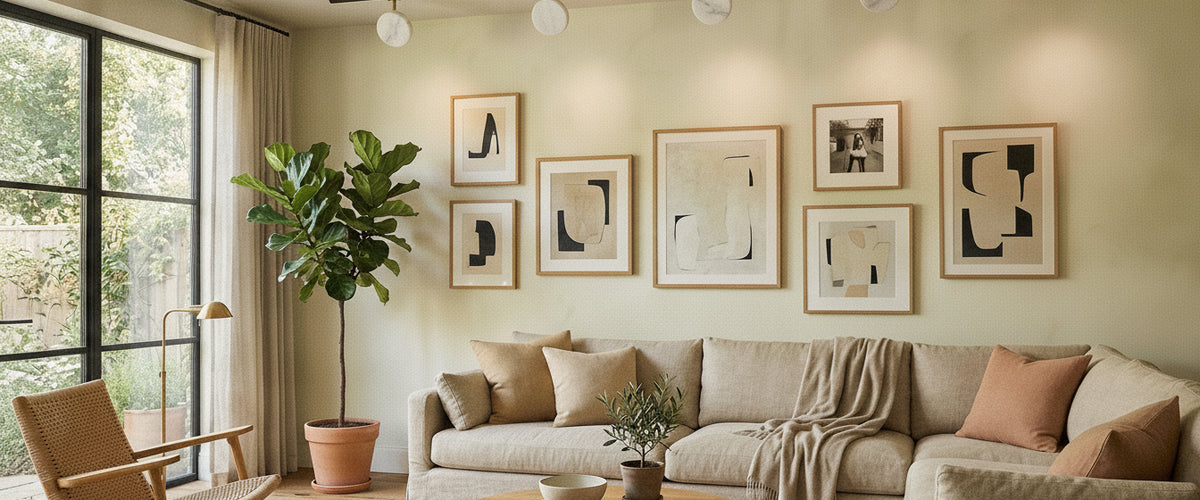

Most rooms lit with track spotlights fail in exactly the same way: eight or ten heads bolted to the ceiling in a straight line, all pointed straight down, washing the floor and leaving the walls in gloom. The fitting is rarely the problem. Track spotlights are one of the most precise tools in a lighting scheme, capable of grazing a stone wall, picking out a painting or lifting a worktop without a single visible glare source. They simply have to be specified and aimed by someone thinking about where the light lands, not where the ceiling joists happen to sit.

At a Glance: What to Get Right
- Beam angle beats wattage. A 24-degree beam on a picture reads as intentional. A 60-degree flood on the same picture reads as an office.
- Distance from the wall matters more than spacing. Roughly 60 to 90cm (24 to 36 inches) off the wall face is the workable zone for most ceiling heights.
- Aim at around 30 degrees from vertical to light art and stone without throwing your own shadow across it or bouncing glare back at eye level.
- Colour temperature: 2700K at home, 3000K for mixed living and display, 4000K for gallery, retail and commercial spaces. Keep CRI at 90 or above.
- Track spotlights are a supporting layer. They should work alongside a warm, diffused centrepiece such as an alabaster pendant or chandelier, never replace it.
- Dimming is not optional. Confirm driver and dimmer compatibility before anything is ordered.

What Track Spotlights Suit, and Who Should Be Buying Them
Track lighting earns its place wherever the things worth lighting move. Art collections rotate. Retail displays change every six weeks. Kitchen islands get reconfigured. A track system lets you slide, add or re-angle heads without touching the plaster, which is why galleries, showrooms, restaurants and serious collectors keep coming back to them.
They are also the quiet fix for period properties with awkward ceilings. Where downlights would mean butchering a lath-and-plaster ceiling or a run of exposed beams, a surface-mounted or suspended track needs one supply point and does the rest along its own length. We have specified them repeatedly for converted warehouse flats in Manchester and Leeds, where the concrete soffit rules out recessed anything.
Who should think twice? Anyone hoping directional heads alone will make a living room feel warm. Directional light creates contrast and drama, and contrast without a soft ambient layer is exhausting to sit under. That is the pairing we push hardest at Niori: precise accent light from track, plus the low, glowing body of light that only translucent stone gives you. Browse the alabaster lighting collection and you will see the counterweight, pendants and wall lights that glow rather than beam.
Sizing, Height and Placement That Works
Start with the wall, not the ceiling. Decide what the track is lighting, then work backwards.
Distance From the Wall
For a standard 2.4m (8ft) ceiling, run the track 60 to 75cm (24 to 30 inches) out from the wall face. On a 3m (10ft) ceiling, push it to 90cm (36 inches). Too close and you get a harsh scallop across the top of the wall with the lower half dark. Too far and the beam hits the artwork at a shallow angle, so anyone standing in front casts a shadow straight onto it.
Head Spacing
Space heads at roughly the same interval as their distance from the wall for an even wash, and cluster them tighter when picking out individual objects. Resist the urge to fill the track. A 1m track with three well-aimed heads outperforms the same track carrying six, and it looks considerably calmer when the lights are off. Length is part of the same calculation: over a short alcove, a single hallway wall or a run of shelving, a compact fitting such as the Display Black Accent Linear Track Light, 53.5cm covers the target without the run of empty track that makes a ceiling look unresolved.
Ceiling Type and Mounting
Surface-mounted track is the default. Suspended track on drop rods suits double-height spaces, mezzanines and rooms where you want the light source closer to the plane it is lighting. Recessed track sits flush in a plasterboard ceiling and disappears almost entirely, but it has to be planned before boarding out. Get that decision made at first fix, not after decorating.
Kitchens and Islands
Over a run of worktop, keep the track parallel to the counter and offset toward the front edge so your body does not block the beam. Above an island, leave the centre free. That is where a stone pendant belongs, and it is the moment the whole scheme stops looking like a shop fit.
Materials, Finishes and Light Quality
Track hardware is deliberately reticent. Matt black recedes against dark or exposed ceilings; matt white vanishes into a painted plaster ceiling from three metres away. Where the ceiling is white and you want the hardware to disappear entirely, a white-bodied run like the Display UGR White Linear Track Light, 106.5cm is the more disciplined choice than a contrasting finish. Brushed brass or bronze heads are worth the premium only when the track is genuinely on show, in an open-plan space with high ceilings, for instance, where the hardware becomes part of the ceiling composition.
Quality shows up in three places. Anti-glare optics are the first: look for a deep-set lens, honeycomb louvre or a stated UGR rating, which is the standard measure of discomfort glare. Linear track lights with a UGR rating are the ones you want anywhere people sit and look up, so over a dining table or a meeting room a controlled fitting such as the Display UGR Black Linear Track Light, 106.5cm is closer to the right design language than an unshielded head. The second is colour rendering, where CRI 90 or above is the floor for any room containing artwork, food, timber or stone. The third is beam control, and it is the one buyers most often ignore.
Beam angles in shorthand: 10 to 15 degrees for a sculpture or a single tall object, 24 degrees for framed art and shelving, 36 degrees for general wall washing, and 60 degrees where you need a broad, soft field. Mixing angles on one track is normal practice and is exactly how galleries do it.
There is a real conservation dimension here too. Directional light concentrates energy, and sensitive materials such as watercolours, textiles and photographs degrade under cumulative exposure. The Canadian Conservation Institute publishes clear guidance on light, ultraviolet and infrared damage, and it is worth reading before you point a narrow beam at anything irreplaceable. Dim the accent layer, and use warm LEDs with no UV output.
Pairing Track Spotlights With Alabaster and Natural Stone
This is where track spotlights become genuinely interesting rather than merely useful. Alabaster and onyx are translucent, so they behave as light sources in their own right; hit them with a directional beam from outside and you get a completely different effect, one that reveals the surface veining instead of the internal glow.
We keep an alabaster offcut on the studio bench for exactly this test. Under a wide flood the stone looks pale and slightly flat. Swap to a 15-degree beam raking across it at a shallow angle and the fossil bands, the fine crystalline streaks and the subtle colour shifts jump out. That is the trick for a stone-clad chimney breast, a marble splashback or a travertine wall: light it from the side, not the front.
The practical rule for a whole scheme is to give each layer one job. Track spotlights handle art, joinery, worktops and texture. A pendant, chandelier or table lamp in alabaster handles atmosphere and the sense that a room has a centre. Our wider lighting collection is organised around that logic, with statement pieces designed to sit comfortably under a ceiling that also carries technical light.
Common Mistakes and How to Avoid Them
- Buying the track before checking the circuit. Single-circuit track puts every head on one switch. Three-circuit track lets you separate art from worktop from general wash. Low-voltage 48V magnetic systems offer the finest control and the slimmest profiles, but need a dedicated driver.
- Ignoring dimmer compatibility. Trailing-edge dimmers suit most LED drivers; leading-edge often causes flicker or buzz. For commercial projects, specify DALI or a wireless protocol at design stage. The Lighting Industry Association's technical guidance is a sane starting point on LED and control compatibility.
- Running the track along the room's short axis out of habit. The track should follow the wall you want lit, which is not always the wall the ceiling grid suggests.
- Aiming everything at 90 degrees. Straight-down beams flatten faces, create hot pools on the floor and make ceilings feel lower.
- Overfilling the track. Ten heads at 30 per cent output is not the same as five heads at 60 per cent. It costs more, clutters the ceiling and rarely looks better.
- Mixing colour temperatures across one ceiling. One dining room we advised on had 3000K track heads beside 4000K replacements bought later. The mismatch was obvious the moment they dimmed the room, and the alabaster pendant in the middle turned faintly grey-green under the cooler light. Alabaster and onyx read best under warm light; keep the whole ceiling consistent.
- Treating installation as DIY. Track carries mains voltage along its full length. Use a qualified electrician for connection, earthing and testing.
Pre-Order Checklist for Track Spotlights
- Mark on a plan what each head will light. If a head has no target, cut it.
- Confirm ceiling height and set the track offset from the wall accordingly.
- Choose track type: surface, suspended or recessed, and single or three-circuit.
- Select beam angles per head rather than ordering one angle in bulk.
- Fix colour temperature across the whole room and note the CRI.
- Check UGR or anti-glare optics for any space with seating.
- Confirm driver, dimmer and control protocol compatibility in writing.
- Decide the ambient layer at the same time, not afterwards.
- Book the electrician before the fittings arrive, not after.
- Plan an aiming session at dusk, once furniture and art are in place.
How Niori Can Help With Lighting Projects
Niori is an alabaster and natural-stone lighting brand, and we ship worldwide to homes, galleries, restaurants and hotels. Our team spends most of its time on the pieces people notice: alabaster pendants, onyx wall lights, marble table lamps and floor lamps. But schemes only work when the technical layer is right too, which is why we advise on how those directional fittings should sit alongside the statement pieces rather than competing with them.
If you are working on a project, send us the room dimensions, ceiling height and a note of what needs lighting. We will talk through fixture types, beam angles and where a stone piece will do more good than another spotlight. Budget depends on material, scale, complexity, engineering, installation and finishing, so we quote each project individually rather than publishing a figure that would be meaningless out of context. Start at the Niori homepage to see the range, then request a tailored quote.