
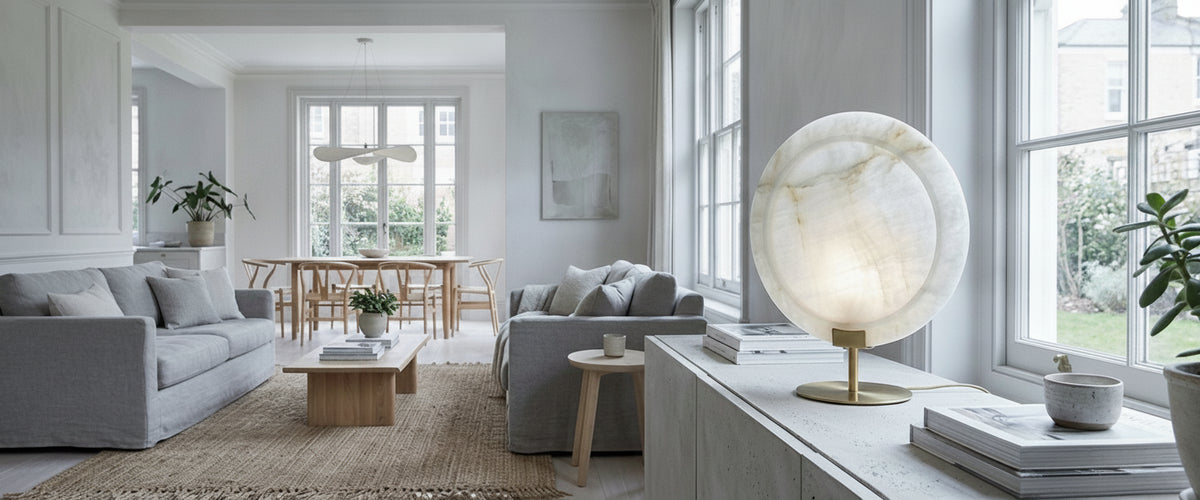

Most table lamps do one job: they push light onto a surface. Alabaster table lamps do two, because the stone itself becomes a light source the moment you switch on. That second job is where the money either shows or disappears. Get the stone thickness, metalwork and bulb right and the lamp reads as a small piece of illuminated sculpture; get them wrong and you have an expensive object that glows like a nightlight.

At a Glance: What Separates Good Alabaster Table Lamps From Dull Ones
- Stone thickness controls the depth of the glow. Thinner sections read luminous; thicker sections read solid and only bloom at the edges.
- Veining depth decides how much drama you get when lit. Faint veining stays quiet; heavy mineral banding turns theatrical.
- Metalwork should sit second. Brass, bronze or blackened steel exists to frame the stone, not to argue with it.
- Shade choice can double the effect or kill it. Translucent linen and silk feed the warmth; opaque black card cuts the lamp in half.
- 2200K to 2700K is the working range. Anything cooler makes warm stone look grey and slightly ill.
- Dimming is not optional on any lamp where the stone lights up.

Veining Depth and Stone Thickness Decide the Character of the Glow
Alabaster is a gypsum stone, soft enough to carve with hand tools and translucent in a way marble rarely manages. That translucency is not uniform. Every block carries mineral banding at different depths, so when a lamp body is turned or carved, the walls end up varying subtly in density. Light finds the thin passages first. This is why two alabaster table lamps cut from the same quarry can throw completely different patterns across a wall.
Thin-walled bodies, the kind used for cylinders, domes and slim column bases, give an even, lantern-like glow with the veining floating inside it. Thicker forms behave more like solid stone with a lit halo at the top and base. Neither is better. A bedside lamp usually wants the softer, thinner read; a heavy console piece can carry a denser body because you are looking at it across a room rather than from 60cm (2ft) away.
One habit we picked up in the studio: photograph every alabaster shade twice, unlit and lit. Clients almost always choose on the unlit image and then live with the lit one. A piece that looks quietly veined in daylight can turn amber and heavily marbled once a bulb sits behind it, and that surprise is worth removing before anything ships.
Let the Metalwork Follow the Stone, Not Compete With It
Hardware is where alabaster table lamps most often go wrong. Bright polished chrome next to warm honey-toned stone creates two temperatures fighting over the same object. The stone loses, because metal reflects harder than stone glows.
Aged or unlacquered brass is the reliable partner for cream and honey alabaster, because it shares the same yellow undertone and darkens gently over years rather than sitting still. Bronze suits stone with brown or rust veining. Blackened steel or gunmetal works for cooler grey-white alabaster and for interiors where you want the outline to read graphic rather than decorative. Across the Niori range we keep the metal detailing deliberately restrained for exactly this reason: a slim collar, a low base, a discrete stem. You can see the same discipline running through the wider alabaster lighting collection, where pendants and wall lights use the same visual logic at larger scale.
A practical test before buying: cover the metalwork in the product photo with your thumb. If the lamp suddenly looks better, the hardware is too loud.
The Shade Decision: What Amplifies the Warmth and What Flattens It
Some alabaster table lamps have no shade at all, because the stone is the shade. Those are the easiest to buy. The harder decision comes with lamps that pair a carved stone base with a fabric shade, where the shade controls how much of the base's character survives.
Translucent shades in natural linen, oyster silk or fine parchment let light bleed downward and sideways, so the lit base and the shade read as one warm column. Heavily lined shades, dark cotton and anything with a rubberised backing block that spill entirely; you get a bright pool on the table and a base that looks like an ornament rather than a lamp. Card shades in cream still work, but the light becomes more directional.
Shape matters as much as fabric. Empire and drum shades with a generous lower diameter keep the base within the glow. Tall, narrow shades create a hard cut-off line halfway down the stone, which almost always looks accidental. If the lamp is going somewhere you sit close to, choose a shade deep enough to hide the bulb from a seated eye line. Where a room wants that same enveloping, all-over glow but the scheme leans cooler and more contemporary than warm stone allows, a diffusing glass body such as the Dolce 1 Light Glass Table Lamp is closer to the right design language, since the material carries the light rather than a fabric shade directing it.
Colour Temperature and Wattage Where Alabaster Performs at Its Best
Alabaster is a warm stone, and alabaster table lamps reward warm light while punishing cool light hard. Stay between 2200K and 2700K. At 3000K the cream turns faintly clinical; at 4000K it goes grey and the veining flattens out completely. Look for a colour rendering index of 90 or above, because low-CRI lamps strip the subtle pinks and ochres out of the mineral banding.
Output is more forgiving than people expect. A lit stone body rarely needs a bright source: something in the region of 300 to 500 lumens is usually plenty for a bedside or console lamp, and going brighter tends to make hot spots visible through the thinner wall sections. Where a fabric shade sits above a lit base, you may want a slightly higher output because the shade absorbs some of it.
Fit a dimmable lamp and a compatible dimmer, and check the driver is rated for the fitting rather than assuming. Trailing-edge dimmers generally handle LED retrofit lamps more gracefully than older leading-edge units, and mismatched pairs are the usual cause of flicker and buzz. The Energy Saving Trust's lighting guidance is a sensible starting point on LED efficiency and dimming compatibility. Any rewiring, plug changes or fixed installation should go to a qualified electrician.
Bedside, Console, Living Room and Study: What Each Placement Asks For
Bedside
The lamp needs to work at three levels: reading light, low ambient light, and something you can find at 3am without being blinded. A lit stone base solves the third problem elegantly, since it gives you a soft marker even at the bottom of the dimmer. Keep the bulb shielded from a lying-down eye line and prefer a switch on the base or cord rather than one you have to hunt for under the shade.
Console and Hallway
This is where alabaster earns its keep, because a hallway console is seen more often than any other surface in the house. A pair works better than a single lamp on anything over about 1.5m (5ft) of console, and symmetry suits stone. Guests read the glow before they read the furniture.
Living Room
Table lamps here are layering tools rather than task lights. Two or three low-level warm sources beat one ceiling fitting every time. We shipped a pair of carved alabaster table lamps to a client refitting a first-floor drawing room in Bath who had been running a single central pendant for years; the change she noticed first was not brightness but that the corners of the room stopped feeling dead. Place them at different heights on either side of a seating group and let a floor lamp or wall light fill the gap.
Study and Desk
A study wants directional task light plus a warm counterweight so the screen is not the only glow in the room. A stone lamp with a proper shade does the second job well. Position it on the opposite side of the desk from your writing hand to avoid casting a shadow across the page.
Scale and Proportion Rules That Stop Alabaster Table Lamps Reading as Incidental
The most common buying mistake is going too small. Stone reads visually lighter when lit, so a carved lamp that measures the same as a ceramic one will look smaller in the room. Size up rather than down.
Ten centimetres sounds like nothing on a specification sheet and changes everything on a console. Setting the Global Globe Table Lamp in 20cm beside the 30cm version of the same design is the clearest way to see it: the smaller body reads as an accent next to a stack of books, while the larger one holds a surface on its own. Apply the same test to any alabaster piece you are considering before committing to the smaller size.
- On a bedside table, the lamp base plus shade should generally reach somewhere near your seated shoulder height when sitting up in bed.
- Leave breathing room: the lamp should not occupy more than roughly a third of the table's surface.
- Shade width should sit close to two-thirds the width of the lamp base for a balanced silhouette.
- On a console, the lamp should be tall enough to relate to the artwork or mirror above it rather than floating in the gap.
- Weight is part of the design. Stone bases are heavy by nature, which is a virtue on a hall table and a nuisance on a fragile antique surface. Check the surface, not just the lamp.
Buying and Care Checklist
- Ask to see the piece lit. Veining behaves differently under illumination. Any specialist should have lit imagery.
- Accept variation. Natural stone is quarried, not printed. No two lamps match exactly, and that is the point.
- Check the switch position against how you will actually use the lamp.
- Confirm the flex length and plug type for your market before ordering internationally.
- Buy dimmable, and buy the dimmer at the same time.
- Dust with a dry, soft cloth. Alabaster is soft, around 2 on the Mohs scale, and water-sensitive; standing moisture will dull and etch the surface over time. The Natural Stone Institute's care guidance covers the wider principles for soft and calcareous stone.
- Keep it away from radiators, humid bathrooms and direct sun, which can shift the colour of pale stone over the long term.
- Never use vinegar, bleach or general household spray. Acids attack gypsum quickly.
Budget for alabaster table lamps depends on the block size, how much of the stone is lost in carving, wall thickness, the metalwork specification and finishing time, so ranges quoted online are rarely comparable. Ask for a tailored quote against your actual specification, particularly for pairs where stone matching adds work.
Where Table Lamps Fit in a Whole-Room Scheme
A single carved stone lamp is a nice object. Two or three warm sources at different heights are what make a room feel finished. Think of the table lamp as the lowest layer, with wall lights carrying the middle and a pendant or chandelier holding the ceiling. When those layers share a material language, the scheme settles without looking matched. If you are planning a full room rather than one purchase, it helps to browse the complete lighting range and work out the layers together, or start at the Niori homepage to see how alabaster and natural stone behave across pendants, wall lights and floor lamps.
Buy for the glow, not just the profile. Alabaster table lamps only really show what they can do once the switch is on.