
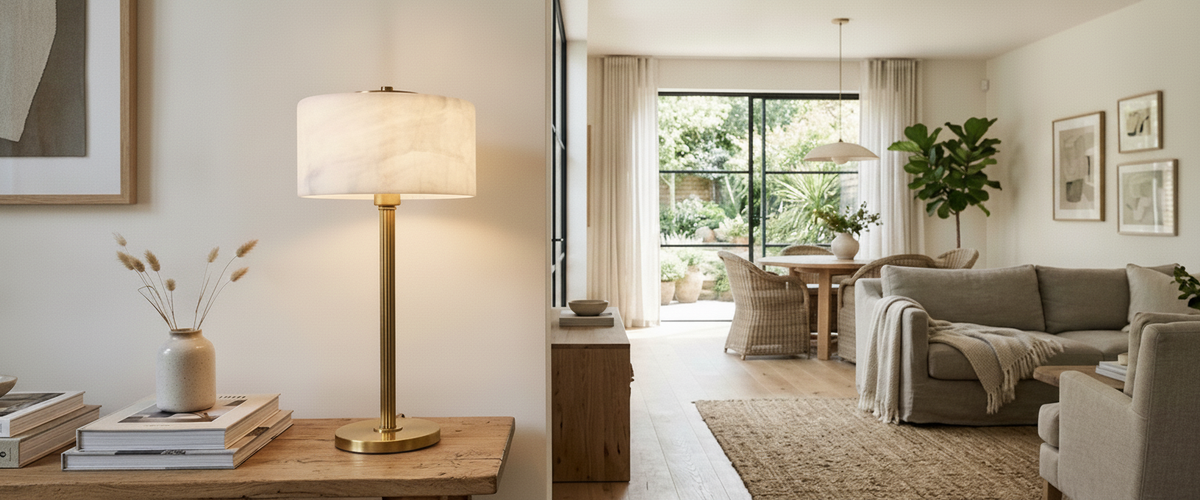

A brass table lamp is nearly always bought for the metal and then judged by the light. That gap is where most of the disappointment lives. The finish photographs beautifully on a console, the proportions look right in the room, and then someone fits a cold 4000K bulb and the whole thing turns sour. Brass table lamps reward a bit of planning, because brass is a warm metal that behaves badly under cool light and glows under warm light.
At Niori we make and supply alabaster and natural-stone lighting, and brass is the metal we return to most often: as a stem, a collar, a base plate, a switch detail. It sits against honey-toned alabaster and gray-veined marble without arguing with them. What follows is the advice we give designers and homeowners who ask us the same questions about brass table lamps every week.

Quick Answer: What to Get Right First
Color temperature: 2200K to 2700K. Anything cooler makes brass look green and stone look dead.
Scale: a bedside lamp around 22 to 28in tall (roughly 55 to 70cm); a console or sideboard lamp taller, so the shade reads at standing sightline.
Finish: decide early between lacquered brass (stable color) and unlacquered or antique brass (it will patinate).
Diffusion: brass reflects, it does not diffuse. Pair it with alabaster, onyx or opal glass if you want soft light rather than a hotspot.
Dimming: most brass table lamps need it. Specify a dimmable bulb and a trailing-edge dimmer or an in-line dimmer switch at the point of order, not afterwards.
Weight: stone bases are heavy. Check the surface can take it before you fall in love with a piece.
A matched pair of brass table lamps at bedside height, with the shade edge sitting just below seated eye level.

What Brass Table Lamps Suit, and Who Actually Buys Them
Brass is a forgiving metal in interiors because it carries a yellow-red bias that reads as warmth even when it is switched off. That makes brass table lamps a natural fit in rooms with timber, wool, leather, plaster and stone: drawing rooms, panelled studies, bedrooms with linen headboards, hotel lobbies where the lighting has to feel hospitable at four in the afternoon and again at midnight.
Three buyer types come to us for brass table lamps. Homeowners who want one confident object on a sideboard rather than four small ones. Interior designers specifying pairs, because symmetry across a console or a pair of bedsides is one of the fastest ways to make a room feel resolved. And venue owners, particularly boutique hotels and members' clubs, who need table lighting that survives daily handling and still looks considered in year five.
Where brass struggles is in cool, high-contrast schemes built on chrome, glass and gray-blue paint. It can still work there, but it needs to be deliberate: one brass table lamp as a warm punctuation mark, not brass everywhere. If your scheme is genuinely cool, a paler stone with a nickel or blackened metal fitting will sit more comfortably. You can compare how different metal and stone combinations behave across the wider lighting collection before committing to a pair.
Sizing, Height and Placement That Works
Most brass table lamps fail on height rather than style. The rule that has never let us down: when you are seated in the position the lamp serves, the bottom edge of the shade should sit at or just below eye level. That hides the bulb, throws light onto the page or the tabletop, and keeps glare out of the room.
Bedside
Aim for roughly 22 to 28in (55 to 70cm) overall, adjusted for bed height. A high divan with a deep mattress needs a taller lamp than a low platform bed. Leave clear space on the nightstand for a book and a glass; a lamp base wider than about a third of the table depth will crowd it.
Console and Hallway
Here the lamp is seen standing up, so go taller and slimmer. A pair of brass table lamps flanking a mirror gives even light across a face, which matters more in a hall than anywhere else in the house. Keep the shade diameter narrower than the console depth so nobody catches it with a coat sleeve.
Living Room and Study
Side-table lamps should relate to the arm height of the sofa, not to the room. If the shade sits below the arm, the light pools uselessly on the floor. The surface underneath matters too: where a lamp already carries a brass stem, a table that repeats the metal quietly keeps the corner calm, which is why the Amalfi Wooden Cocktail Table in dark mango wood and brass sits better under a warm lamp than a chrome-legged alternative. For desks and reading chairs, position the lamp on the side opposite your writing hand so it does not cast a shadow across the work.
Hospitality
We supplied brass table lamps to a small hotel recently, and the operations manager's only request was that the switch be reachable without leaning across the bed. It sounds trivial. It is the detail guests actually notice, and it changed the stem we supplied.
Materials, Finishes and Light Quality
Brass is a copper and zinc alloy, and the ratio shifts its color from pale gold to a deeper red-gold. Finishing decides the rest. Polished brass is bright and reflective and shows fingerprints; brushed or satin brass softens the reflection and hides handling; antique or bronzed brass has been chemically darkened for a duller, older look. Lacquered brass is sealed to hold its color. Unlacquered brass is left to oxidize, and it will darken unevenly around the parts people touch. That is the point of it, but buyers of brass table lamps should choose it knowingly rather than discover it three months in. To judge how a darker brass sits beside a warm stone before committing to a lamp finish, the Clifton II Small Round Coffee Table in light travertine and antique brass puts the same pairing in front of you at furniture scale.
Polished, brushed and antique finishes read very differently once the stone behind them is lit.
The bigger question with brass table lamps is what the light passes through. Brass reflects; it cannot soften a source on its own. Pair it with alabaster and the calculation changes entirely. Alabaster is a form of gypsum, fine-grained and slightly translucent, so light entering the stone scatters inside it before it leaves. The result is a glow with visible veining rather than a bright disc. Onyx pushes further into amber and dramatic banding. Marble is generally too dense to transmit much light, so it works as a base or a solid body rather than a shade. Our alabaster lighting collection is the clearest place to see how the stone reads when lit against a brass fitting.
For the bulb itself, specify warm. 2700K is the safe default; 2200K gives a candlelit quality that suits alabaster particularly well in the evening. Look for a color rendering index of 90 or above so that fabric colors, timber and the stone's own veining stay true. Dimmable LED in an E27 or E14 cap covers most fittings, and warm-dim lamps that drop in color temperature as they dim are worth the extra outlay in bedrooms. Match the dimmer to the driver: most LED brass table lamps prefer trailing-edge dimming, and mismatched kit causes the flicker and buzz people wrongly blame on the lamp.
Common Mistakes and How to Avoid Them
Buying too small. A lamp that looks generous in a photograph often shrinks in a real room. When in doubt, size up.
Matching every metal in the room. Perfectly matched brass throughout reads flat. One contrasting metal, usually a darker one, gives the brass something to be warm against.
Ignoring the flex. Cable color and length are part of the design. A black rubber flex trailing across a pale marble console will undo the whole piece.
Skipping the dimmer. A brass table lamp at full output in a small bedroom is a torch. Dimming is not a luxury on these fittings; it is how they earn their place.
Polishing stone by accident. Metal polish on an alabaster shade will stain it. Keep products away from the stone entirely.
Underestimating weight. Solid stone bases can be heavy enough to mark a delicate veneer. A stone-topped surface such as the Circulael 60cm Marble Coffee Table in brushed brass takes that load without complaint. Use a felt pad either way, and check what is underneath first.
Care Checklist for Brass and Stone Table Lamps
Dust weekly with a dry microfiber cloth or a soft brush. Alabaster is porous, and moisture does more harm to it than dust.
Clean lacquered brass with a barely damp cloth and dry it straight away. Never use abrasive polish; it cuts through the lacquer and creates patchy bright spots.
Let unlacquered brass patinate, or bring it back with a proprietary brass polish applied off the lamp where possible. For anything older or valuable, the National Trust collections care pages are a sensible starting point on handling historic metalwork.
Blot spills on stone immediately. Avoid vinegar, lemon, bathroom sprays and anything acidic near alabaster, marble or onyx.
Check the flex, plug and switch annually for wear. Any rewiring, hardwiring or dimmer installation should go to a qualified electrician; Electrical Safety First publishes clear guidance on when professional work is required.
Move brass table lamps by the base, never by the shade or stem. Stone shades are strong in compression and vulnerable to a knock on the rim.
How Niori Can Help With Lighting Projects
Most of our work starts with a room rather than a product code. Designers send elevations and ask whether a pair of brass table lamps will hold a long console or whether the scheme needs a wall light instead. Homeowners send a photograph of a bedside table and a paint reference. Either is a fine place to begin, and you can browse the full range from the Niori homepage to see how the alabaster, marble and brass pieces sit together as a family.
For bespoke and larger commissions, cost depends on the stone selected, the scale of the piece, the complexity of the metalwork, the engineering behind it, and the installation and finishing required. We quote per project rather than publishing a band that would be meaningless across those variables, so send the brief and we will price it properly. We ship worldwide and can advise on plug types, voltage and dimming compatibility for the destination market before anything is made.
Get the warmth right and brass table lamps do something no downlight can: they make a room feel occupied. That is worth an extra week of deliberation.