
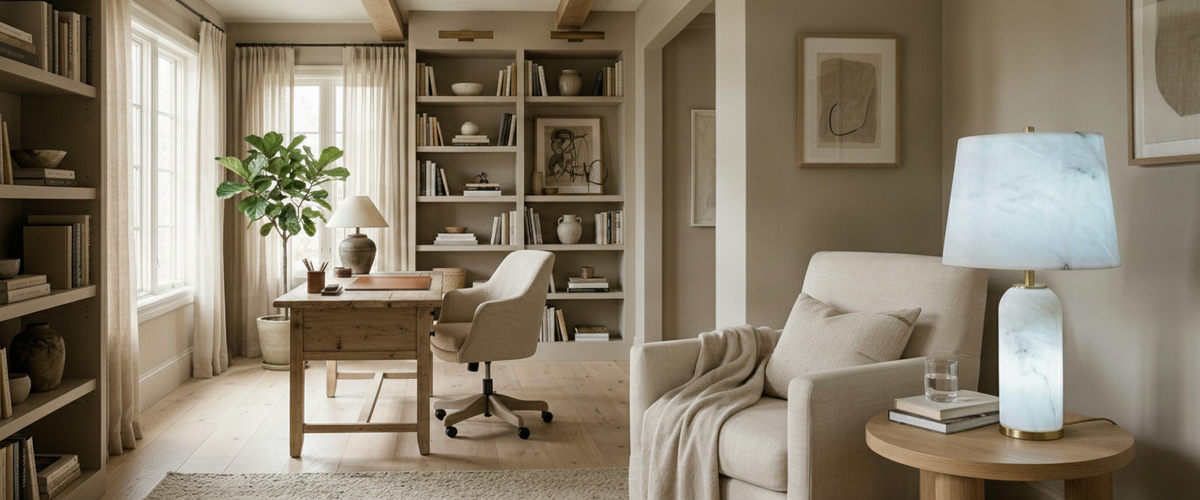

Hold two natural stone table lamps side by side and switch them on, and the difference is instant. One softens the whole corner of a room, the stone lit from the inside like a lantern. The other throws light out of the top and leaves the body dark and inert. Same category, same shelf, completely different result. The gap between those two lamps is what most buyers miss, and it decides whether you are buying a light source or a piece of sculpted stone that happens to hold a bulb.
That distinction matters more with stone than almost any other material, because stone is the thing people fall for first and question last. At Niori we work in alabaster and natural stone every day, and the questions worth asking before you buy natural stone table lamps are not about style. They are about how the stone behaves once the electricity arrives.
An alabaster lamp lit from within, showing the soft internal glow translucent stone produces.

Key Takeaways Before You Shop
Translucency is decided by thickness and stone type, not by how expensive the lamp looks unlit.
Alabaster and onyx transmit light; most marble and slate reflect it. Both are valid, but they do different jobs.
Veining becomes visible light once the bulb is on, so read the pattern before you commit.
Bulb warmth and dimming either flatter the stone or fight it. Get this wrong and even good alabaster looks cheap.
A solid-stone base is heavy and gets warm. Plan the surface and the bulb accordingly.

The Translucency Test: Why Thickness Decides Everything
Translucent stone is not a marketing word; it is a physical property you can test. Thin, fine-grained stone lets light pass through and scatter, which is what gives one of these natural stone table lamps that soft internal glow. Thick or dense stone blocks the light and reflects it back, so the bulb reads as a bright top and a dark body.
Before buying, ask a simple question: does this lamp glow through the stone, or does it only push light out of an opening? A shade carved thin enough to transmit light, often just 6mm to 10mm thick, will show warmth across its whole surface. A solid column with a bulb perched on top will light the room but keep the stone dark. Neither is wrong. You just need to know which one you are looking at, because product photography often lights the piece from outside and hides the answer.
Alabaster is prized precisely because it can be worked thin and still hold its structure, which is why it has been carved into lamps and window panes for centuries. The best natural stone table lamps trade on that quality. The Metropolitan Museum of Art has noted alabaster's long history as a material valued for the way it filters and softens light, a quality that translates directly to modern lighting.

Alabaster Versus Onyx: Soft Milk-Light Against Veined Fire
These two get grouped together and they should not be. Alabaster gives a soft, even, milky light. The best pieces glow like the inside of a shell, with gentle cloudy movement rather than hard pattern. It flatters skin, warms a room, and rarely fights the furniture around it. If you want quiet natural stone table lamps, alabaster is the answer.
Onyx is the drama. It carries bold bands of colour, amber, honey, deep brown, sometimes green, and when you light it from within those bands catch fire. An onyx lamp becomes the loudest object in the room by design. That is exactly what some people want in an entrance hall or a bar, and exactly what others should avoid in a calm bedroom. If you are drawn to onyx, commit to it fully; a timid onyx lamp in a beige scheme just looks confused.
Our alabaster lighting range leans toward that quieter, diffused glow, which is why designers reach for these natural stone table lamps in living rooms and bedrooms where the light needs to feel like atmosphere rather than a statement.
Onyx banding reads as projected colour once the lamp is switched on.
Marble and Slate: Stones That Reflect Rather Than Carry Light
Marble and slate are wonderful materials that mostly do not glow. They are dense and opaque, so light bounces off them instead of passing through. That changes the whole design brief. Marble or slate natural stone table lamps are usually built around a fabric or glass shade, with the stone acting as a weighted, tactile base rather than the light source itself.
This is not a downgrade. A honed marble base under a linen shade gives you cool solidity and a beautiful surface to the touch, and slate brings a matte, grounded quality that suits darker, more textural interiors. That grounded slate character carries into overhead fixtures too, where something like the Stone CCT LED Pendant Light in multicoloured slate, a 60cm fixture drawing 95W across a 3000K to 6000K range, uses the stone for its texture and weight rather than any internal glow. Buy stone lamps for what they are. If you want the stone itself to light up, marble and slate will disappoint you every time. If you want a heavy, handsome base that anchors a shade, they are excellent.
You can see how differently opaque and translucent stone behave across the wider lighting collection, where some pieces are built to glow through the material and others use stone purely as structure.
Reading the Veining Before You Buy
Veining is decoration when the lamp is off and projected light when it is on. This is the single most overlooked thing when choosing natural stone table lamps. Once the bulb is lit, every vein, cloud and mineral line becomes part of the light the lamp casts. A soft, feathered vein reads as gentle movement. A hard, high-contrast band can throw an actual shadow line onto the surface beside the lamp.
Because stone is natural, no two lamps are identical, and reputable sellers will tell you that. What you want to check is the direction and density of the veining relative to how the lamp is lit. Ask for a photograph of the exact piece switched on if you can, especially for onyx. We have had clients choose a lamp from an unlit image and then love the glowing result even more, and we have had others who needed to see it lit first because they wanted a specific vein to fall a certain way. Both are reasonable. Do not guess.
Matching Bulb Warmth and Dimming so the Stone Speaks
The wrong bulb can ruin good stone. Cool, blue-white light drains warmth out of alabaster and makes honey onyx look grey and dead. For most natural stone table lamps, a warm colour temperature in the region of 2700K to 3000K lets the material do what it does best. Warmer light picks up the ambers and creams; cooler light flattens them. Where you want the flexibility to move between a warm evening glow and a cooler working tone, a colour-selectable fixture such as the PREDA LED Desk Lamp, a 7.3W unit with a selectable white output, lets you tune the temperature to the stone and the hour rather than committing to one bulb.
Colour rendering matters too. A bulb with a colour rendering index above 90 shows the stone's true tones instead of a washed-out version. The Lighting Research Center at Rensselaer has long explained why colour rendering affects how accurately we perceive surfaces, and stone is exactly the kind of material where a poor bulb betrays itself.
Dimming is where natural stone table lamps earn their keep. Bring the level down and translucent alabaster shifts from a bright reading light into a low amber glow that reads almost like candlelight. For that you want a dimmable bulb paired with a compatible dimmer, and if the lamp is being wired into a fixed circuit rather than plugged in, have a qualified electrician confirm the setup. Test the dimming range before you settle on a bulb; some LEDs flicker or drop out at the low end, which is precisely where a stone lamp is at its most beautiful.
The Weight and Heat Reality of Living With Solid Stone
Nobody warns you how heavy solid stone is until you are lifting it. Substantial natural stone table lamps can weigh 3kg to 6kg (roughly 7 to 13 pounds) more than a typical ceramic lamp, and that has practical consequences. Put them on furniture that can take the load. A delicate side table or a floating shelf is not the place for a solid marble or onyx base.
Heat is the other practical point. Stone holds warmth, and the area around the bulb will get noticeably warm during a long evening. This is normal, but it means bulb choice is not only aesthetic. Cooler-running LEDs are the sensible default; they keep the internal temperature down, protect the fitting, and run efficiently. Avoid high-wattage incandescent bulbs above 40W in an enclosed stone body.
A Short Buying and Care Checklist
Confirm the glow. Ask whether the stone transmits light or only holds the bulb.
Match stone to mood. Alabaster for calm, onyx for drama, marble and slate for a weighted base under a shade.
See the veining lit for high-contrast stones, especially onyx.
Choose 2700K to 3000K with a colour rendering index above 90 and a dimmable bulb.
Check the surface can hold the weight and give the base a stable footing.
Dust gently with a soft dry or barely damp cloth. Skip acidic or abrasive cleaners, which etch and dull natural stone over time.
Buy natural stone table lamps for how they behave lit, not for how they photograph off. Get the translucency, the veining and the bulb right, and a natural stone table lamp stops being an ornament and starts doing the quiet, atmospheric work that made you want it in the first place.