
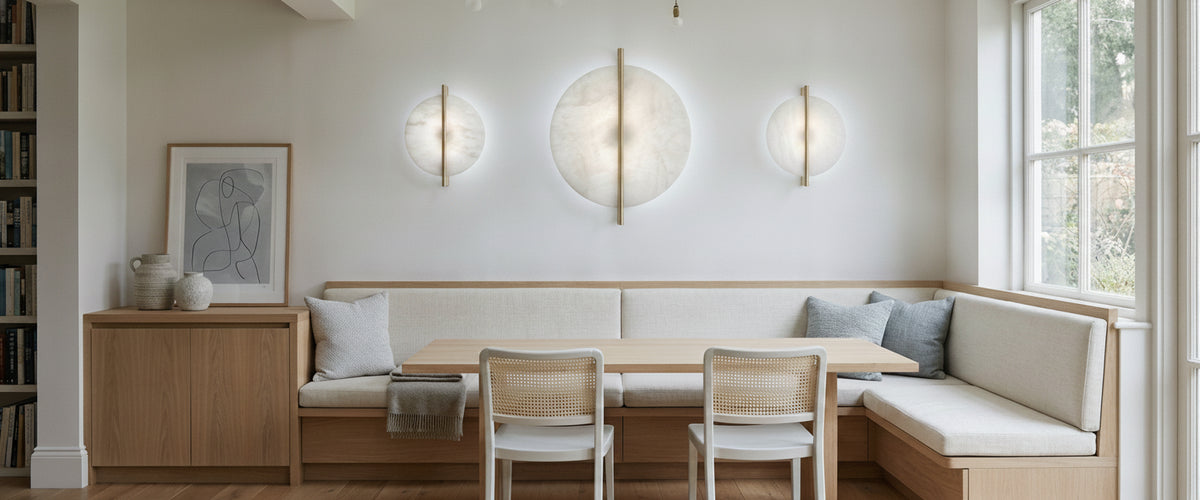

Most dining rooms are lit from a single point in the ceiling and nothing else, which is why so many of them feel like a conference room by eight o'clock. Dining room wall lights are the correction. They add a second layer of light at roughly eye level, where faces actually are, and they do it without hanging another object above the table to argue with your centerpiece. Get the height and the glow right and the room reads warm from the doorway. Get them wrong and you have installed two very well-made glare sources.

Key Takeaways Before You Shop
- Dining room wall lights are a second layer, not a replacement. Pair them with a pendant or chandelier, or use them alone in narrow and open-plan rooms where a ceiling fixture would crowd the space.
- Mounting height rules the result. Centering the fixture around 60 to 66 inches (152 to 168 cm) above the finished floor suits most rooms with standard ceilings.
- Diffusion beats brightness. Alabaster, marble and onyx shades soften output so you see light rather than a lamp.
- Everything must dim. Warm, dimmable LEDs on a compatible dimmer, ideally on a separate circuit from the ceiling fixture.
- Budget varies enormously with material, scale, hand-finishing and installation complexity, so ask for a tailored quote rather than assuming a figure.

What Dining Room Wall Lights Suit and Who They Are For
Wall lights earn their place in four common situations. Narrow rooms where a table sits close to one wall and a pendant would hang awkwardly off-center. Open-plan kitchens and dining zones where the ceiling is already busy with downlights, speakers and structural beams. Rooms with a long banquette or built-in bench, where sconces above the seating give guests light on their plates without a fixture in their sightline. And rooms with art or a serious sideboard that deserve their own pool of light.
The buyers who benefit most tend to be people renovating rather than decorating. If you are already opening walls, adding a pair of junction boxes is small work with a large payoff. Designers use dining room wall lights to control the visual rhythm of a room, spacing them like punctuation along a long wall. Restaurant and members' club operators like them for a blunter reason: they light guests attractively at low levels, they survive service, and they never get knocked by a server carrying plates.
One caveat worth saying out loud. If your dining table is a genuine focal point under a high ceiling, wall lights should support a central fixture rather than replace it. Sconces alone in a large room can leave the table itself feeling flat.
Sizing, Height and Placement That Works
Dining room wall lights fail more often on height than on style. Start with the eye. In a dining room, the seated eye line sits far lower than in a hallway, so a fixture mounted too high throws light over everyone's heads and lands on the ceiling. As a working rule, center the fixture 60 to 66 inches (152 to 168 cm) from the finished floor with an 8 to 9 foot ceiling. Push toward 66 to 72 inches (168 to 183 cm) when the ceiling runs to 10 feet or more, and lower slightly when the sconces sit above a banquette so the shades clear seated heads comfortably.
For spacing, pairs and threes read better than clusters. On a wall of 12 to 16 feet (3.7 to 4.9 m), two fixtures spaced roughly 6 to 8 feet (1.8 to 2.4 m) apart usually feels balanced; longer walls can take a third. Flanking a mirror, chimney breast or large artwork, keep a consistent gap either side and align the fixture center with the visual center of the artwork rather than its frame.
Projection matters more than people expect. If the wall lights sit on a circulation route, particularly between a table and a doorway, choose a shallow profile so nobody clips a shoulder on the way to the kitchen. On that kind of pinch-point wall, a tight single-arm fixture such as the Bray 1 Light Wall Light in Black sits closer to the plaster than a deep sculptural sconce and keeps the walkway clear. Deep, sculptural sconces belong on the wall you look at, not the wall you walk past.
Finally, judge dining room wall lights against the wall, not against the table. A slim stone fixture that looks generous in a photograph can vanish on a broad plaster wall. We had a client in Austin who ordered a single sconce for a 14 foot (4.3 m) dining wall, saw it installed, and immediately ordered two more. The fixture was right; the count was not.
Materials, Finishes and Light Quality
This is where dining room wall lights separate into two categories: fixtures that hold a bulb and fixtures that become the light. Alabaster belongs firmly in the second group. Because the stone is translucent, the entire shade glows from within, and the mineral veining shows as faint amber and honey shadows moving through the surface. Nothing prints or films can imitate that, which is why alabaster has been cut into lamps and vessels since antiquity; the Metropolitan Museum of Art holds Egyptian alabaster pieces made precisely because the stone carries light.
Marble reads more solid and architectural, often used as a backplate, arm or base with a glass or stone diffuser doing the light work. Onyx is the drama option, with stronger banding and warmer color, and it can dominate a small dining room. Fluted or ribbed glass gives a crisper, more reflective sparkle if your scheme leans art deco. Across all of them, brass detailing is the usual companion: unlacquered brass will patinate over time, brushed brass stays consistent, and matte black holds a graphic edge against pale plaster. The same fixture in two finishes makes the point quickly: the Arden 1 Light Wall Light in Brushed Gold warms up a pale or limewashed wall, while the matt black version of the same design reads sharper against off-white and better suits joinery in darker timber.
Practically, veining is the thing to ask about before you buy. Natural stone varies piece to piece, so a pair of alabaster dining room wall lights will never be identical twins. That is the point. If you want them close, say so at order stage so panels can be selected from adjacent stock. You can compare how different stones behave across the alabaster lighting collection, which is the fastest way to see the difference between a milky, even glow and a heavily veined one.
Bulbs, Dimming and Switching
Dining room wall lights live or die on color temperature. Stay between 2200K and 2700K. Anything cooler makes alabaster look gray and makes food look worse, which defeats the purpose. Ask for a CRI of 90 or above so wine, wood and skin tones stay accurate.
Every sconce should be dimmable, and the dimmer should be matched to the driver. Modern LED lamps generally prefer trailing-edge dimmers, and mismatched kit is the usual cause of flicker or a buzz you only notice at dessert. Wire the wall lights on a separate circuit from the pendant so you can drop the ceiling to a whisper and let the sconces carry the room. That single decision does more for atmosphere than any fixture upgrade.
Wiring, boxes and dimmer specification are jobs for a qualified electrician, not a weekend. Bring them in before you finalize positions, because a stud in the wrong place can move a sconce by four inches and change the whole composition.
Common Mistakes and How to Avoid Them
- Mounting at hallway height. Sconces set at 70 inches or higher in a standard dining room light the crown molding, not the guests.
- Uplight only. An upward-throwing sconce alone can leave the table dim. Where the dining room wall lights are doing most of the work, a two-directional fixture such as the Sabina 2 Light Wall Light in Black washes the wall above and drops light toward the table at the same time, which is closer to the right design language than a single upward throw.
- Exposed filaments at eye level. Beautiful in photos, punishing across a table. If the bulb is visible, it must dim very low.
- Mixing three metal finishes. Pick a dominant metal for the lighting and let hardware follow it.
- Cleaning stone with the kitchen spray. Gypsum alabaster is soft and reacts badly to water and acidic cleaners. Conservation guidance from the American Institute for Conservation is clear that water-sensitive stone should be dusted dry rather than washed.
- Forgetting the switch plan. Wall lights on the same switch as everything else give you one setting: on.
Your Dining Room Wall Lights Checklist
- Measure the wall length and ceiling height, then decide on two fixtures or three.
- Mark proposed centers in painter's tape at 60 to 66 inches (152 to 168 cm) and sit at the table to check sightlines.
- Confirm projection depth against any walkway.
- Choose your stone: even and milky, or strongly veined.
- Lock the metal finish to match or deliberately contrast with cabinetry hardware.
- Specify 2200K to 2700K, CRI 90+, fully dimmable lamps.
- Ask your electrician to confirm dimmer compatibility and a separate circuit.
- Plan care: dry microfiber dusting, no sprays, no abrasive pads.
How Niori Can Help With Dining Room Lighting Projects
Niori designs and supplies alabaster and natural-stone lighting: pendants, chandeliers, wall lights, table lamps and floor lamps, with brass, glass and marble detailing. Because the pieces are stone, we handle a lot of pre-purchase conversations about veining, weight, mounting and how a fixture will behave on a specific wall. That is normal and welcome. A recent project shipped a run of stone sconces to a Napa dining room where the client had a 12 foot (3.7 m) walnut table and a low, beamed ceiling; wall lights carried the entire scheme and the ceiling stayed clear.
For designers and venue owners specifying dining room wall lights across several rooms, it helps to see the full range together before narrowing down, and the wider lighting collection makes it easier to keep a family of finishes consistent from entry hall to dining room. Where a project needs specific quantities, matched stone or coordinated fixture types, get in touch and we will quote it properly. Cost depends on material, scale, complexity of the stone work, engineering and finishing, so a tailored quote is far more useful than a guess.
Dining room wall lights are one of the few upgrades that change how a room feels rather than just how it looks. Put warm, diffused light at the height of a seated guest, give yourself a dimmer worth using, and the table starts doing the job it was bought for.