
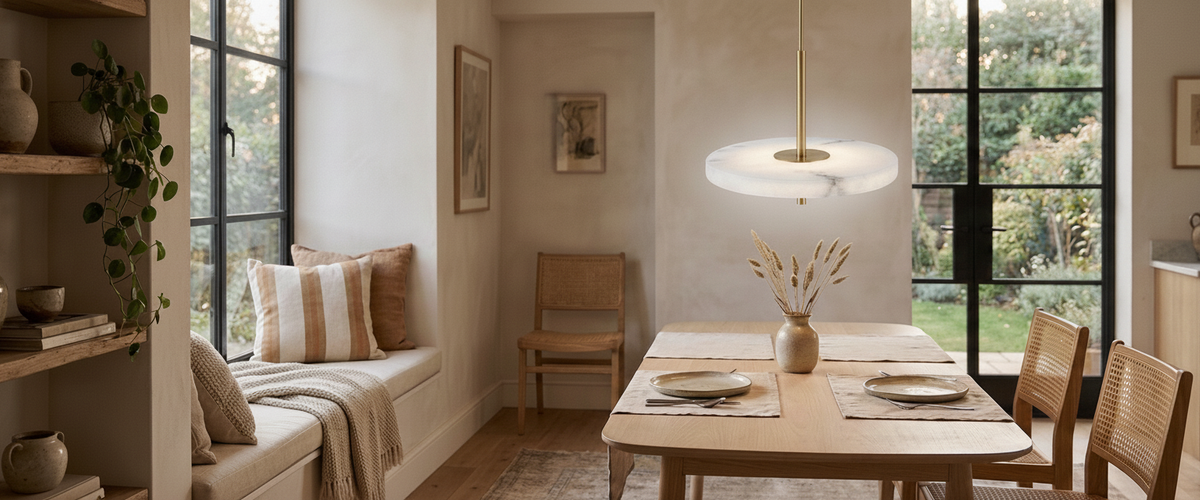

Two gold alabaster pendants can look identical in a photograph and behave completely differently once they are switched on. One glows like a lit lantern, veining warm and even from edge to edge. The other shows a hot bulb through a thin patch and a dead grey band where the stone runs dense. The difference is not the price tag. It is a chain of quiet decisions made before the fixture ever reaches your ceiling, and most buyers never get told what those decisions are.
At Niori we work with alabaster and natural stone every week, and the questions that separate a good gold alabaster pendant from a disappointing one are almost always the same. This is the version we wish more buyers knew before they put down a deposit.
A well-cut shade glows evenly from edge to edge once lit.

Key Takeaways for Buying a Gold Alabaster Pendant
The slab matters more than the shape. Alabaster is graded, and most of a block is unusable for lighting.
A gold finish should sit as a rim, cap or detail, not smother the translucent stone that does the actual glowing.
Wall thickness is the hidden spec. Too thick and the veining goes flat; too thin and the piece turns brittle.
Even glow comes from the bulb chamber and heat management, not the wattage.
Ask about hand-finishing, LED spec and colour temperature before you commit to a gold alabaster pendant.

The First Decision: Which Slab of Alabaster Gets Cut, and Why Most Get Rejected
Alabaster is a soft, translucent form of gypsum, and no two blocks read the same under light. Some run milky and even. Others carry heavy iron staining, chalky clouds, or fracture lines that only show once a lamp sits behind them. A maker cutting a gold alabaster pendant is not choosing the prettiest surface; they are choosing the slab that will glow cleanly, and that rules out a surprising amount of stock.
Gypsum alabaster is prized precisely for how light passes through it, which is also why flaws that would vanish in a solid marble worktop become obvious in a pendant. As the Encyclopaedia Britannica notes, gypsum alabaster is a fine-grained, translucent stone soft enough to carve, which is exactly what makes it work for lighting and also what makes its flaws show. A dense vein looks like a shadow. A hidden crack becomes a dark scar the moment the bulb warms. Good makers reject far more stone than they keep, and they will tell you so.
This is worth understanding as a buyer, because it explains the pricing logic. When someone asks why one alabaster light costs several times another, the honest answer usually starts at the block, long before anyone touched a lathe.

How the Gold Finish Is Applied So It Warms the Glow Instead of Blocking It
Gold on a gold alabaster pendant should never fight the stone. The whole point of alabaster is that it transmits light; cover it and you have an expensive opaque bowl. The best gold detailing sits where the light does not need to pass: a brushed brass rim around the base, a gilded cap at the ceiling rose, a slim collar where the flex meets the stone. Where you want the metalwork to frame the stone rather than compete with it, a piece like the Serava LED Small Alabaster Loop Pendant shows how a warm leather-and-metal detail can sit around the glowing stone without smothering it.
Warm metals also do something to the colour of the light itself. Brass and gold tones pick up the amber already sitting inside alabaster and push the glow a touch warmer, which is why a gold alabaster pendant tends to read cosier than a chrome or nickel version of the same shape. In practice we steer buyers toward gold or brass detailing when the room already leans warm, walls in clay, oak floors, brushed plaster, and toward cooler metals when the scheme is crisp and grey.
Watch out for painted or sprayed gold. It can chip at the rim over years of cleaning and it flattens under light. A plated or solid brass component ages far more gracefully. If you are comparing gold alabaster pendants across our alabaster lighting range, it is worth asking which metal parts are structural and which are purely decorative.
Brass detailing works best as a rim or collar, framing rather than covering the stone.
Carving to a Wall Thickness That Lets Veining Read Without Going Brittle
This is the specification nobody advertises, and it decides almost everything about how the finished gold alabaster pendant looks lit. Alabaster carved too thick behaves like frosted glass with the lights off: pretty, but the veining barely reads and the glow stays dull. Carved too thin, the stone becomes fragile and prone to hairline cracks, especially near the fixing point where it takes the weight of the flex and hardware.
The sweet spot is a wall that lets the internal light bring the veining forward without turning the piece into something you daren't dust. A skilled carver adjusts thickness across a single shade, leaving more material where a natural flaw needs support and thinning the areas where the grain is clean and worth showing off. That kind of judgement only comes from hand-finishing. Over a longer dining table, where you need that even glow to carry across a wide span, a linear form such as the Axis 27 Light Alabaster Linear Chandelier spreads the carved stone across several segments rather than relying on one thin shade to do all the work.
One lesson from the studio: the pieces that photograph best off are rarely the ones that glow best on. If a maker only shows you unlit product shots, ask for a lit image. The gap between the two tells you how honestly the stone has been cut.
Wiring and Heat: Why the Bulb Chamber Design Decides How Evenly It Glows
Even glow is an engineering problem before it is an aesthetic one. Put a single bare bulb close to one wall of the shade and you get a bright hotspot with darker edges. Set the light source centrally, diffuse it, and give it room to breathe, and the whole shade lights uniformly. The bulb chamber, the space and baffle arrangement between the lamp and the stone, is what makes or breaks that in any gold alabaster pendant.
Heat is the other half of the same story. Alabaster does not love thermal stress, and running an old-style hot halogen tight against the inner wall invites problems over time. This is why most quality gold alabaster pendants now use LED sources, often integrated. A well-designed LED array runs cooler, spreads its output, and holds a consistent colour temperature, all of which makes for more comfortable, glare-free light.
For colour temperature, we generally recommend somewhere around 2700K for alabaster in living spaces. It flatters the warm minerals in the stone. Push much cooler and the glow starts to feel clinical, which defeats the reason you chose the stone in the first place. Any electrical installation should be signed off by a qualified electrician; the fixture may be beautiful, but the connection is not a DIY job.
What Separates a Hand-Finished Pendant From a Mass-Poured Lookalike
Not everything sold as "alabaster" is stone. There are resin and composite pendants poured to imitate the look, and under a photograph they can pass. Lit, they rarely do. A real gold alabaster pendant carries depth: the veining sits inside the material and shifts as you move around it. A poured lookalike prints its pattern near the surface, so it looks flat and slightly plasticky once the light is behind it.
A few tells worth knowing:
Weight. Genuine stone has heft. If a large shade feels suspiciously light, question it.
Uniqueness. Every real alabaster shade is one-off in its veining. If two "alabaster" pendants are identical, they were cast, not carved.
Temperature to the touch. Stone stays cool and feels dense; resin warms up faster and feels lighter.
Edge detail. Hand-finished rims show subtle variation. Moulded edges are machine-perfect and slightly dead.
None of this makes composite worthless, but you should know which one you are buying and pay accordingly. When you browse our wider lighting collection, the pieces described as alabaster are cut from the stone itself, which is why each shade differs.
Questions to Ask a Maker Before You Commit the Deposit
Treat the deposit as the moment to get specific about the gold alabaster pendant you want. A confident maker will answer all of these without hesitation:
Is the shade solid alabaster, and can I see a lit photograph of the actual piece or batch?
What is the light source, and is the LED replaceable or fully integrated? Integrated units look cleaner but plan for eventual replacement.
What colour temperature does it run at, and is it dimmable? Confirm the dimmer type it needs.
Is the gold detailing solid or plated brass, or a sprayed finish? This affects how it ages.
How is the shade fixed and supported? Stone is heavy; the fixing should be engineered for it.
What is the care routine, and what happens if the stone develops a hairline crack?
Care itself is refreshingly simple. Dust with a soft dry cloth, avoid anything acidic or abrasive, and never soak the stone. Alabaster is water-sensitive, so a barely damp cloth for marks and a dry buff afterward is as far as it should go. Keep it out of splash zones; a gold alabaster pendant belongs over a dining table or an island, not directly above a sink.
Get these answers and you will know very quickly whether you are buying a considered, hand-finished gold alabaster pendant or a lookalike dressed up in a good photograph. The gold catches the eye. The stone, the carving and the chamber behind it are what you actually live with.