
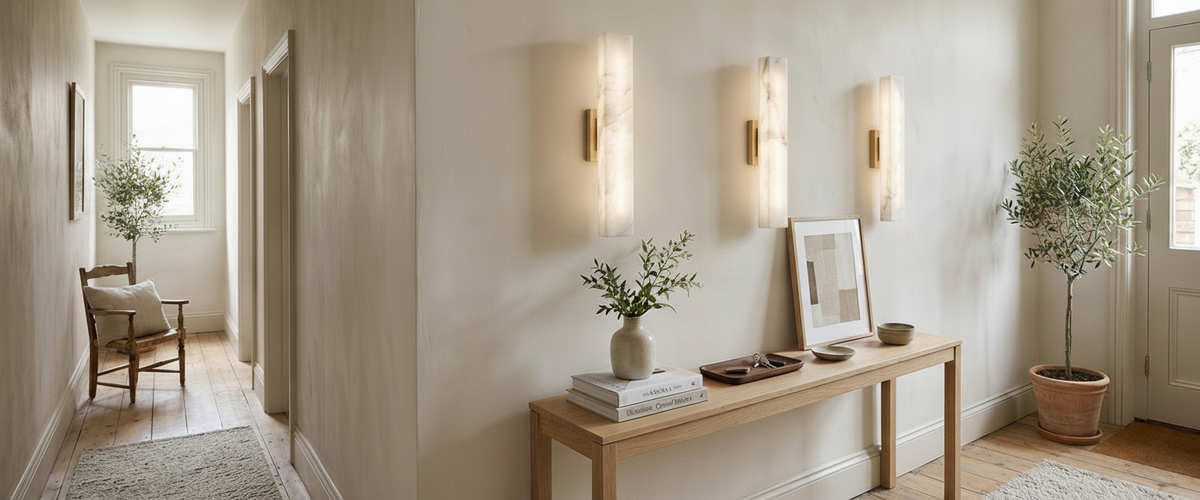

Gold wall lights are the fastest way to warm up a flat, unloved wall, and also the fastest way to make a good room look like a hotel corridor. The gap between those two outcomes is smaller than most people expect. It comes down to which gold you pick, how high you fix it, and whether the light leaves the fixture as a soft wash or a hard hot spot. Get those right and a pair of gold wall lights will do more for a room than a bigger ceiling light ever could.

Key Takeaways
- Finish sets the tone: brushed gold wall lights read calm and contemporary, polished gold reads formal and reflective, distressed or antique gold reads softer and older.
- Height beats style: most sconces belong with their center around 60 to 66 inches (152 to 168 cm) off the floor, adjusted for ceiling height and use.
- What the light passes through matters more than wattage: alabaster, marble and onyx diffusers turn a bare source into a glow you can look at.
- Match warmth, not metal: gold wall lights beside gold hardware rarely match exactly, so aim for a family of warm metals rather than a perfect twin.
- Dimming is not optional in bedrooms, dining rooms and hallways. Specify dimmable lamps and a compatible dimmer, and have a qualified electrician handle the wiring.

What Gold Wall Lights Suit, and Who They Are for
Gold works because it is a warm metal reflecting warm light. A polished chrome sconce throws a cool, clinical edge into the room; gold pushes everything a half step toward candlelight. That makes gold wall lights a natural fit for spaces where you want people to linger: dining rooms, bedrooms, snugs, restaurant banquettes, hotel lobbies, powder rooms with dark paint.
They also solve practical problems. In a Texas guest room with no space for bedside tables, a pair of swing-arm sconces gave the clients reading light and a clear nightstand. In a narrow NYC apartment hallway, three small gold wall lights at even spacing did what a row of downlights could not: they lit the walls instead of the floor, which made the corridor read wider. Designers reach for wall lighting when the ceiling is already busy, when there is no joist to hang from, or when the room needs light at seated eye level rather than overhead.
Who they are not for: anyone hoping a single sconce will light a whole room. Wall lights are layer lights. They work alongside a pendant, a floor lamp or recessed light, and they earn their keep in the evening, when the big fixtures get turned down.
Sizing, Height and Placement That Works
Scale is where most schemes go wrong. A sconce that looks generous in a photograph often looks like a doorbell once it is on an 11-foot wall. As a rough guide, gold wall lights should read as roughly one quarter to one third the width of what they flank, whether that is a mirror, a headboard or a fireplace. Where the job is to flank rather than to make a statement, a slim single-light form such as Ariel 1 Light Wall Light, Brushed Gold holds proportion better beside a mirror than a wide two-arm fixture, which belongs on a broader fireplace or hallway wall.
Heights by Room
- Hallways and stairwells: center at 66 to 72 inches (168 to 183 cm), spaced every 6 to 8 feet (1.8 to 2.4 m). On stairs, follow the pitch so each fixture sits at the same height above its own tread.
- Bathroom mirrors: flank the mirror at around 64 to 66 inches (163 to 168 cm), roughly eye level, so light hits the face from both sides rather than from above. Confirm the fixture carries an appropriate rating for damp locations and let an electrician confirm the zone.
- Bedsides: aim for the bottom of the shade 22 to 30 inches (56 to 76 cm) above the mattress, adjusted to where your shoulders land when you sit up to read.
- Living rooms: if the gold wall lights flank art or a fireplace, hang them in relation to that object rather than to a standard number. Consistency with the artwork's center line looks deliberate; a mismatch looks accidental.
- Dining rooms: keep sconces below the level of a pendant's brightest point so the eye still reads the table as the center of the room.
Always mock up before you commit. Gold wall lights land at eye level, so an inch out is visible in a way a ceiling fitting never is. Cut a paper template, tape it to the wall, live with it for a day and check it while seated, not just standing. Junction box positions are the one decision you cannot undo cheaply once the wall is closed.
Materials, Finishes and Light Quality
Not all gold is the same gold. Brushed gold has a fine directional grain that scatters reflections, so it hides fingerprints and sits comfortably in contemporary rooms. Polished gold and polished brass behave like small mirrors, which is glamorous in a formal dining room and distracting in a low-ceilinged hallway. Distressed and antique finishes have a deliberate unevenness that reads warmer and older, and they pair well with limewash, plaster and reclaimed timber, which is the logic behind a fixture like Kristy 1 Light Wall Light, Distressed Gold. Where the metal needs softening further still, brushed gold combined with rattan, as in Kai 2 Light Wall Light, Brushed Gold & Rattan, is closer to the right design language for coastal and Californian interiors.
Then there is the question of lacquer. A lacquered finish holds its color and takes a light dusting; an unlacquered or living finish will shift over time as it patinates, which some clients love and others panic about. Ask which you are buying before it arrives.
The real difference in light quality, though, comes from the diffuser. This is where alabaster and natural stone change the conversation. Alabaster is translucent enough to transmit light while thick enough to soften it, so instead of a visible bulb you see a lit panel with veining running through it. At Niori we build most of our gold wall lights around that principle: a warm metal frame carrying stone that does the diffusing. The result is a low-glare glow that flatters skin tones and plaster alike, which is exactly what you want at eye level. You can compare stone types across our alabaster lighting collection and see how veining behaves when it is backlit rather than just lying flat.
Marble and onyx sit at either end of that spectrum. Honed marble is denser and tends to glow only at its thinner edges, giving a graphic, sculptural look. Onyx is more dramatic, with banded color that comes alive when lit and can look surprisingly plain when switched off. Alabaster sits in the middle and is the most forgiving choice for gold wall lights, since its creamy tone flatters warm metal instead of fighting it. One thing worth knowing: calcite and gypsum alabasters are soft and water-sensitive, so treat them as stone that dislikes moisture rather than as glass. The Natural Stone Institute publishes useful background on how porous stones react to water and acidic cleaners, and the short version is that a dry microfiber cloth is your best tool.
Bulbs and Dimming
The lamp you drop into gold wall lights matters as much as the fixture itself. Specify 2700K for living spaces and bedrooms. Push to 3000K only where the scheme is cool-toned or heavily white, because anything higher turns gold slightly green and makes alabaster look gray. Choose lamps with a color rendering index of 90 or above; cheap LEDs flatten the veining in stone and dull the metal. The Illuminating Engineering Society is a good reference point on rendering and glare if you want to go deeper into the numbers.
Keep output modest. Wall lights are atmosphere, and a sconce that is too bright creates a scallop of glare on the wall above it. If in doubt, go lower in lumens and add a second fixture rather than over-driving one. Confirm that your lamps, driver and dimmer are compatible as a set, and ask an electrician to check the load before you commit to a wall of sconces on one circuit.
Gold Wall Lights: Common Mistakes and How to Avoid Them
- Chasing an exact metal match. Gold varies by manufacturer, plating process and age. Group warm metals as a family and stop hunting for a perfect twin.
- Mounting too high. The single most common error we see in project photos. High sconces light the ceiling and leave faces in shadow.
- Buying one when you need two. Gold wall lights almost always look intentional in pairs or a rhythm. A lone sconce on a wide wall reads unfinished.
- Forgetting the off state. A fixture spends most of its life unlit. Check that the stone, the frame and the shape still please you at noon.
- Ignoring the shadow line. Uplight sconces on a textured or uneven wall exaggerate every ripple. Smooth plaster forgives; heavy texture does not.
- Cleaning stone with the wrong thing. Skip glass sprays, vinegar, alcohol and anything abrasive on alabaster or onyx. Dust dry, and wipe gold finishes with a soft, barely damp cloth only if needed.
A Pre-Install Checklist
- Confirm switch position and whether you want each pair on its own dimmer.
- Mark junction box heights on the wall and check them from seated eye level.
- Check clearance from door architraves, cabinetry and any swinging shutter or window.
- Verify the fixture's rating for the room, particularly in bathrooms and covered outdoor areas.
- Order lamps at the same time as the fixture so color temperature is consistent across the whole scheme.
- Have a qualified electrician complete the wiring and testing. Stone fixtures are heavier than they look, so fixings need to suit the wall build-up.
- Keep one spare lamp per fixture type so a failed bulb never leaves a mismatched pair.
How Niori Can Help With Lighting Projects
We work with homeowners, interior designers, architects and venue owners on schemes where gold wall lights have to hold up under scrutiny: hotel corridors, restaurant banquettes, spa treatment rooms, entrance halls that guests see before anything else. Because we specialize in alabaster and natural stone, we can advise on how a particular block will read when backlit, how much variation to expect between pieces cut from the same stone, and where gold sits comfortably against your other finishes.
If you are pulling a scheme together, browse the full lighting range to see how wall lights, pendants and table lamps behave as a set rather than in isolation. For quantities, custom sizes or trade support, send over your drawings and finish schedule and we will quote against the actual specification. Budget for gold wall lights depends on the stone, the scale, the metalwork, the electrical engineering and the finishing involved, so a tailored quote is far more useful than a headline figure. Start at the Niori homepage if you would rather see the whole picture first, then narrow down by room.
One last piece of advice from the studio. When clients cannot decide between a bare-metal sconce and a stone one, we ask them to look at a lit alabaster panel and then at a lit bulb, one after the other. Nobody chooses the bulb.