
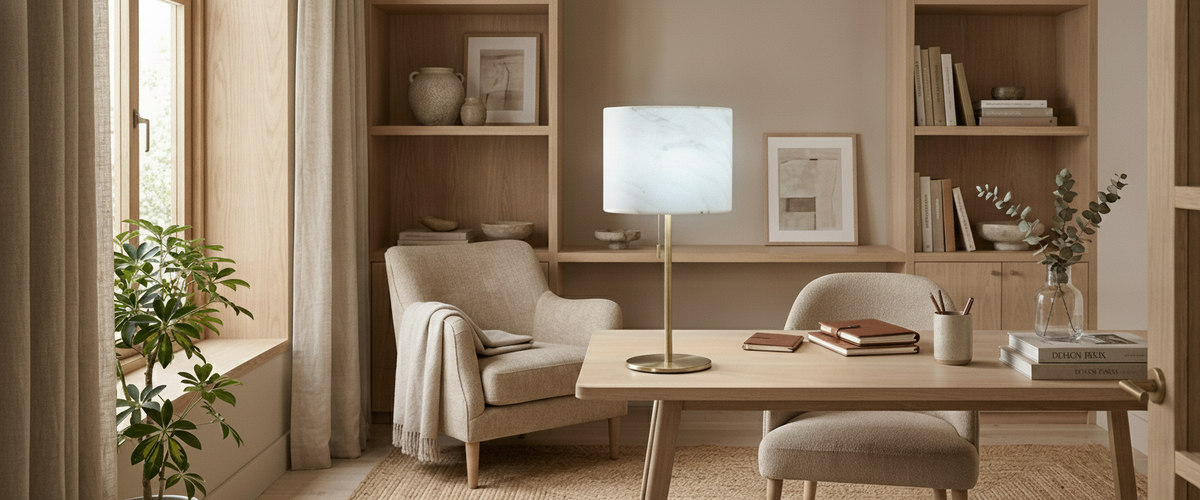

Two LED desk lamps can sit side by side, draw similar wattage, and cost wildly different amounts. From across the room they look the same. Put them on a desk for a week and the gap becomes obvious: one throws a steady, even pool of light you forget about, the other hums faintly, shifts color as it warms up, and tires your eyes by mid-afternoon. The difference almost never lives in the part you can see. It lives in the driver, the diodes, and the way heat moves through the body of the LED desk lamp.
At Niori we work mostly in alabaster and natural stone, where the material does the heavy lifting on light quality. But the engineering questions behind a good LED desk lamp are the same ones we ask of every fixture we ship, and they are worth understanding before you spend a penny.
A well-engineered task light throws a steady, glare-free pool you stop noticing.

Key Takeaways
A quality LED desk lamp lives or dies on its driver, not its shade.
Look for a CRI of 90 or higher and a stated color temperature, not vague "warm white" claims.
Flicker is usually a driver problem; it shows up on camera and tires your eyes off camera.
Heat management decides lifespan. A diode that runs hot fades and shifts color years early.
Build choices (metal versus plastic, switched versus stepless dimming) change both feel and price.

The Components a Maker Obsesses Over Before a Line Is Even Drawn
Before anyone sketches a silhouette, the serious questions are about parts you will never touch. Which diode, run at which current. Which driver, with what dimming method. How the heat gets out. A small LED desk lamp like this runs for thousands of hours, often close to your face, so every one of those choices compounds.
The visible design (the arm, the joint, the base, the material of the shade) follows the engineering, not the other way round. When a lamp is designed shade-first and electronics-last, you end up with something that photographs beautifully and performs poorly. That order of priorities is the single clearest tell between a considered LED desk lamp and a commodity one.

Driver Quality and Why Cheap LED Desk Lamps Flicker Under a Camera
The driver is the small power supply that turns mains electricity into the steady current the diodes want. A good one delivers smooth, constant current. A cheap one delivers electricity that pulses with the mains frequency, and that pulsing is flicker.
You can sometimes catch it with your phone: point the camera at the lit lamp and watch for rolling bands or a strobe across the screen. If they appear, the driver is cutting corners. Flicker that is too fast to see consciously still registers; it is a known contributor to eye strain and headaches over a long work session, which is exactly the wrong outcome for a fixture you sit under all day. The Chartered Institution of Building Services Engineers has published guidance on flicker and stroboscopic effects in lighting design for precisely this reason, and it is one of the metrics worth asking a maker about directly. See the CIBSE resources on lighting quality if you want the technical detail.
Stepless dimming is where drivers separate further. Cheap dimming chops the current on and off rapidly to fake lower brightness, which makes flicker worse at low settings. Better drivers reduce the actual current, so the light stays smooth all the way down. If an LED desk lamp flickers more as you dim it, that tells you how it was built. For a compact USB-powered task light where the priority is a steady pool of light over a keyboard rather than a statement silhouette, the LYYT 12 LED USB Desk Lamp sits at the workhorse end of the category, and is a useful reference for what a small fixed-source design should feel like.
CRI, Colour Stability, and the Difference Good Binning Makes
Color Rendering Index, or CRI, measures how faithfully a light shows colors against daylight. For desk work, aim for 90 or above. Below that, reds go muddy, skin tones look off, and anything you are judging by eye (artwork, fabric samples, printed proofs, food photography) is harder to trust.
Binning is the less-discussed half of the story. LED diodes come off the production line with small variations in color and brightness, and manufacturers sort them into bins. Tight binning means the diodes in your LED desk lamp match each other and match the next unit off the shelf. Loose binning is why two "3000K warm white" lamps from a budget brand can look noticeably different, one pinker, one greener. A maker who specifies tight binning is paying more per diode for consistency you will see every day.
Color stability over time matters just as much. A well-built LED desk lamp holds its stated color temperature for years. A poorly built one drifts as the diodes age and overheat, usually toward a cooler, harsher tone. That drift is slow enough that you blame your eyes before you blame the lamp.
A metal body pulls heat off the diode so the color holds true for years.
Heat Management: Why Lifespan Lives or Dies on Diode Temperature
LEDs do not fail like old bulbs that simply blow. They fade. The hotter the diode runs, the faster it loses output and the more its color shifts. So the real engineering battle inside the body of an LED desk lamp is moving heat away from the diode and into the air.
This is where a metal body earns its keep. Aluminium pulls heat off the diode and spreads it across a larger surface, keeping the junction cool. A sealed plastic housing traps that heat against the diode and slowly cooks it. Two lamps rated for the same lifespan on paper can diverge sharply in reality, depending entirely on whether the heat had somewhere to go.
It is also why we think carefully about materials at Niori. Stone and alabaster carry and release heat differently from thin metal or plastic, and any LED desk lamp that combines a natural-stone shade with an LED source has to be engineered so the diode stays within its safe temperature range. Get that wrong and you shorten the life of the piece to protect a pretty silhouette. You can see how we balance material and light across the alabaster lighting range, where the stone diffuses the source rather than sitting directly against it.
Build Choices That Change Both the Feel and the Price
Once the electronics are sorted, the build decisions shape both how an LED desk lamp feels in use and what it costs to make.
Body material. Solid metal arms and weighted bases feel planted and adjust with a smooth, damped motion. Hollow plastic feels light, drifts out of position, and reads cheap the moment you touch it.
Joints and friction. A good articulated arm holds any angle for years without sagging. Cheap joints loosen within months, and a lamp that slowly droops onto your keyboard is one nobody keeps.
Dimming and control. Stepless touch dimming and adjustable color temperature add genuine flexibility for different tasks. They also add cost, because the control electronics behind them are more demanding.
Finish. Hand-finished metal, real stone, or solid brass detailing costs more than painted plastic and ages far better. Cheap coatings chip; honest materials patinate.
Not every desk needs a swing-arm LED desk lamp, either. Where the work surface sits beneath a shelf or a run of cabinetry and you want even, glare-free light along the whole span rather than a single pool, a dimmable run such as the Ecliptus 24V Dimmable LED Strip in a warm 3000K solves the placement differently, washing the surface from above instead of throwing a beam across it. The same logic runs through our wider lighting collection: the material and the engineering set the price, not a marketing tier. If you are weighing a quote, ask what it buys you in driver, diode, and build, then judge from there.
Red Flags to Raise Before You Commit Your Money
A few questions sort the serious lamps from the rest quickly.
No stated CRI. If the listing only says "natural light" with no number, assume it is below 90.
No color temperature in Kelvin. "Warm" and "cool" mean nothing precise. A real spec gives you 2700K, 3000K, 4000K.
Visible flicker on a phone camera. Test it if you can, especially at low dim settings.
Sealed plastic body with high wattage. Nowhere for the heat to go, and a short life ahead.
Vague or absent lifespan figures. Good makers state rated hours and the percentage of output retained at that point.
A loose or sagging arm in the showroom. It only gets worse with use.
Is a Vintage Desk Lamp the Best Choice for a Home Office?
Vintage desk lamps have real charm, and a well-made mid-century piece can feel far better built than most new ones. The catch is the light source. Old fittings were designed around incandescent or halogen bulbs, so you are relying on the quality of whatever LED retrofit bulb you screw in, with no control over driver or heat management. For occasional use and atmosphere, a vintage lamp with a good retrofit bulb is a lovely thing. For long working hours where flicker, CRI, and color stability genuinely affect your eyes, a purpose-built LED desk lamp engineered around its diode usually wins. Plenty of people keep both: the vintage piece for character, the considered LED desk lamp for the hours that count.
Buy for the week ahead, not the moment you unbox it. Almost any LED desk lamp looks fine on day one; the flicker, the color drift, and the sagging arm show up later, once the diode has run hot a few hundred hours. So spend your attention on the driver, the heat path, and the binning, then treat the shade as the reward for getting those right.